Stop New Taxes on Internet Access

internetThe Internet has revolutionized the way we communicate, learn, innovate and for business owners, it has been a game changer in their ability to manage and grow their businesses.  The Internet’s success and rapid growth is due in large part to a current law, the Internet Tax Freedom Act (ITFA), which has kept Internet access free from state and local taxes and fees since 1998.

We believe that Congress should act now and permanently extend the moratorium on taxing Internet access. ITFA is critical to keeping Internet access affordable for business owners and consumers, enhancing Internet adoption rates and growing the digital economy.

Finally, after much delay, it looks like the vote on a permanent version of ITFA could be as early as tomorrow! We need your help to urge your Senators support the Customs Bill and keep the Internet Tax Freedom Act in the bill. 

Urge your Senator to Support the Internet Tax Freedom Act!

With communications taxes on telephone services already on average at 17%, we don’t need the potential for another tax of close to 20% added to our Internet bills. In a time when our economy is still recovering, any money saved from the monthly bills of women-owned small businesses is much welcomed.

Tell your Senator to permanently extend ITFA today and keep Internet access free from new taxes.

House Committee Passes Bipartisan Federal Contractor Changes

By: Ann Sullivan, WIPP Government Relations


In its first major action of 2016, the House Small Business Committee approved changes to federal contracting which affect small companies who do business with the federal government. Acting in a bipartisan manner is relatively rare in Congress these days, but the Committee unanimously adopted the legislation, The Defending America’s Small Contractors Act of 2016, with over two-thirds of the Committee contributing content to the bill.


For the last three years, the House Small Business Committee has pushed for changes to the government’s buying rules and this week’s legislation was no exception. In our view, the following changes in the bill will prove to be significant to small contractors. One attacks an age-old problem – showing past performance without a government contract. The bill establishes a pilot program that enables contractors to receive a past performance rating by submitting a request to the contracting officer and/or prime contractor.  Second, the bill strengthens agency small business offices to recommend which small business set-aside programs should be used for each contract at their agency.

Anne CrossmanThird, WIPP’s recommendations were incorporated in the legislation, including one made by Anne Crossman, a member of WIPP’s Leadership Advisory Council, in her testimony before the Committee. Anne took the opportunity to highlight WIPP’s “if you list us, use us” policy for prime contractors’ subcontracting plans. This bill incorporates WIPP’s recommendations to clarify the role of commercial market representatives (CMRs) in encouraging prime contractors to work with small businesses. Lastly, the bill takes the first step toward getting a better handle on the actual amount set aside for small businesses by requiring agencies to divulge awards counted toward multiple small business goals.

An amendment offered by Rep. Takai scored a victory for women entrepreneurs by allowing Women’s Business Centers (WBCs) to provide procurement assistance to women participating in the DOD mentor-protégé program. Rep. Takai’s statement on the amendment is available here and includes WIPP’s statement of support.

These improvements set the stage for a productive year of improvements for small contractors. The bill, which passed unanimously, will now be considered by the full House of Representatives. The House Small Business Committee is off to a great start. We can’t wait to see what they do next.

Did You Really Mean That FCC?


This week, the House Energy and Commerce Committee held a hearing on a bill, HR 2666, which would prevent the FCC from regulating broadband rates. In fact, the FCC’s Chairman Tom Wheeler is quoted as saying “Let me be clear, the FCC will not impose ‘utility style’ regulation…” when
issuing the Commission’s decision to subject broadband service providers to regulations that govern telecommunications services – Title II of the Communications Act.


That begs the question, why pass a bill that reiterates what the Chairman promised? There are a couple of reasons why. First, FCC Commissioners do not have permanent appointments—they arinternet.jpge appointed by the President and serve five-year terms. While we doubt anyone questions Chairman Wheeler’s integrity, the next set of Commissioners may not hold the same view. Second, regulating rates in utility- style fashion does not really fit the fast moving technological changes that come with the industry providing internet services. Third, talk about a damper on investment – subjecting broadband networks to the government’s slow ratemaking process would surely have a negative effect.
 

As we understand this issue, no one is purporting to restrict the FCC’s ability to protect the consumer with respect to broadband access or technology companies who rely on an open internet to conduct business. Women-owned businesses have much to lose if the government does not properly balance internet access with regulation.


We are keenly aware that according to the SBA Office of Advocacy, “Small businesses, defined as firms employing fewer than 20 employees, bear the largest burden of federal regulations. As of 2008, small businesses face an annual regulatory cost of $10,585 per employee, which is 36 percent higher than the regulatory cost facing large firms (defined as firms with 500 or more employees).” Small businesses are usually the losers when it comes to more regulation.


The Congress ought to pass this bill. Broadband access is a critical lifeline to all businesses. Business certainty resonates throughout our economy—especially small companies. Putting the FCC intent into law with respect to broadband rate regulation is a good idea.

From the Hill: Small Contractors Make Big Gains in New Legislation

By: Jake Clabaugh WIPP Government Relations


ChabotThe House Small Business Committee is leading off 2016 by continuing its

efforts to make federal contracting more accessible to small businesses. Committee Chair Steve Chabot’s (R-OH) legislation, Defending America’s Small Contractors Act of 2016, makes an array of changes to procurement policy.

Although impossible to summarize all of the changes in a few paragraphs, which is why we have the link to the bill above, here are the highlights. The bill tackles transparency by rewriting – in plain English – the requirements for small business procurements. Since getting past performance is an obstacle for contractors getting started in federal contracting, the bill establishes a pilot program that enables them to get a past performance rating by submitting a request to the contracting officer and prime contractor. Offices of Small and Disadvantaged Business Utilization (OSDBUs) will now have increased authority to recommend which small business set-aside programs are most appropriate for each contract at their agency. The Act even touches the Department of Defense (DOD) by requiring that Mentor-Protégé plans in DOD’s program be approved by SBA – an update aimed at adding consistency to Mentor-Protégé Programs government-wide – but controversial since the last time we looked the Defense Department does not generally defer to SBA.

If some of these changes sound familiar, it’s because Anne Crossman, a member of WIPP’s Leadership Advisory Council, proposed several of these improvements during a Subcommittee hearing last fall.  Specifically, Anne noted WIPP’s “if you list us, use us” policy for prime contractors’ subcontracting plans and in her testimony she advocated for prime contractors to be accountable to the subcontractors listed on their plans. This bill incorporates Anne’s recommendations by requiring commercial market representatives (CMRs) assist prime contractors in identifying small business subcontractors and assess the prime’s compliance with their subcontracting plans.

The intent of the legislation is to assist federal agencies in meeting their small business contracting goals. The goal for women owned companies of 5% has never been met. A continued push for data transparency surfaces in the bill as well, requiring agencies to do a better job of reporting the contracting dollars awarded to small businesses.

The Committee is expected to hold a markup to consider this legislation during the week of January 11.  The WIPP Government Relations team will continue to provide updates as the bill moves through Congress.

More Than Cheer In Congressional Stocking

stocking

Women business owners enter the holiday season with a gift from Congress — more money for important women’s entrepreneurship programs.

Just when it seemed like Members of Congress would have to delay their Holiday break, the House and Senate passed two key bills to conclude the legislative year. After funding the government with stopgap measures for over two months, Congress agreed on a spending bill thru September 2016. Accompanying the yearlong spending bill is a bipartisan agreement to extend expiring tax rules for businesses and families. Both bills give women-owned businesses reason to celebrate during the Holiday season.

The $1.1 trillion funding bill sets spending levels for all government programs through September 30, 2016. Congress increased funding for many of the Small Business Administration’s (SBA) lending and entrepreneurial development programs. The chart below highlights WIPP’s priorities and the programs import to women entrepreneurs:

  FY2016 WIPP’s Request FY2015
Women’s Business Centers $17 million $16 million $15 million
National Women’s Business Council $1.5 million $1 million $1 million
Microloan Program Lending $35 million $35 million $25 million
Microloan Program Technical Assistance $25 million $25 million $22.3 million
PRIME Program $5 million $5 million $5 million
Office of Advocacy $9.1 million $9.1 million $8.45 million

WIPP advocated throughout 2015 on behalf of women-owned businesses and entrepreneurs and WIPP’s efforts culminated in full and increased funding levels for vital programs. Congress gave a huge boost to the microloan program- a primary capital access vehicle for women-owned businesses – by expanding lending authority by 40% to $35 million. Women’s business Centers (WBCs) will receive an increase of $2 million, which will enable the WBC program to provide additional grants for entrepreneurial development training for women entrepreneurs. Not only did WIPP advocate for increased funding for the WBC program, WIPP supported The Women’s Small Business Ownership Act of 2015. This bill would increase the WBC program’s authorization to $21.75 million, increase awards to Centers from $150,000 to $250,000, and provide modernizations to the program’s granting and approval process.

Congress’ tax “extenders” bill, an annual extension of certain tax credits and deductions, provides certainty for businesses and valuable incentives for research and investment. The Protecting Americans from Tax Hikes Act will expand and make permanent small business expensing rules and the Research and Development (R&D) Tax Credit. Lawmakers permanently extended the small business expensing limitation of $500,000 that was in effect from 2010 to 2014.  Had this rule not been extended, businesses would only have been allowed to deduct a maximum of $200,000 for machinery and equipment investments.

The bill also makes permanent the R&D credit, making it easier for start-ups and small businesses to receive tax deductions for innovative projects. According to WIPP’s 2015 Survey of Women Business Owners, tax burdens were the prime concern of women-owned firms. Specifically, women business owners cited uncertainty in tax credits and deductions as an annual concern. This bill helps alleviate some of the uncertainty.

As we wrap up 2015, Congress’s end of the year legislation provides full funding and certainty for programs important to women entrepreneurs.  We are looking forward to a productive and successful 2016.

Congress Temporarily Extends Internet Access Tax Ban – GUEST POST

by Rob Schrum, myWireless.org

myWireless logoJust as time was running out, Congress passed a continuing resolution, which – among a handful of other provisions – will extend the ban on Internet access taxes through December 11th. As you may recall, the ban on Internet access taxes was due to expire on October 1st.
Earlier this year, the U.S. House of Representatives made a move to permanently extend the ban on Internet access taxes by passing the Permanent Internet Tax Freedom Act (H.R. 235). Unfortunately the Senate has yet to take up the companion legislation, known as the ‘Internet Tax Freedom Forever Act’ (S.431).
The ban on Internet access taxes was originally put in place in 1998 and incrementally extended by Congress over the years to encourage the continued expansion of Internet use. Last year, CTIA – The Wireless Association found that the decision to keep Internet access tax free led to more than $34.4 billion in savings for Americans – and that doesn’t even account for the benefits the Internet provides on how we communicate, learn and conduct business.
If the Internet access tax ban expires, the high state and local taxes that are already applied to wireless service could be expanded to include Internet access, increasing the cost of service. This despite the fact that the FCC National Broadband Plan says that cost is the largest barrier to consumer broadband adoption. We urge Congress to address this issue once and for all by enacting a permanent ban on Internet access taxes before the December 11th deadline. We can’t afford anything less.
View the original post at myWireless.org:  http://bit.ly/1LtinGf 

How PPACA Will Affect Your Business The Next 5 Years?

Tod Covert  By Todd Covert, Executive Vice President of ACA Track

The Patient Protection and Affordable Care Act (PPACA) – also known as the Affordable Care Act or ACA – is the landmark health reform legislation passed by the 111th Congress and signed into law by President Barack Obama in March 2010. The legislation includes a long list of health-related provisions that began taking effect in 2010 and will “continue to be rolled out over the next four years.” Key provisions are intended to extend coverage to millions of uninsured Americans, to implement measures that will lower health care costs and improve system efficiency, and to eliminate industry practices that include rescission and denial of coverage due to pre-existing.

What does it mean for business today?

Business With 50-99 Employees 2015

Key Point #1

Navigating through transition relief to determine the date you need to make sure you are in compliance.

Applicable large employers (ALEs) with fewer than 100 full-time employees, including full-time equivalent employees, may have until 2016 to offer health insurance to eligible employees and their dependents without facing penalties.

This transition relief is available to employers who can certify that they have not reduced their workforce to remain under the threshold and have not materially reduced or eliminated health coverage previously offered. This certification needs to be included with your filing under Section 6056 for 2015.

The IRS will still grant transition relief to employers who reduced their workforce for “bona fide” business reasons.

Key Point #2

If you are over 50 FTE (Full-Time Equivalents) or part of a control group (Parent Company) with more than 50 FTE than you MUST file the 1095-C and 1094-C even if you do not offer coverage.

Key Point #3

Don’t “expect” your payroll company to complete these 1094-C and 1095-C forms.

Why?  Most payroll companies don’t even track the information required to complete these new IRS forms—It is more a benefit enrollment and plan design function than payroll.

  1. Dates of hire and waiting periods determine when employees are in the limited assessment period. Partial months are treated uniquely differently than full months and the series coded will change. Most payroll vendors only track deductions.
  1. Termination, rehire dates and class changes impact offer of coverage and safe harbor designations. Employees with a number of changes during the year can see a variety of different codes appearing on form 1095. Not a payroll function
  1. Offer of coverage determines whether 70% (2015) and 95% (2016) levels are reached or significant penalties are to be paid. Not a payroll function
  1. Safe harbor designations and income drive affordability calculations. Not a payroll function
  1. Transition relief provides the ability to mitigate risk and avoid penalties altogether.  Not a payroll function

Key Point #4

Start balancing culture and cost now because the “Cadillac Tax” is on the horizon in 2018—It’s not a matter of “IF” we hit the Cadillac Tax it’s a matter of “When” we hit the Cadillac Tax.

If health insurance exceeds $10,200 in premiums for an individual or $27,500 for a family. The tax amounts to 40 percent of the cost above that threshold AND its Non-Tax Deductible.

Why do we say “When” we hit the Cadillac Tax?  The insurance cost threshold ($10,200 in premiums for an individual or $27,500 for a family) only increases at CPI each year which is about 3.1% and Healthcare inflation increases close to 8.0% thus the X & Y axis lines are eventually going to cross.

Please join us September 29th for Women Accessing Capital: 5 Things You Need to Know About the New 1094-C and 1095-C IRS Reporting. Register now! 

From The Hill: Dodd-Frank’s Impact on Small Business Lending

By Jake Clabaugh, WIPP Government Relations

wmn$

Women entrepreneurs face unintended consequences of wall-street reform. According to a House Committee hearing yesterday, the Dodd-Frank Wall Street Reform and Consumer Protection Act, introduced in an effort to prevent another financial crisis, is contributing to small businesses’ inability to access capital from banks.

WIPP’s Access to Capital Platform has cited some of Dodd-Frank’s regulations as a contributing factor to the decrease in small businesses lending. Capital access is a lifeline for small businesses. It is essential for entrepreneurs to have access to sufficient capital to found and grow businesses.

DF picThe House Committee on Small Business convened lenders and experts to discuss how Dodd-Frank has affected the ability to provide entrepreneurs with critical capital. Access to private capital, including bank loans is a primary concern to women entrepreneurs as women-owned small businesses receive only 4% of private sector lending dollars. Additional regulatory burdens could be exacerbating this problem.
The hearing touched on many of the difficulties WIPP members have experienced when trying to access to capital. The Committee cited increased administrative burdens as a significant cost for small and community banks, a primary lender to small businesses. These regulations have increased the cost of making loans and therefore made it more difficult for banks and borrowers. The result is less capital for entrepreneurs.

The hearing also cited the direct impacts on borrowers. Many that would have qualified pre-recession are no longer able to obtain loans from banks due to tighter lending standards. WIPP’s platform advocates for modernized credit scoring that would level the playing field for women business owners.

Until Dodd-Frank is fully implemented, its complete impact will remain unclear. WIPP continues to review ongoing regulations as well as work with Congress to scale back unnecessary barriers to capital access for women entrepreneurs.

Success: Sole Source Finalized

women_in_business

by Ann Sullivan, WIPP Government Relations 

When you’ve been working on a program for 15 years, it’s almost anti-climatic when you realize you won and it’s over. I suppose lawyers feel this way when they win a big case, or business owners when they close a major contract.

For me, the SBA announcement integrating a sole source component into the WOSB procurement program on October 14, 2015 marks the end of a long campaign by Women Impacting Public Policy (WIPP). First, we fought for eleven years to establish a program that gives a government buying preference to women-owned companies whose industries have been underrepresented. Not an easy fight – we had plenty of Congressional and White House opponents—it wasn’t until the Obama Administration came into power that the program was established. At the time, SBA Administrator Karen Mills made it her number one priority, which we will always be thankful for. We had strong Congressional proponents – Senators Cantwell and Shaheen and Representatives Speier and Graves.

Then, we had to make the program work. That required two major changes to the program in 2013 and 2014. The first change required lifting the award caps the law imposed on the program. The WOSB procurement program limited contract awards through the program to $4 million ($6.5 million for manufacturing). In 2013, Congress helped us get rid of those caps. The last big piece was the sole source piece—allowing contracting officers to award sole source contracts to women-owned companies through the program. This major change gives the program parity with other small business programs and again, required Congressional action. Effective October 14, agencies will be able to use this mechanism to award contracts to women whose companies offer innovative products and services.

As with all government programs, the rules are a little complicated and the ability to self-certify as a woman owned business will eventually have to change, due to Congressional direction in 2014. But for now, self-certification remains the law and women should be actively pursuing contracts through the WOSB procurement program whether or not they are self-certified or certified by a third party.

It is important to note that not all industries (NAICS codes) qualify for the program. You can find a list at http://www.SBA.gov/WOSB. We have developed a one pager that go through the rules of the sole source portion of the program and our GiveMe5 program has comprehensive information on the WOSB program. In addition, our ChallengeHER events are all over the country so that women can find out more about the program. The information can all be found at www.wipp.org.

The WOSB procurement program is in good hands. All the major pieces to make it successful are in place. When we started this effort in 2002, women received 2.7% of government contracts. Since the program has been in place, more than $500 million has been set-aside for women- owned companies. In fact, in 2014 the government awarded 4.7% of its contracts to WOSBs –a 75% increase since 2002. Now women business owners need to know how to use it with the help of SBA, the federal contracting community and organizations, such as WIPP.

Fifteen years seems like a long time, but when you are fighting for something—somehow it doesn’t seem that long. WIPP members and coalition partners were with us every step of the way. For this, I am exceedingly grateful.

Time for Congress to Move a Neutral Net into Drive

WIPP infographic II

Capital investment is a solid predictor of economic health. That’s why recent news in the communications policy arena deserves Congress’ attention.

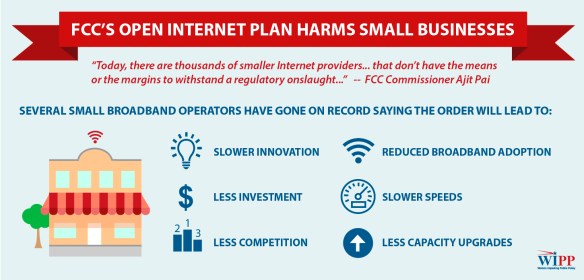
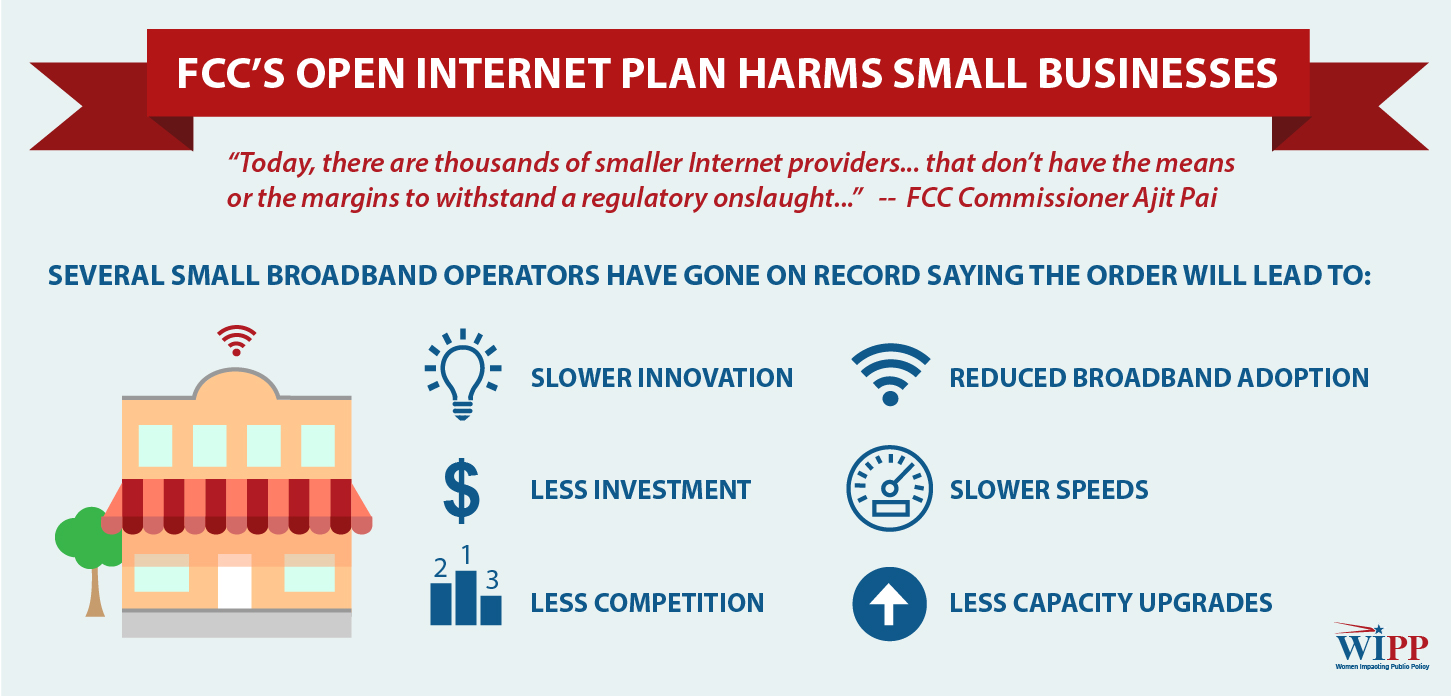
Last week, a new regulatory regime over the Internet took effect. But before these rules came to life, a half-dozen small Internet providers in the Midwest, South and Pacific Northwest told federal officials that they had been forced to cut back on expanding faster broadband service because of the FCC’s recent decision to begin micromanaging the Internet.

All six of these Internet providers specialize in serving small towns and underserved areas; none have the size or scale to accommodate the new regulations’ expenses without budget cuts elsewhere. Moreover, their statements were made under threat of perjury.

For women in particular, this issue should raise serious concerns. Almost half of women-owned businesses are home-based. Anything that slows home broadband deployment has a potential to impact the full economic participation of women.

These verified reports about higher regulatory costs and less money for investment are a clear “canary in the coal mine” warning to Congress about the FCC’s decision to regulate the Internet with Title II regulations written in 1934. That 3-2 party line vote on February 26 overturned decades of successful experience about the benefits of “light touch” rules for the Internet.

Prior to that ill-fated FCC vote, federal Internet policy was both an area of broad agreement and a shining example of successfully encouraging an important new industry. The lack of federal micromanagement that was a hallmark of federal policy since Bill Clinton’s Presidency was key to unleashing a tidal wave of communications investment — $1.3 trillion since 1996 and $75 billion just in 2013.

The results speak for themselves, especially when compared with other countries’ experiences. The U.S. has a huge lead over Europe in both fiber optic deployment and high-speed 4G LTE broadband. Americans spend more time talking on their mobile phones than people in any developed country in the world.

This investment also produced jobs – lots of them. The growth of the mobile app economy, which developed because of America’s high-speed wireless networks, sustains more than 750,000 U.S. jobs, according to the Progressive Policy Institute.

The FCC’s decision to regulate the Internet as a public utility with outdated Title II rules undercuts the very policies that helped spur this success. The FCC’s action is as inexplicable as it is wrongheaded.

Indeed, the Commission’s efforts to explain this action border on the comical. As Hal Singer noted in a recent Forbes commentary, the FCC’s own economic analysis of its action is almost amusing. For example, the agency claimed that the broadband industry’s strong record of investment in 2010 showed that its regulations encourage investment, despite the fact that the Commission’s vote on a more reasonable set of Internet rules occurred on December 21, 2010.

Ultimately, the key reason that Congress must update America’s communications laws is to protect the people who lost an opportunity for better Internet service, because the FCC’s action added pointless new expenses and legal uncertainties to broadband deployment.

The 8,000 St. Louis-area residents served by Wisper ISP, a Missouri-based Internet provider, have felt the negative impact of these utility style regulations. As a result of the FCC’s decision, Wisper estimates that compliance costs will grow to 10% of its operating revenue. It has already had to cut investment, resulting in what the company calls “slower broadband speeds, less dense coverage, and absence of expansion into new areas.”

It is a testament to the bipartisan, light-touch policies implemented back when Internet access meant a 56 KB modem that consumers enjoy so much today. Yet, at just the time when the United States was poised to run the table in a 21st century economy, the FCC pulled the rug out from under small businesses. The FCC’s February vote, and last week’s rules enactment, undid the phenomenal success of the modern Internet.

It is time for Congress to set things right again. We hope that members of both parties come together to enact common-sense legislation that both protects the Internet and reinstitutes the wise telecom policy that has brought us the Internet we use and enjoy today.