So Close and Yet So FAR

Despite its official passage into law and SBA’s implementation, some contracting officers in federal agencies are waiting for the addition of official language to the Federal Acquisition Regulation (FAR) to use the new sole source authority in the women’s procurement program. We have seen first hand that regardless of SBA’s assurances that the law is ready to use, some agencies are reticent to use the new authority until the FAR has officially adopted the change in law. The Federal Acquisition Regulatory Council has already drafted the rule, which is currently in a review phase. And so we wait.


sole sourceOn October 14th, after many years of advocacy spearheaded by WIPP, sole-source authority for Women Owned Small Businesses (WOSB) officially went into effect.  The Small Business Administration (SBA) fast-tracked its official rule authorizing WOSB sole-source, allowing Contracting Officers to cite the rule and award sole source contracts. SBA encouraged agencies to use the new law upon release—before the October 14 date.  


How can women business owners speed the process and become an early pioneer in sole source contracts? Sharing key information with federal agencies is important. Small business offices as well as the contracting community need education on the program.  Since this is the newest small business contracting program on the books, many acquisition officials are still getting used to it.  The sole source piece, although mirroring the HUBZone program, is brand new and worthy of explanation.


Resources from WIPP such as the criteria for a WOSB sole source article, SBA’s final rule on sole source, and any future rulings by federal agencies reinforcing sole source awards for WOSBs, can help Contracting Officers support a sole source justification. ChallengeHER events now being held around the country are an excellent venue for learning about the WOSB program and recent changes.  


And, it is important to dispel the myth that sole source justifications can only be used if your company is the only company in the universe that has a particular product or performs a specific service. Take a look at other sole source justifications found at FBO.gov. You will find that reasons such as close proximity to the buyer, employing the most highly skilled staff, and the ability to customize a product have all served as justifications for sole-source awards in other programs.
We are so close but every day that the FAR Council fails to act, some woman owned company stands to lose what could have been a contract award.  WIPP, through its advocacy, will continue to do what it takes to get this final piece in place.  
WIPP Testifies to Congress on Challenges Facing Small Contractors

Anne Crossman

The House Small Business Committee hearing last week focused on one of WIPP’s key priorities: ongoing issues affecting small companies trying to do work with the federal government. Anne Crossman, a member of WIPP’s Leadership Advisory Council, used her expertise in subcontracting to testify before the Committee regarding the challenges faced by small subcontractors.


In particular, many WIPP members have questioned to what extent subcontracting plans are enforced. WIPP has long advocated for a policy of “if you list us, use us” and it is still unclear if prime contractors are being held to these plans.


Subcontracting is a staple of many small contractors and facilitates the flow of federal contract dollars into small businesses, which provide jobs and boosts local economies. Agencies have subcontracting goals to ensure that small firms get a fair shot at contracting dollars.


The Committee delved into these and many other challenges facing small subcontractors. The hearing can be found in full here.

Revising the Veterans Certification – Top to Bottom

WomenVeteransAccording to the Small Business Administration (SBA) veterans own nearly 10% of all small businesses and those veteran-owned businesses generate more than $1 trillion dollars in revenue each year. In order to qualify for federal contracting preferences at the Veterans Administration (VA), these businesses have to certify as a veteran owned business. The Veterans Administration calls this program “Veterans First.” Government-wide contracting programs give preferences to service disabled veteran owned businesses (SDVOBs) which are required to go through the certification process at the VA.

The Veterans Administration is asking for comments on a new set of changes for the Veteran Owned Small Business program (VOSB). Among many other changes, the proposal would alter the definition of a veteran, a caregiver, the verification requirements for a VOSB, and requirements for joint ventures.

First, the definition of “veteran” in the program is now consistent with a recent update to the VA’s overall definition of veteran. This means owners who served in the National Guard or in the Reserves are still only eligible to be an owner of VOSB or SDVOSB if they received a service-connected disability. The single definition of “veteran” is intended to create consistency when applying to all programs within the VA.

Veteran owners would be required to oversee “daily business operations,” replacing the terms “daily business management” and “day to day operations” in an effort to simplify the application process. In addition, references to spouses and personal caretakers are removed, replaced by “permanent caretaker” to more clearly define a single role aiding the service-disabled owner. A letter outlining the service-disabled veteran’s disability and the need for the permanent caregiver must be included in order to qualify. The VOSB application process, which was required annually, would be expanded to last for two years if the proposed rule was adopted.

Last, language on VSOB joint ventures has been clarified, requiring at least one joint partner be a verified VOSB. Additionally, the same project and time restrictions that apply to other set-aside programs have been added. All these changes, and more, can be viewed and commented on here.

If you have an opinion on the VA certification, now is the time to submit them. Your comments will make a difference – agencies receive every submission and carefully review them.

Sole Source Authority for the WOSB Program is Official Today!

sole sourceWIPP has reason to celebrate with all women business owners. As of today, contracting officers now have the authority to award sole-source contracts to women-owned small businesses. This authority will level the playing field in the federal marketplace and provide additional opportunities for women entrepreneurs to expand their businesses.

So how do you get a sole sourced contract? There are four questions to ask when considering if a contract can be awarded to a WOSB via sole source authority:

  1. Is the contract in a WOSB or EDWOSB eligible NAICS code?

The Women Owned Small Business (WOSB) Procurement program is unique in that it is only applicable to contracts in certain NAICS codes. In addition some NAICS codes are open to all WOSBs, while some are only available to Economically-Disadvantaged WOSBs (EDWOSBs). You can check if a contract’s NAICS codes are in the program on the SBA website www.sba.gov/wosb. Again, the NAICS code of the contract, not just your company, is important.

  1. Is the contract (including options) valued at $6.5 million or less for manufacturing contracts or $4 million or less for all other contracts?

Similar to other small business contracting programs, WOSB sole source contracts are limited to certain sizes. For manufacturing contracts (the 31-33 NAICS codes) that cap is $6.5 million, while all other contracts have a cap of $4 million. This is including all options on the contract.

  1. Can the contract be awarded to the WOSB or EDWOSB at a fair and reasonable price?

The law also requires that the contract can be awarded at a “fair and reasonable price.” This common term in federal contracting is described in the FAR – essentially the federal procurement rulebook.  Good news – if you are submitting pricing that is on the GSA schedule, it is already considered fair and reasonable.

  1. Lastly, in the determination of the contracting officer, is there a reasonable expectation that there is only one WOSB/EDWOSB that can perform?

The final requirement for a sole-sourced contract in the WOSB program is the contracting officer’s determination, through market research, that only one WOSB/EDWOSB can perform the requirement. Many people find this component especially difficult, however, it is important to note that agency-specific requirements may make your solution unique. Also, if it is determined that 2 or more WOSB/EDWOSBs can perform, the contract can be set-aside through the WOSB program.

If the answer to all four questions was yes – you have yourself a strong case for a WOSB sole source contract.

Keep an eye out for additional education from WIPP on sole source authority.  WIPP will be working with the SBA and OSDBU offices to help educate both women business owners and contract officers on sole source authority.

Don’t forget! If you are looking for federal contracting opportunities, make sure to get your business listed in WIPP’s National Directory of Women-Owned Small Businesses.

From the Hill: Contractors Face Additional Reporting Burdens

By: Jake Clabaugh, WIPP Government Relations

hillFederal contractors will now face a bevy of additional reporting requirements when seeking procurement opportunities. The House Small Business Committee held a hearing Tuesday to exam the Fair Pay and Safe Workplaces regulations. These new rules are expected to be finalized late this year or early next year and require federal contractors to document and report labor law and safety violations for their firm and all subcontractors when bidding for contracts above $500,000.

WIPP supports efforts to rid the contracting environment of businesses with a history of abusive and neglectful violations, but these new rules will be particularly burdensome for small contractors. The House Committee hearing focused on the increased administrative burden that small contractors will face and how opportunities for small and women-owned businesses to enter the federal contracting arena will be affected.

WIPP addressed many of these issues in its official comment, submitted earlier this summer. The hearing highlighted the likelihood that contractors may be “blacklisted” from contracting opportunities, a concern that WIPP expressed. The regulations require all violations to be reported, even infractions that have yet to be adjudicated. The contractor is not afforded the opportunity for explanation until the contract is likely to be awarded. The danger is that a contracting officer will simply pass over or “blacklist” a potential contractor rather than dig deeper into nature and validity of the reported infraction. This could leave many upstanding small and women-owned firms with unproven or minor violations unable to secure contracting opportunities.

The hearing also stressed the duplicative nature of these regulations. Several witnesses noted how suspension and debarment procedures already exist. In its comments, WIPP recommended incorporating safe workplaces into the well-established system of suspension and debarment as an alternative to creating this enormous reporting burden.

These reporting requirements will impose significant costs for small and women-owned firms. Not only will it require the business to submit excessive documentation, it will also require significant resources to research, gather, and report the necessary information for the small business and all of its potential subcontractors.

Far from leveling the playing field for the millions of businesses playing already by the rules, these regulations will add to the tremendous burden facing small and women-owned businesses.

ChallengeHER 2015 Update … Fall Edition

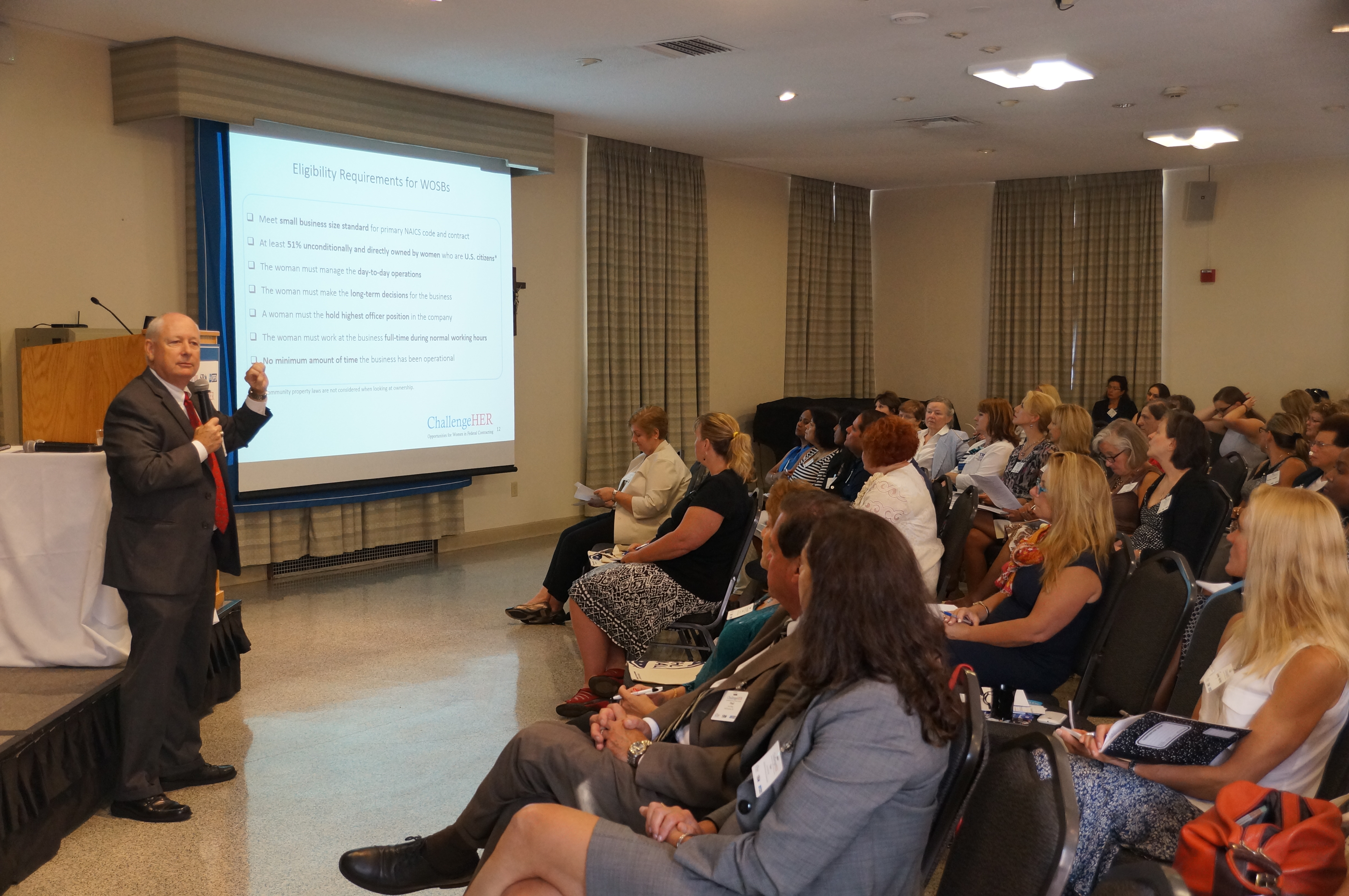
A substantial part of Women Impacting Public Policy’s (WIPP) Federal Procurement Programming lies undoubtedly with ChallengeHER. ChallengeHER is an educational program, which provides women business owners with the guidance to better compete for federal contracts under the Women-Owned Small Business (WOSB) Federal Contract Program.

CH-Transparent

In order to provide as much impact as possible and to get women business owners together with federal buyers, ChallengeHER events are being held in several cities and states throughout 2015. As the year is progressing toward the fall season, several events have already been held (e.g. Washington D.C., New York, Dallas, Atlanta, New Hampshire), but many more are still scheduled until the end of the year. And what can participants expect?

ChallengeHER provides women around the United States with the most important, standardized knowledge and guidance in the federal marketplace and an opportunity to:

  • Learn about the WOSB set aside program and how to market their business using this set aside.
  • Learn from experiences and best practices of successful WOSBs working as federal contractors.
  • Find out from federal buyers how to do business with their agency in Federal Buyer’s Panel.
  • Participate in one-on-one matchmaking sessions with federal buyers at most events.
  • Learn about the new Sole Source Authority rule! More information on SBA’s announcement integrating a sole source component into the WOSB procurement program starting October 14, 2015, can be found here.
  • Network with peer mentors and other WOSB and Economically Disadvantaged Women-Owned Small Business (EDWOSB) firms.

Some of the participants’ feedback:

BlogPost“I am glad I was able to attend ChallengeHER. The speakers were great and very informative.” – Attendee from New Hampshire event

“ChallengeHER provided me with pathway to applying for federal contracts and becoming a successful women business owner.” – Attendee from Atlanta event

“I truly appreciate the information shared. It provoked me to think differently about how I was running mBlogPosty business. I was so inspired I even recorded the speech.” – Attendee from Atlanta event

“As well as strong individual speakers, it was particularly helpful to have “panels” that provided different perspectives at once.” – Attendee from NYC event

Registration for upcoming events is available for:

More events to come will be held in Central New Jersey, Baltimore, Kansas City, and Orlando in Florida throughout November and early December 2015.

ChallengeHER aims not only to provide one time learning experience but also to build a standing long-term knowledge and support base for its participants. Therefore additional resources are available for attendees both before and after the event:

  1. To prepare and get ready for discussions and topics covered during the event by listening the following courses:
  2. To follow up on gained knowledge and sort out where to go from there, by following 10 Quick Steps for guidance to successful federal contracting.

For those of you, who are not familiar with the program, here is some basic information:

ChallengeHER, an initiative from the U. S. Small Business Administration (SBA), WIPP, and American Express OPEN (OPEN), is designed to strengthen and promote the Women-Owned Small Business (WOSB) Federal Contract Program. ChallengeHER offers women business owners important information to established and new businesses on working with the federal government. Further, these events enable more women business owners to take advantage of contracting opportunities so they can boost their businesses and help propel the success of the WOSB Procurement Program.

For more information on upcoming events and news visit our website and connect with us online on Twitter, Facebook or LinkedIn.

Success: Sole Source Finalized

women_in_business

by Ann Sullivan, WIPP Government Relations 

When you’ve been working on a program for 15 years, it’s almost anti-climatic when you realize you won and it’s over. I suppose lawyers feel this way when they win a big case, or business owners when they close a major contract.

For me, the SBA announcement integrating a sole source component into the WOSB procurement program on October 14, 2015 marks the end of a long campaign by Women Impacting Public Policy (WIPP). First, we fought for eleven years to establish a program that gives a government buying preference to women-owned companies whose industries have been underrepresented. Not an easy fight – we had plenty of Congressional and White House opponents—it wasn’t until the Obama Administration came into power that the program was established. At the time, SBA Administrator Karen Mills made it her number one priority, which we will always be thankful for. We had strong Congressional proponents – Senators Cantwell and Shaheen and Representatives Speier and Graves.

Then, we had to make the program work. That required two major changes to the program in 2013 and 2014. The first change required lifting the award caps the law imposed on the program. The WOSB procurement program limited contract awards through the program to $4 million ($6.5 million for manufacturing). In 2013, Congress helped us get rid of those caps. The last big piece was the sole source piece—allowing contracting officers to award sole source contracts to women-owned companies through the program. This major change gives the program parity with other small business programs and again, required Congressional action. Effective October 14, agencies will be able to use this mechanism to award contracts to women whose companies offer innovative products and services.

As with all government programs, the rules are a little complicated and the ability to self-certify as a woman owned business will eventually have to change, due to Congressional direction in 2014. But for now, self-certification remains the law and women should be actively pursuing contracts through the WOSB procurement program whether or not they are self-certified or certified by a third party.

It is important to note that not all industries (NAICS codes) qualify for the program. You can find a list at http://www.SBA.gov/WOSB. We have developed a one pager that go through the rules of the sole source portion of the program and our GiveMe5 program has comprehensive information on the WOSB program. In addition, our ChallengeHER events are all over the country so that women can find out more about the program. The information can all be found at www.wipp.org.

The WOSB procurement program is in good hands. All the major pieces to make it successful are in place. When we started this effort in 2002, women received 2.7% of government contracts. Since the program has been in place, more than $500 million has been set-aside for women- owned companies. In fact, in 2014 the government awarded 4.7% of its contracts to WOSBs –a 75% increase since 2002. Now women business owners need to know how to use it with the help of SBA, the federal contracting community and organizations, such as WIPP.

Fifteen years seems like a long time, but when you are fighting for something—somehow it doesn’t seem that long. WIPP members and coalition partners were with us every step of the way. For this, I am exceedingly grateful.

Overtime Rule is Over The Top

By John Stanford, WIPP Government RelationsOvertime pic

The Department of Labor, it would appear, is working overtime. Two weeks ago, WIPP responded to the agency’s proposal to require labor history for federal contractors. Now, WIPP is addressing a different proposed regulation – this one making changes to overtime pay. Both proposals were well intentioned, and both pose risks to women entrepreneurs.

Disclaimer: this blog is a brief summary, so if your business may be affected I encourage you to read WIPP’s comment in its entirety.

It all began last spring, when President Obama directed the Labor Department to update overtime regulations, saying the standards for some employees had “not kept up with the modern economy.” Specifically, the so-called white-collar exemption was out of date. The exemption allows employers to avoid paying overtime (required anytime an employee works more than 40 hours a week) for executive, administrative, and professional employees because they typically have better pay, benefits, and privileges.

The exemption has three criteria. First, the employee must be salaried. Second, the salary must be above a certain threshold. Third, the employee duties must meet certain criteria – basically, you cannot just give someone a manager’s title and exempt them; they must be acting as a manager.

To answer the President’s call for modernization, the Labor Department proposed to update the second piece, the salary threshold, from roughly $24,000 to $50,440 and index it to economic growth. Essentially, this qualifies white-collar employees who make less than $50,000 a year for overtime pay if they work more than forty hours a week.

WIPP agrees with the President that our regulations do not match a 21st century economy, and we should work on updating these requirements for a fair and modern workplace. Moreover, companies that are purposefully skirting the rules on overtime pay and cheating otherwise qualified employees should be held accountable.

Nonetheless, simply doubling the salary threshold goes too far and achieves too little. While large companies in large cities may be able to afford a $50,000 salary floor, the entrepreneurial community is left with bad options: possibly cut employees to afford a minimum salary for others, or restrict working hours and set up an hourly tracking system. Notably, the Labor Department estimated only a quarter of employees will likely see higher paychecks. Others may see reduced hours.

In the comment, WIPP highlighted concerns about the cost to implement the rule, difficulties in application of the rule, and the dangerous impact on employee wages and benefits.

The Labor Department predicted that simply implementing this change would cost small businesses, including the vast majority of the nearly ten million women-owned firms, between $130-$180 million in the first year alone. That does not include the more than $500 million in increased wages small businesses are expected to pay. The Labor Department itself mentions that business could cut hours and benefits to make up for this loss.

Moreover, to ensure compliance with these new regulations, businesses will begin closely monitoring and tracking their employees’ work hours. Tracking and monitoring employee hours is very difficult, if not impossible, given the evolving dynamics of the workforce. Many white collar employees have flexible schedules, work from home, check and answer emails from smartphones or tablets and are no longer restricted by a rigid 9-5 schedule.

It also isn’t just companies. Non-profits face the same requirements. An exception for them (as well as small businesses) is so narrowly crafted it may not cover many mission-oriented organizations or the smallest of businesses. Both are places where working above and beyond forty hours a week may be more about commitment to a cause than a bigger paycheck. For this reason, WIPP asked that the exception be broadened to actually apply to small businesses and non-profits.

The idea that our regulations need to be updated is not political – it’s common sense. But often the regulatory pendulum swings too far as it has here. As proposed, women entrepreneurs could face the arduous tasks of transitioning current employees from salaried to hourly workers and possibly cutting benefits to make payroll all while tracking and limiting employee hours. Talk about working overtime.

“Fair Pay” Rules Just Aren’t Fair

women comp

By John Stanford, WIPP Government Relations

Women Impacting Public Policy (WIPP) recently submitted comments on proposed regulations that would require federal contractors to disclose labor violations from the past three years. This blog accompanies those comments as a summary of WIPP’s position. For more details or if this impacts your business, I encourage you to read the full comment here.

Last summer, President Obama issued an Executive Order with the goal of barring bad companies from winning federal contracts. WIPP, along with most in the contracting community, agrees that companies that follow the rules should not have to compete against companies that break them for federal contracts.

In May, the Labor Department and the FAR Council (overseers of contracting rulebook, “the FAR”) proposed how the President’s order would be implemented. It turns out, as with most things, the devil is in the details.

The proposed regulations require federal contractors and subcontractors to disclose violations of 14 federal labor laws and equivalent state laws from the previous three years. Exemptions were provided for companies with contracts valued less than $500,000. As proposed, prospective federal contractors would need to declare if they had labor violations in the previous three years when submitting an offer. During an initial evaluation, contracting officers would see that declaration (a simple “yes” or “no”), without any additional detail or explanation.

Later, if a contractor were likely to win an award, the contracting officer would have to decide if the contractor is a responsible company (a requirement of all government contracts already). It is in this phase that details like appeals, remediation, or mitigating factors could be explained. Contracting officers will attempt to identify companies with “serious”, “willful”, “repeated”, and/or “pervasive” violations and not award them contracts. Companies with minor violations could still be considered responsible and win contracts.

WIPP responded to the regulation during the public comment period expressing concerns with the new system and how it could negatively impact women-owned businesses, including those who had no history of unsafe or unfair work practices.

Notably, the proposals were incomplete as the Labor Department and FAR Council chose not to include what state labor law violations must be reported. It is impossible to gauge the impact of a regulation – the reason for comments– when missing significant portions.

What was in the proposals, however, was equally concerning. WIPP’s comment discusses how, in some cases, violations that require reporting will not be be fully adjudicated. That is, companies would have to report decisions against them that may ultimately be overturned – as nearly a third of NLRB decisions have been.

This is compounded by WIPP’s worry that simply having violations on record will “blacklist” companies without providing any opportunity to offer explanation. With limited resources and time, contracting officers may elect to avoid companies with any disclosed violations, despite the intent of the order to only bar violations of a certain severity.

The comment also considers burdens on subcontractors who similarly must report violation history, and the lack of resources the government may face to answer questions about weighing different labor violations. Moreover, the onus to collect and judge subcontractor violations falls to primes, a strategy the Labor Department itself questions.

WIPP’s final concern is that this rule is one of many in a disconcerting trend of new regulations that specifically target federal contractors. Earlier this year, regulations raised the minimum wage solely for workers on federal contracts. New requirements regarding sick leave are expected to come later this year. These make contracting with the federal government more onerous, particularly for women entrepreneurs seeking to enter the market.

Without question, WIPP supports efforts by the federal government to rid the contracting environment of businesses with a history of abusive and neglectful violations. In doing so, the government levels the playing field for the millions of businesses playing by the rules. But the proposals commented on will not achieve this goal. Instead, they will make it harder to be a contractor – pushing the innovative products and services of women-owned businesses out of the federal market.

Take Advantage of the Federal Contracts with WIPP

In 2000, the federal government set a goal to award 5% of all contracts to women-owned businesses. In February 2011, after 11 long years of work, the Women-Owned Small Business Federal Contract Program was finally enacted to help make that goal a reality. This program allows federal contracting officers to restrict competition for certain federal contracts to women-owned businesses.

Give Me 5 LogoSince then, our goal was to provide women-owned companies with guidance on how to take advantage of the set asides, which resulted in launch of a specialized program, Give Me 5.

Give Me 5, named for the 5% federal contracting goal for women-owned businesses and created by WIPP and American Express OPEN®, is designed to educate women entrepreneurs on how to successfully navigate the federal contract marketplace through a full range of freely accessible and on-demand online educational courses ranging from contracting basics to more advanced courses.

Give Me 5 has over 90 educational courses, with 20 highly specialized contracting instructors .

We encourage you to join successful women-owned companies and start doing business with federal government. Our next webinars are focused on Understanding Project Accounting and its Impact on Government Contracting and on The Essential Ingredient of All … Relationships!

Also don’t forget to check out WIPP’s other federal contracting education resources: