
ChallengeHER 2015 Update … Fall Edition

A substantial part of Women Impacting Public Policy’s (WIPP) Federal Procurement Programming lies undoubtedly with ChallengeHER. ChallengeHER is an educational program, which provides women business owners with the guidance to better compete for federal contracts under the Women-Owned Small Business (WOSB) Federal Contract Program.

CH-Transparent

In order to provide as much impact as possible and to get women business owners together with federal buyers, ChallengeHER events are being held in several cities and states throughout 2015. As the year is progressing toward the fall season, several events have already been held (e.g. Washington D.C., New York, Dallas, Atlanta, New Hampshire), but many more are still scheduled until the end of the year. And what can participants expect?

ChallengeHER provides women around the United States with the most important, standardized knowledge and guidance in the federal marketplace and an opportunity to:

  • Learn about the WOSB set aside program and how to market their business using this set aside.
  • Learn from experiences and best practices of successful WOSBs working as federal contractors.
  • Find out from federal buyers how to do business with their agency in Federal Buyer’s Panel.
  • Participate in one-on-one matchmaking sessions with federal buyers at most events.
  • Learn about the new Sole Source Authority rule! More information on SBA’s announcement integrating a sole source component into the WOSB procurement program starting October 14, 2015, can be found here.
  • Network with peer mentors and other WOSB and Economically Disadvantaged Women-Owned Small Business (EDWOSB) firms.

Some of the participants’ feedback:
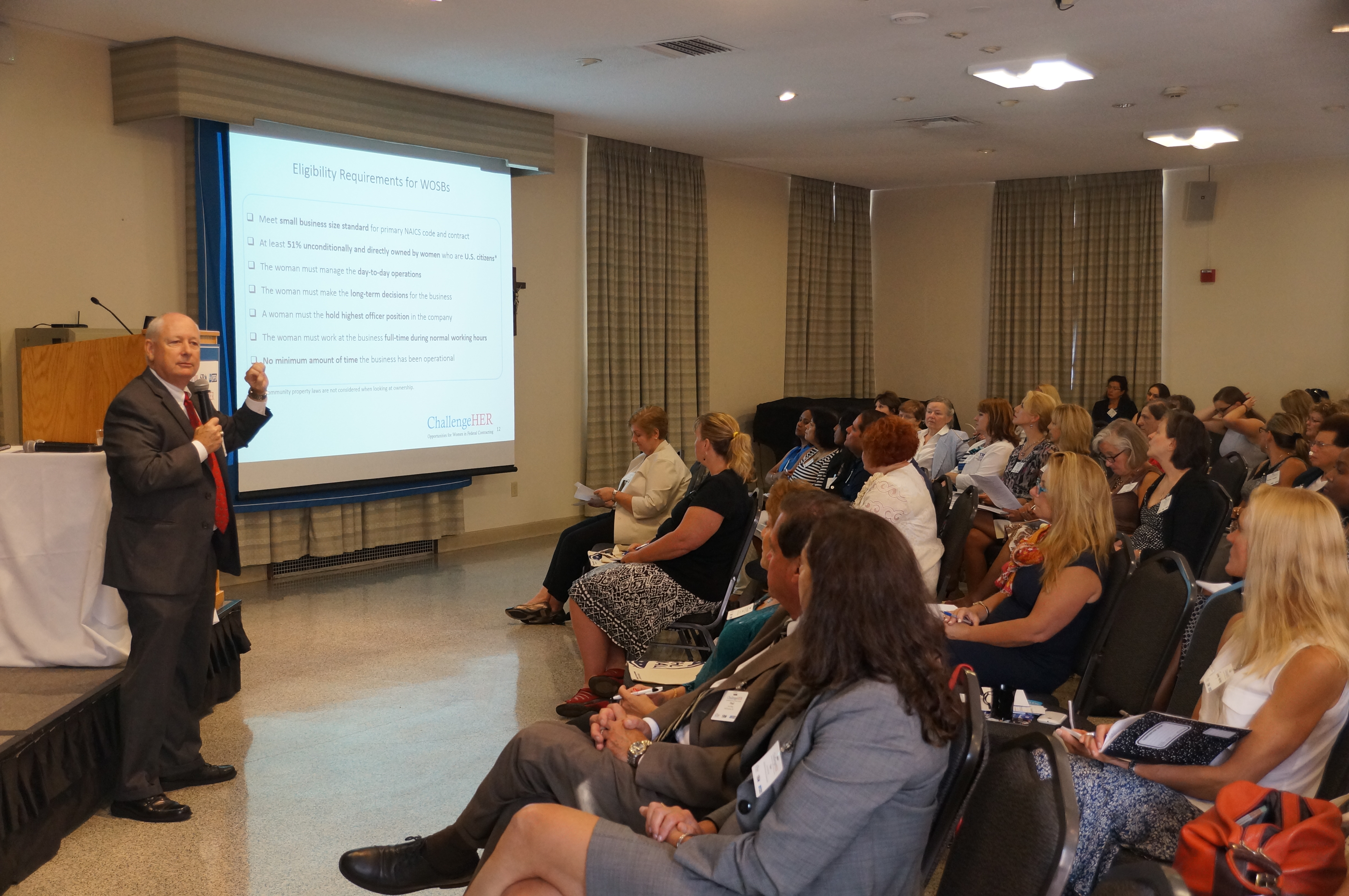
BlogPost“I am glad I was able to attend ChallengeHER. The speakers were great and very informative.” – Attendee from New Hampshire event

“ChallengeHER provided me with pathway to applying for federal contracts and becoming a successful women business owner.” – Attendee from Atlanta event

“I truly appreciate the information shared. It provoked me to think differently about how I was running mBlogPosty business. I was so inspired I even recorded the speech.” – Attendee from Atlanta event

“As well as strong individual speakers, it was particularly helpful to have “panels” that provided different perspectives at once.” – Attendee from NYC event

Registration for upcoming events is available for:

More events to come will be held in Central New Jersey, Baltimore, Kansas City, and Orlando in Florida throughout November and early December 2015.

ChallengeHER aims not only to provide one time learning experience but also to build a standing long-term knowledge and support base for its participants. Therefore additional resources are available for attendees both before and after the event:

  1. To prepare and get ready for discussions and topics covered during the event by listening the following courses:
  2. To follow up on gained knowledge and sort out where to go from there, by following 10 Quick Steps for guidance to successful federal contracting.

For those of you, who are not familiar with the program, here is some basic information:

ChallengeHER, an initiative from the U. S. Small Business Administration (SBA), WIPP, and American Express OPEN (OPEN), is designed to strengthen and promote the Women-Owned Small Business (WOSB) Federal Contract Program. ChallengeHER offers women business owners important information to established and new businesses on working with the federal government. Further, these events enable more women business owners to take advantage of contracting opportunities so they can boost their businesses and help propel the success of the WOSB Procurement Program.

For more information on upcoming events and news visit our website and connect with us online on Twitter, Facebook or LinkedIn.


From The Hill: Dodd-Frank’s Impact on Small Business Lending

By Jake Clabaugh, WIPP Government Relations

wmn$

Women entrepreneurs face unintended consequences of wall-street reform. According to a House Committee hearing yesterday, the Dodd-Frank Wall Street Reform and Consumer Protection Act, introduced in an effort to prevent another financial crisis, is contributing to small businesses’ inability to access capital from banks.

WIPP’s Access to Capital Platform has cited some of Dodd-Frank’s regulations as a contributing factor to the decrease in small businesses lending. Capital access is a lifeline for small businesses. It is essential for entrepreneurs to have access to sufficient capital to found and grow businesses.

DF picThe House Committee on Small Business convened lenders and experts to discuss how Dodd-Frank has affected the ability to provide entrepreneurs with critical capital. Access to private capital, including bank loans is a primary concern to women entrepreneurs as women-owned small businesses receive only 4% of private sector lending dollars. Additional regulatory burdens could be exacerbating this problem.


The hearing touched on many of the difficulties WIPP members have experienced when trying to access to capital. The Committee cited increased administrative burdens as a significant cost for small and community banks, a primary lender to small businesses. These regulations have increased the cost of making loans and therefore made it more difficult for banks and borrowers. The result is less capital for entrepreneurs.

The hearing also cited the direct impacts on borrowers. Many that would have qualified pre-recession are no longer able to obtain loans from banks due to tighter lending standards. WIPP’s platform advocates for modernized credit scoring that would level the playing field for women business owners.

Until Dodd-Frank is fully implemented, its complete impact will remain unclear. WIPP continues to review ongoing regulations as well as work with Congress to scale back unnecessary barriers to capital access for women entrepreneurs.

Millennials in the Workplace – What Are Your Thoughts?

Millennials are the largest workforce group since they surpassed Generation X this year and the U.S. Bureau of Labor Statistics preMillennialsdicts they will make up 75% of employees by 2030. Therefore it is no surprise that many reports and articles have been dedicated to the topic of how to get along with and manage this generation at work.

From hiring practices to benefit packages and work-life balance, expectations of this generation are widely different to the ones of Baby Boomers or Generation X.

Towan Isom is a President and CEO of Isom Global Strategies where millennials make up more than 50% of all employees in her company. Since she started the company 15 years ago in her basement, she has accumulated extensive experience and knowledge working with different generations of workers. She shares her insights and often speaks on how to be successful with this intergenerational workforce and on managing millennial employees.

In the end of September, Towan will speak at a conference on Millennials in the workplace, and she offers a unique opportunity to make your insights to be heard. By responding to the quick survey your professional opinion on working with millennials will be shared with her audience and presented in a case study afterwards. The conference will be also recorded and available on Isom Global Strategies website few weeks after the event.

Towan will also share outcomes and her professional views with us here in a guest blog after the conference.

Meet the World’s Youngest Self-Made Female Billionaire: Elizabeth Holmes.

by Annie Wilson, InternEH

According to Forbes, Elizabeth Holmes has been named the world’s youngest self-made female billionaire with a net worth of $4.5 billion. Earlier this month she was named as Time Magazine’s List of 100 most influential people. Her billion dollar idea?: a revolutionary way to make blood testing accessible for anybody. Holmes’ company, Theranos, created a system that brings together a minimally invasive and needle free method of blood withdrawal with hundreds of low cost tests that almost anyone could afford. Holmes’ intention is to restructure our healthcare system to be more preventative as opposed to a reactive:

“The current health care paradigm is one in which diagnosis often takes place after symptoms are already present, and diseases have begun to progress. We’re committed to changing that. We’re pioneering a new paradigm in which lab testing is accessible and affordable for everyone. When cost is no longer a consideration and people no longer have to be symptomatic in order to get a test. Meaning your patients can get the tests they need, and you can get the information you need, early and in time for therapy to be effective.” – Elizabeth Holmes, Theranos website

Holmes attended Stanford University but dropped out at the age of 19 to start Theranos in 2003. Since then, Holmes has impressed investors with the potential commercial, military, and humanitarian applications of her idea. Holmes has also acquired a very impressive board of directors, including former cabinet secretaries George Shultz, Bill Perry and Henry Kissinger, two former Senators, a retired CentCom commander, a retired Navy admiral and a former director of the Center for Disease Control and Prevention. She has rapidly developed her company since 2003 and has notably partnered with Walgreens to build thousands of Wellness Centers for Theranos to carry out its testing. To date, Theranos has also accumulated $92 million in venture capital funding from investors like Larry Ellison and Draper Fisher Jurvetson with her first venture capital funding worth $5.8 million in 2005 at the age of 21. Holmes owns 84 patents to her name and Theranos is estimated to be worth $9 billion with Holmes owning half of its stock.

If you want to learn more about Elizabeth Holmes:

  • Click here for a video about how she came up with her business idea.
  • Click here for a timeline of Theranos’ conception
  • Click here to watch a TED Talk given by Holmes about the importance of early detection

SBA’s Announcement of the 2016 InnovateHER Challenge and Summit

FeatureInnovateHER

By Annie Wilson, Intern

On Tuesday, August 4th the Small Business Administration (SBA) announced the launch of the 2016 InnovateHER: Innovating for Women Business Challenge and Summit. In partnership with Microsoft, the 2016 InnovateHER includes the second round of the women’s business competition to feature new, innovative products and services that help to change and empower the lives of women and families. Last year, the SBA engaged over 100 organizations and reached 1000+ entrepreneurs around the country and this year they have expanded their challenge to include a women’s summit.

It is the SBA’s hope that through this summit they can unveil products or services that have a measurable impact on women and their families, fulfill a marketplace need and have potential for commercialization. The SBA recognizes that while women control 80% of the purchasing power in this country they only make up less than 5% of venture capitalists. The InnovateHER Challenge is an effort to bridge that economic standard for women and elevate commercial success for women entrepreneurs and products for women.

The InnovateHER event will kick off in the fall of 2015 in its initial round starting with competitions hosted by universities, accelerators, clusters, scale-up communities, resource partners and other organizations. The SBA is encouraging organizations all across the country to participate in this challenge to provide accessibility to an innovative space for women. A way in which organizations can help the InnovateHER challenge and women entrepreneurs within their community is to host a local business competition and submit the winner to the SBA no later than December 3rd, 2015 for the semi final rounds. The SBA will then select up to 10 semifinalists from their community nominations that will be sent to the final pitch competition. The 2016 InnovateHER and final pitch competition will be held March 16-17th, 2016 in Washington D.C. At the final competition, the remaining contestants will do one final marketing pitch and compete to be one of the top three winners to receive up to $70,000 in prize money.

Make sure to check out last year’s winners: LIA Diagnostics, the Shower Shirt, and Trusst.

If you’d like to learn more about the challenge rules or how to become a host organization, please click here.

If you’d like to learn more about the challenge itself, please click here.

What We Can Learn from High Growth Women Owned Firms

By Annie Wilson, Intern

Last year Susan Coleman D.P.S. and Alicia Robb Ph. D published research prepared for the National Women’s Business Council examining the factors affecting access to capital for high-growth women-owned businesses. In their research, Coleman and Robb found that currently in the business community 30% of businesses were owned by women, however they are mostly small:

  • only 12% of women-owned small businesses (WOSBs) employ anyone other than the business owner;
  • 2% have 10 or more employees; and
  • only 2% have revenues in excess of $1 million.

NWBC Blog Image

This new data shows the need to engage and educate women owned businesses on growth strategies that can expand their businesses.

This report delves deeper into the issues relating to capital accessibility specifically for growth oriented firms, which comparative studies have yet to research thoroughly due to a lack of data.

According to the study, access to capital may be more challenging for women-owned firms than for men for a multitude of reasons:

  • In terms of financial capital, there are considerable gender gaps in the amounts of financing across firms. Men start firms with nearly double the amount of capital that women do and, of high growth firms, men use more than double of what women use. Men also indicated to have used six times the amount of financing that women do.
  • For startup capital, women were found to be more reliant on owner equity and insider financing as opposed to men who used outsider equity predominantly. For women owned firms, a very small fraction of startup capital came from outsider equity regardless of where the firm was on the size spectrum.
  • In terms of credit market experiences, women indicated to have similar loan application rates as men even though there are more unmet credit needs among women. Women were more likely to not apply for the necessary credit due to a fear of a denied loan application. Also, credit scores are generally lower for women.
  • While men and women are on par in terms of education levels, men exceed women in degrees in the STEM fields, which is the industry that experiences more growth.
  • By means of industry experience, as women tend to have lower levels of startup experience, team ownership and hours worked compared to men.
  • Women have higher rates of owning businesses that are home-based due to family commitments and research has indicated that being home based is negatively related to growth.

However, when comparing the top ranking female businesses by employment and growth potential, there are some considerable differentiations that set them aside.

  • They had a higher rate of employment from their startup year onwards.
  • They are more likely to be in tech industries.
  • They were more likely to offer services as opposed to products.
  • They were less likely to be based from the owner’s home.
  • They were more likely to be incorporated and as a result yield higher credit scores.

For leadership traits, women business owners of high growth firms also had some unique characteristics:

  • They were likely to have more years of industry experience and more likely to have more startup experience.
  • They started their businesses with much more capital (even more than the male owned firms overall.)
  • They used more outsider equity for startup capital. However, this was typically still less than their male counterparts.

Learning from these success measures, it is clear that increased capital for women entrepreneurs, specifically in the startup phase of their business, has an important correlation to the trajectory of women owned businesses. In order to foster a more successful environment for women, there must be changes in the business environment to give women the support and resources they need to turn this trend around.

It is clear that the financing gap between men and women business owners is a considerable detriment to the vitality of women-owned firms. In order to ensure stronger female entrepreneurship and make strides towards closing this gap, efforts must be made to strengthen the financial capabilities of women entrepreneurs and encourage accessibility to bank and equity financing. Also, providing more visibility and accessibility to successful female industry professionals and providing more opportunity for women to attain industry experience could help bolster the entrepreneurial confidence that women need to compete with their male competitors. Another important step forward would be an increased use of family-friendly policies, which could give women the flexibility to work outside of their homes and in an environment more conducive to entrepreneurial growth.

Take a look at WIPP’s recently launched Access to Capital platform to address funding gaps and the crisis of capital faced by women entrepreneurs.

To read the full report, click here.

How to Boost Women’s Entrepreneurship

While numbers of women entering labor force are steadily increasing, their participation in entrepreneurship is less favorable. In fact, according to the Kauffman Foundation, an entrepreneurship think tank, women are only half as likely as men to start a business resulting in unrealized potential for their contributions to job creation, innovation, and ultimately economic growth.

UntitledKauffman Foundation released a new study claiming that women would make great entrepreneurs but they often fail to start their own business mostly due to following reasons:

  • Shortage of available mentors;
  • Perception of entrepreneurship as a masculine activity;
  • Additional hurdles maintaining a work-life balance due to parenthood.

However, we can address these barriers as Kauffman highlights 5 ways for policymakers on how to encourage women to start their own business.

  1. Provide more exact, gender based, data on entrepreneurship programs and initiatives to understand how they can better help women entrepreneurs. Collecting data based on gender will help them to make more accurate decisions in assisting women entrepreneurs.
  1. Increase the number of women leading entrepreneurship programs. Women can better lead and support other women entrepreneurs by using their networks for accessing mentors, financial capital, and creating women inclusive events that attract women entrepreneurs.
  1. Increase Small Business Innovation Research (SBIR) awards to women-owned businesses. Although federal agenciesparticipating in the SBIR Seed Fund are encouraging women to engage in federal research/Research and Development, only 15 percent of SBIR awards went to women-owned businesses in 2012. One of the ways to increase this number is to partner with women’s professional organizations and make better effort of reaching out to women entrepreneurs to participate in these programs.
  1. Share stories of successful women entrepreneurs. Celebrating accomplishments of women entrepreneurs will change the false perception that only men are successful entrepreneurs and encourage more women to follow successful women in business.
  1. Decrease the risk of becoming an entrepreneur. Pressure and risks that women as entrepreneurs are facing, especially with young families, can discourage them of starting in the first place. By exploring various policies such as subsidized childcare or preschool, can help alleviate the pressure and create a more favorable environment for women to start their own businesses.

Read the full study here.

Flourishing women with flourishing careers

Start your week with an article on women who continue building their careers in the age which is usually connected with retirement and taking care of grandchildren -> Clinton, Yellen, and Warren all reached their 60s having raised families and built long professional tracks as well.

Statistics also point to a significant rise in entrepreneurship during the “retirement years”. According to Kauffman stFlourishing womenudy, Americans in their fifties and sixties have started businesses at a faster pace over the last decade, while that pace has continuously slowed among Americans in their twenties and early thirties. The article puts a new perspective on the topic: “Perhaps having to wait awhile isn’t an entirely bad thing. If more people in professional and public life had to perform, and keep performing, before they got top posts, all of us might be better off.”

Whether building and expanding professional careers, entering public service, or building that dream business, retirement years are now years of opportunity and excitement for all of us.

Read the whole article here http://theatln.tc/1IF5GHi

More Taxes? No Taxes? How About Fair Taxes

By John Stanford, WIPP Government Relations

WIPP recently submitted testimony to the House Small Business Committee on comprehensive tax reform. This blog gives an overview of WIPP’s advocacy efforts. For more details, I encourage you to read the testimony. Our government relations team strives to make official communications as easy-to-read as possible, but should you have questions please reach out to WIPP.   


Women entrepreneurs deserve a tax system that rewards the effort, tenacity, and risk it takes to start and grow a business. Moreover, they deserve a system of revenue collection (because that’s what taxes are) that is simple and fair.

In testimony submitted to the House Small Business Committee, WIPP said just that. Citing reports from the IRS National Taxpayer Advocate as well as the SBA Office of Advocacy, the testimony documents what women business owners already know: the tax system is broken, failing under the weight of complexity, uncertainty and outdated policies. But more importantly, the testimony addresses the impact of possible reforms – and the need for any overhaul to be comprehensive.

What does that mean? It means that the idea to lower the corporate tax rate, favored by the White House and some in Congress, must not happen independently of adjusting individual rates in a similar manner. This distinction matters because so many businesses, including almost 9 in 10 women-owned businesses, are structured as “pass-through” entities paying taxes as individuals (including S-Corps, Sole-proprietorships, partnerships, and LLCs).

Corporate-only reforms would be unfair to these businesses – and for that reason WIPP has always supported comprehensive (corporate + individual) reform. The testimony underscored this important point.

In addition, WIPP identified tax policies that, absent major reforms, would benefit women entrepreneurs. This includes making more small business tax credits and deductions permanent. In recent years, these tax “extenders” have been extended (hence their name) at the last minute, or even retroactively – not a good way for business owners to plan their budgets.

WIPP also asked Congress to consider tax credits that benefit new businesses, helping offset the costs of launching a new company. Another policy request was to avoid changing the Employee Stock Ownership Plan (ESOP) provisions in the tax code, as these have proven to be both popular and good tools to incentivize productivity and long-term business health.

In agreement with the idea that simple businesses (sales – costs = income) should have simple taxes, WIPP also supports simplifying the cash accounting method and expanding its optional use to more small businesses. Finally, with healthcare costs an always-growing burden on employers, WIPP continues its support of expanding the Small Business Health Care Tax Credit so more women entrepreneurs minimize the cost of providing healthcare to employees.

More ideas for reforming the tax system to incentivize entrepreneurship and innovation are out there. WIPP will continue working to identify policies that let women business owners focus more on their business and less on complex tax requirements. At the end of the day, all of these decisions should be made with the basic principles of simplicity and fairness in mind. And that’s exactly what we asked Congress to do.

6 Women Entrepreneurs Share How They Raised VC Funds

VCIf you are a woman entrepreneur trying to raise venture capital, this article, written by Vivian Giang, will certainly guide through the majors difficulties. It will let you succeed in the “Jungle” of raising venture capital funds, or at least it is going to give very useful advices. This article (Hyperlink) shares the stories of six women entrepreneurs who have successfully acquired funding in this complicated system.

Sure statistics prove that the method of financing still has some challenges, especially when you think that male entrepreneurs are 40% more likely to get VC funding than female founders, but change is on the horizon, and these entrepreneurs are certainly an example of tenacity and sharpness.

Get to know Nicole Sanchez, founder of luxury hair distribution company, VIXXENN ; Jessica Richman, cofounder and CEO of uBiome, a platform for microbiome sequencing; Mada Seghete, cofounder of developer tool, Branch Metrics; Mona Bijoor, founder and CEO of JOOR, a private online fashion marketplace for wholesale buying; Fern Mandelbaum, entrepreneur, managing partner at Vista Venture Partners and lecturer at Stanford Business School; and Umaimah Mendhro, cofounder and CEO of VIDA, an e-commerce platform that aims to connect designers, artists, producers, and consumers.

Read the article here.