Federal Government Meets 5% Federal Contracting Goal for Women-Owned Small Businesses for the First Time in Twenty Years

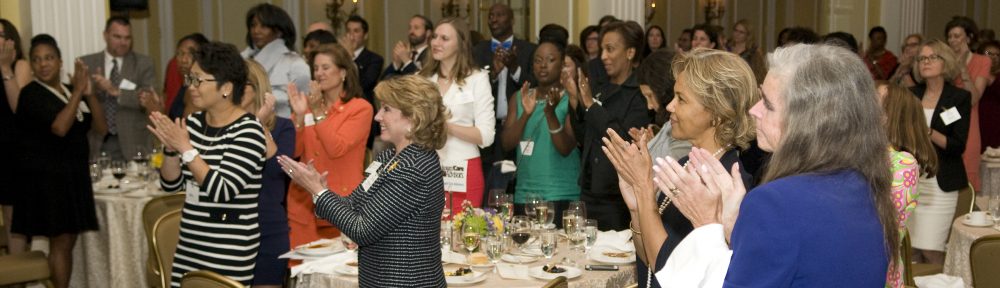
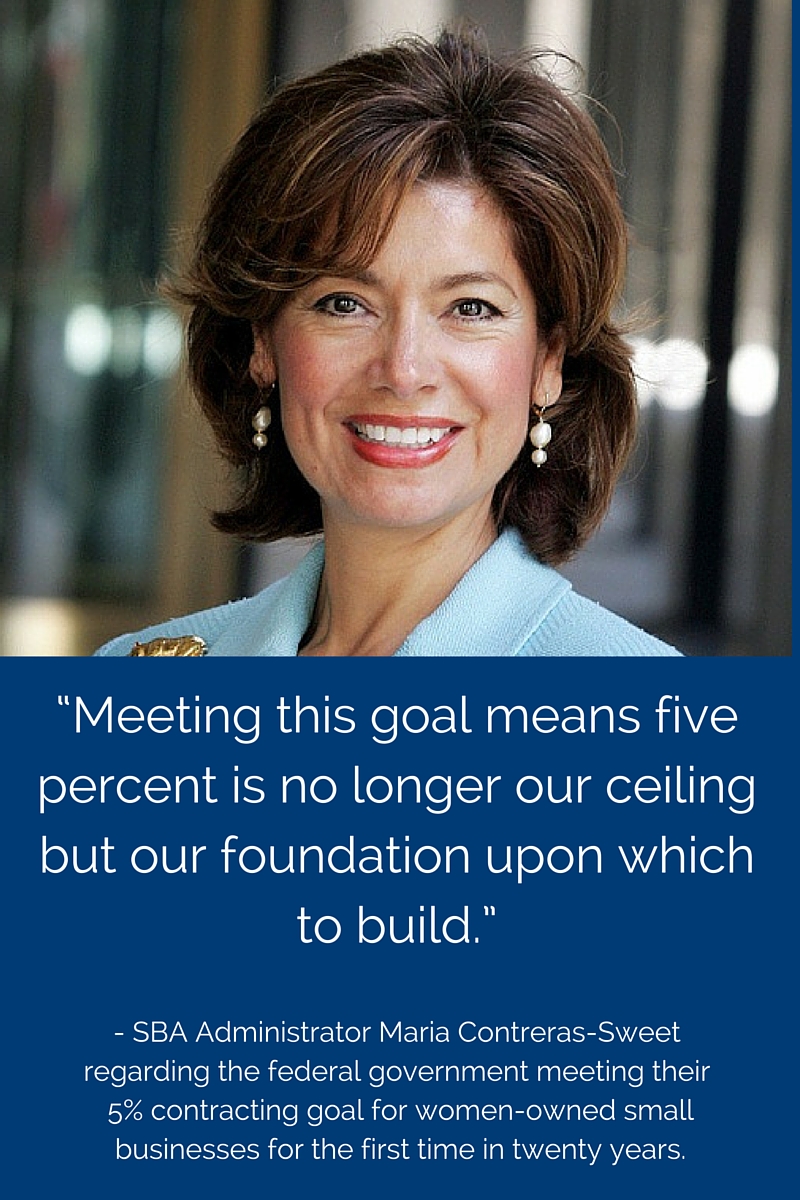
Women Impacting Public Policy (WIPP) is thrilled to celebrate the U.S. Government’s achievement of awarding five percent of its annual federal contracts to women-owned small businesses for the first time since the goal was set more than twenty years ago. The five percent goal was put in place as part of the Federal Acquisition Streamlining Act of 1994 and led to the creation of the Women-Owned Small Business (WOSB) Federal Contract program in the Equity in Contracting for Women Act of 2000.

WIPP, and our partner American Express OPEN are longtime champions of women entrepreneurs in the federal contracting space, creating the Give Me 5 program in 2008 to give women-owned small businesses access to knowledge and resources to help win federal contracts. At the time, just 3.4% of federal contracts were awarded to women-owned small businesses—roughly $13 billion of the approximately $400 billion awarded annually.

In April 2013, WIPP, American Express OPEN and the Small Business Administration (SBA) launched ChallengeHER, a national initiative to boost government contracting opportunities for women-owned small businesses. ChallengeHER delivers free workshops, mentoring and direct access to government buyers. Now entering its fourth year, ChallengeHER has educated more than 5,400 women entrepreneurs at 39 workshops across the country and facilitated more than 1,900 meetings between women small business owners and government officials.

The contracting landscape for women-owned businesses has improved significantly as a result of strong public and private support and bipartisan efforts. In early 2013, due to the efforts of WIPP and their coalition partners, President Obama signed into law the National Defense Authorization Act (NDAA) which removed caps on eligible federal contract awards under the U.S. Small Business Administration’s Women-Owned Small Business (WOSB) Federal Contract program. Before the law was put into place, awards to women-owned small business were capped at $4 million and $6.5 million under the program. WIPP had further success in improving the WOSB Federal Contract Program in 2014 with the passage of a new law that provided federal agencies with statutory authority to award sole-source contracts to women-owned small businesses. The WOSB program was the only major small business contracting program without this authority at the time – putting women entrepreneurs at a distinct disadvantage.

A hearty congratulations and thanks to the folks at SBA, American Express OPEN, the WIPP team, and all of the organizations and women business owners that have helped improve and increase access to the federal marketplace for women-owned small businesses.  Job well done!
WIPP Comments on WOSB Certification Changes

WIPP logo final copyWIPP submitted comments today to the SBA Office of Policy, Planning and Liaison on the SBA Advanced Notice of Proposed Rulemaking (ANPRM) regarding certification in the WOSB Program that was issued on December 18, 2015. The WOSB Program is extremely important in assisting women entrepreneurs entering the federal contracting marketplace. WIPP highlighted the following principles to guide the SBA in their implementation of the changes to the certification process.

Please see a brief outline of the principles below:

  • Third-Party Certification

                 -Keep the Integrity of the Program Intact – we are focused on making sure that    the changes to the certification process do not result in the disruption of the program.

  • State and Federal Agency Certification

                 -Expand Acceptable Certifications in a Uniform Manner – if certification is being accepted from multiple sources then we urge the SBA to have requirements set up so that there is as little duplicative paperwork as possible.

  • SBA WOSB Certification Program

                 -Without Adequate Resources, SBA Certification Will Fail WOSBs  

                 – Strengthen Compliance/Enforce Procedures

To see the submitted comments in their entirety, click here.

SBA Office of Advocacy Report Examines the Millennial Entrepreneur

SBAOOALast week the Small Business Administration published the first report in a series of trends in entrepreneurship by the Office of Advocacy’s Office of Economic Research, “The Missing Millennial Entrepreneurs” by Daniel Wilmoth, PhD. The report’s focus was on how Millennials reported less self-employment than prior generations. This 6-page report analyzes important trends amongst Millennial entrepreneurs, comparing them to Generation X and Baby Boomers – ultimately suggesting that entrepreneurship among Millennials will continue to be relatively low for decades.


Some other important key points highlighted in the report include:

  • In 2014, less than 2 percent of Millennials reported self- employment, compared with 7.6 percent for Generation X and 8.3 percent for Baby Boomers.
  • At age 30, less than 4 percent of Millennials reported self-employment in their primary job in the previous year, compared with 5.4 percent for Generation X and 6.7 percent for Baby Boomers.

To view the full report, click here.

FAR Council Embraces Sole Source

By: Jake Clabaugh, WIPP Government Relations

Women Impacting Public Policy (WIPP) recently submitted comments on the interim rule implementing sole source authority into the Federal Acquisition Regulation (FAR).  For more details please read WIPP’s full comment here.

FB Cover photo

WIPP’s 15-year effort to expand contracting opportunities for women entrepreneurs cleared an important hurdle with sole source authority finalized in the government’s contracting rulebook. The Federal Acquisition Regulation (FAR) is the government’s official source for rules when it comes to awarding contracts. Implementing sole source authority into the FAR means that women entrepreneurs wll now be competing on a level playing with other small business contracting programs.

WIPP’s comment on this rule acknowledged the FAR Council for recognizing the “urgent and compelling need” to grant contracting officers this authority. Their recognition is the culmination of years of hard work and advocacy to bring parity for women-owned contracting firms.

Although the Small Business Administration (SBA) published sole source rules last fall, some contracting officers had been waiting for official language to be put into the FAR before they would use sole source authority.  WIPP members have experienced this inconsistency firsthand and WIPP’s comment highlighted how important it is for the FAR to eliminate the conflict.

The FAR Council’s rule became effective on December 31, 2015 – a great way to start the New Year. Contracting officers now have official instructions to award sole source contracts through the WOSB Procurement Program. We encourage women business owners to comment on this important victory for our community. If you wish to echo WIPP’s comments, you can submit them electronically using Regulations.gov and search for “FAR Case 2015-032.” Please use the “Comment Now” option, which will provide instructions for uploading your document and ensure that your voice is heard.


Did You Really Mean That FCC?


This week, the House Energy and Commerce Committee held a hearing on a bill, HR 2666, which would prevent the FCC from regulating broadband rates. In fact, the FCC’s Chairman Tom Wheeler is quoted as saying “Let me be clear, the FCC will not impose ‘utility style’ regulation…” when
issuing the Commission’s decision to subject broadband service providers to regulations that govern telecommunications services – Title II of the Communications Act.


That begs the question, why pass a bill that reiterates what the Chairman promised? There are a couple of reasons why. First, FCC Commissioners do not have permanent appointments—they arinternet.jpge appointed by the President and serve five-year terms. While we doubt anyone questions Chairman Wheeler’s integrity, the next set of Commissioners may not hold the same view. Second, regulating rates in utility- style fashion does not really fit the fast moving technological changes that come with the industry providing internet services. Third, talk about a damper on investment – subjecting broadband networks to the government’s slow ratemaking process would surely have a negative effect.
 

As we understand this issue, no one is purporting to restrict the FCC’s ability to protect the consumer with respect to broadband access or technology companies who rely on an open internet to conduct business. Women-owned businesses have much to lose if the government does not properly balance internet access with regulation.


We are keenly aware that according to the SBA Office of Advocacy, “Small businesses, defined as firms employing fewer than 20 employees, bear the largest burden of federal regulations. As of 2008, small businesses face an annual regulatory cost of $10,585 per employee, which is 36 percent higher than the regulatory cost facing large firms (defined as firms with 500 or more employees).” Small businesses are usually the losers when it comes to more regulation.


The Congress ought to pass this bill. Broadband access is a critical lifeline to all businesses. Business certainty resonates throughout our economy—especially small companies. Putting the FCC intent into law with respect to broadband rate regulation is a good idea.

From the Hill: Small Contractors Make Big Gains in New Legislation

By: Jake Clabaugh WIPP Government Relations


ChabotThe House Small Business Committee is leading off 2016 by continuing its

efforts to make federal contracting more accessible to small businesses. Committee Chair Steve Chabot’s (R-OH) legislation, Defending America’s Small Contractors Act of 2016, makes an array of changes to procurement policy.

Although impossible to summarize all of the changes in a few paragraphs, which is why we have the link to the bill above, here are the highlights. The bill tackles transparency by rewriting – in plain English – the requirements for small business procurements. Since getting past performance is an obstacle for contractors getting started in federal contracting, the bill establishes a pilot program that enables them to get a past performance rating by submitting a request to the contracting officer and prime contractor. Offices of Small and Disadvantaged Business Utilization (OSDBUs) will now have increased authority to recommend which small business set-aside programs are most appropriate for each contract at their agency. The Act even touches the Department of Defense (DOD) by requiring that Mentor-Protégé plans in DOD’s program be approved by SBA – an update aimed at adding consistency to Mentor-Protégé Programs government-wide – but controversial since the last time we looked the Defense Department does not generally defer to SBA.

If some of these changes sound familiar, it’s because Anne Crossman, a member of WIPP’s Leadership Advisory Council, proposed several of these improvements during a Subcommittee hearing last fall.  Specifically, Anne noted WIPP’s “if you list us, use us” policy for prime contractors’ subcontracting plans and in her testimony she advocated for prime contractors to be accountable to the subcontractors listed on their plans. This bill incorporates Anne’s recommendations by requiring commercial market representatives (CMRs) assist prime contractors in identifying small business subcontractors and assess the prime’s compliance with their subcontracting plans.

The intent of the legislation is to assist federal agencies in meeting their small business contracting goals. The goal for women owned companies of 5% has never been met. A continued push for data transparency surfaces in the bill as well, requiring agencies to do a better job of reporting the contracting dollars awarded to small businesses.

The Committee is expected to hold a markup to consider this legislation during the week of January 11.  The WIPP Government Relations team will continue to provide updates as the bill moves through Congress.

Celebrating National Women’s Small Business Month

10mil

by AnnaKate Moeller, WIPP Programs Manager

This October we are particularly excited to celebrate National Women’s Small Business Month because of the release of the results of the 2012 Survey of Business Owners (SBO) and the SBA issuing the final rule on Sole Source Authority. It has been a big year for women in business to say the least.

The theme for this year’s National Small Business Month is “10 Million Strong” recognizing the 2012 SBO results of the nearly 10 million women-owned businesses currently in the United States. This is a 27.5% increase from 2007 survey results, showing that women-owned businesses are growing and in turn boosting the economy.

We also have cause to celebrate as the Small Business Administration issued the final rule improving access to federal contracting opportunities for women-owned small businesses with Sole Source Authority. This rule is expected to be effective and available for use by federal agencies on October 14, 2015.

As we celebrate 10 Million Strong this October, WIPP will be highlighting women business owners on our boards, throughout our member base and networks. Please check out our twitter, Facebook and blog throughout the month to hear the stories of these female leaders.

Success: Sole Source Finalized

women_in_business

by Ann Sullivan, WIPP Government Relations 

When you’ve been working on a program for 15 years, it’s almost anti-climatic when you realize you won and it’s over. I suppose lawyers feel this way when they win a big case, or business owners when they close a major contract.

For me, the SBA announcement integrating a sole source component into the WOSB procurement program on October 14, 2015 marks the end of a long campaign by Women Impacting Public Policy (WIPP). First, we fought for eleven years to establish a program that gives a government buying preference to women-owned companies whose industries have been underrepresented. Not an easy fight – we had plenty of Congressional and White House opponents—it wasn’t until the Obama Administration came into power that the program was established. At the time, SBA Administrator Karen Mills made it her number one priority, which we will always be thankful for. We had strong Congressional proponents – Senators Cantwell and Shaheen and Representatives Speier and Graves.

Then, we had to make the program work. That required two major changes to the program in 2013 and 2014. The first change required lifting the award caps the law imposed on the program. The WOSB procurement program limited contract awards through the program to $4 million ($6.5 million for manufacturing). In 2013, Congress helped us get rid of those caps. The last big piece was the sole source piece—allowing contracting officers to award sole source contracts to women-owned companies through the program. This major change gives the program parity with other small business programs and again, required Congressional action. Effective October 14, agencies will be able to use this mechanism to award contracts to women whose companies offer innovative products and services.

As with all government programs, the rules are a little complicated and the ability to self-certify as a woman owned business will eventually have to change, due to Congressional direction in 2014. But for now, self-certification remains the law and women should be actively pursuing contracts through the WOSB procurement program whether or not they are self-certified or certified by a third party.

It is important to note that not all industries (NAICS codes) qualify for the program. You can find a list at http://www.SBA.gov/WOSB. We have developed a one pager that go through the rules of the sole source portion of the program and our GiveMe5 program has comprehensive information on the WOSB program. In addition, our ChallengeHER events are all over the country so that women can find out more about the program. The information can all be found at www.wipp.org.

The WOSB procurement program is in good hands. All the major pieces to make it successful are in place. When we started this effort in 2002, women received 2.7% of government contracts. Since the program has been in place, more than $500 million has been set-aside for women- owned companies. In fact, in 2014 the government awarded 4.7% of its contracts to WOSBs –a 75% increase since 2002. Now women business owners need to know how to use it with the help of SBA, the federal contracting community and organizations, such as WIPP.

Fifteen years seems like a long time, but when you are fighting for something—somehow it doesn’t seem that long. WIPP members and coalition partners were with us every step of the way. For this, I am exceedingly grateful.

Introducing Peer-To-Peer Lending: Alternative Funding for Your Small Business

SBA Advocacy- P2P issue brief

The Office of Advocacy is an independent office within the Small Business Administration that is a great source for small business statistics, as well as a voice for small business owners that can express their views and issues to policy makers in DC. Today, the Office of Advocacy released an issue brief on “Peer-To-Peer Lending: A Financing Alternative for Small Businesses”.

To explain a little more, Peer-To-Peer Lending or P2P is a funding model where individual investors give small personal loans online to individuals. The Office of Advocacy describes P2P as a hybrid of crowdfunding and marketplace lending.

The issue brief released today details the funding model and gives a side-by-side view of P2P and traditional small business financing options. It also shows how it could affect small businesses in the future, giving them more opportunity for financial growth.

Read the brief to learn more.

SBA’s Announcement of the 2016 InnovateHER Challenge and Summit

FeatureInnovateHER

By Annie Wilson, Intern

On Tuesday, August 4th the Small Business Administration (SBA) announced the launch of the 2016 InnovateHER: Innovating for Women Business Challenge and Summit. In partnership with Microsoft, the 2016 InnovateHER includes the second round of the women’s business competition to feature new, innovative products and services that help to change and empower the lives of women and families. Last year, the SBA engaged over 100 organizations and reached 1000+ entrepreneurs around the country and this year they have expanded their challenge to include a women’s summit.

It is the SBA’s hope that through this summit they can unveil products or services that have a measurable impact on women and their families, fulfill a marketplace need and have potential for commercialization. The SBA recognizes that while women control 80% of the purchasing power in this country they only make up less than 5% of venture capitalists. The InnovateHER Challenge is an effort to bridge that economic standard for women and elevate commercial success for women entrepreneurs and products for women.

The InnovateHER event will kick off in the fall of 2015 in its initial round starting with competitions hosted by universities, accelerators, clusters, scale-up communities, resource partners and other organizations. The SBA is encouraging organizations all across the country to participate in this challenge to provide accessibility to an innovative space for women. A way in which organizations can help the InnovateHER challenge and women entrepreneurs within their community is to host a local business competition and submit the winner to the SBA no later than December 3rd, 2015 for the semi final rounds. The SBA will then select up to 10 semifinalists from their community nominations that will be sent to the final pitch competition. The 2016 InnovateHER and final pitch competition will be held March 16-17th, 2016 in Washington D.C. At the final competition, the remaining contestants will do one final marketing pitch and compete to be one of the top three winners to receive up to $70,000 in prize money.

Make sure to check out last year’s winners: LIA Diagnostics, the Shower Shirt, and Trusst.

If you’d like to learn more about the challenge rules or how to become a host organization, please click here.

If you’d like to learn more about the challenge itself, please click here.