
So Close and Yet So FAR

Despite its official passage into law and SBA’s implementation, some contracting officers in federal agencies are waiting for the addition of official language to the Federal Acquisition Regulation (FAR) to use the new sole source authority in the women’s procurement program. We have seen first hand that regardless of SBA’s assurances that the law is ready to use, some agencies are reticent to use the new authority until the FAR has officially adopted the change in law. The Federal Acquisition Regulatory Council has already drafted the rule, which is currently in a review phase. And so we wait.


sole sourceOn October 14th, after many years of advocacy spearheaded by WIPP, sole-source authority for Women Owned Small Businesses (WOSB) officially went into effect.  The Small Business Administration (SBA) fast-tracked its official rule authorizing WOSB sole-source, allowing Contracting Officers to cite the rule and award sole source contracts. SBA encouraged agencies to use the new law upon release—before the October 14 date.  


How can women business owners speed the process and become an early pioneer in sole source contracts? Sharing key information with federal agencies is important. Small business offices as well as the contracting community need education on the program.  Since this is the newest small business contracting program on the books, many acquisition officials are still getting used to it.  The sole source piece, although mirroring the HUBZone program, is brand new and worthy of explanation.


Resources from WIPP such as the criteria for a WOSB sole source article, SBA’s final rule on sole source, and any future rulings by federal agencies reinforcing sole source awards for WOSBs, can help Contracting Officers support a sole source justification. ChallengeHER events now being held around the country are an excellent venue for learning about the WOSB program and recent changes.  


And, it is important to dispel the myth that sole source justifications can only be used if your company is the only company in the universe that has a particular product or performs a specific service. Take a look at other sole source justifications found at FBO.gov. You will find that reasons such as close proximity to the buyer, employing the most highly skilled staff, and the ability to customize a product have all served as justifications for sole-source awards in other programs.
We are so close but every day that the FAR Council fails to act, some woman owned company stands to lose what could have been a contract award.  WIPP, through its advocacy, will continue to do what it takes to get this final piece in place.  

WIPP Testifies to Congress on Challenges Facing Small Contractors

Anne Crossman

The House Small Business Committee hearing last week focused on one of WIPP’s key priorities: ongoing issues affecting small companies trying to do work with the federal government. Anne Crossman, a member of WIPP’s Leadership Advisory Council, used her expertise in subcontracting to testify before the Committee regarding the challenges faced by small subcontractors.


In particular, many WIPP members have questioned to what extent subcontracting plans are enforced. WIPP has long advocated for a policy of “if you list us, use us” and it is still unclear if prime contractors are being held to these plans.


Subcontracting is a staple of many small contractors and facilitates the flow of federal contract dollars into small businesses, which provide jobs and boosts local economies. Agencies have subcontracting goals to ensure that small firms get a fair shot at contracting dollars.


The Committee delved into these and many other challenges facing small subcontractors. The hearing can be found in full here.

Revising the Veterans Certification – Top to Bottom

WomenVeteransAccording to the Small Business Administration (SBA) veterans own nearly 10% of all small businesses and those veteran-owned businesses generate more than $1 trillion dollars in revenue each year. In order to qualify for federal contracting preferences at the Veterans Administration (VA), these businesses have to certify as a veteran owned business. The Veterans Administration calls this program “Veterans First.” Government-wide contracting programs give preferences to service disabled veteran owned businesses (SDVOBs) which are required to go through the certification process at the VA.

The Veterans Administration is asking for comments on a new set of changes for the Veteran Owned Small Business program (VOSB). Among many other changes, the proposal would alter the definition of a veteran, a caregiver, the verification requirements for a VOSB, and requirements for joint ventures.

First, the definition of “veteran” in the program is now consistent with a recent update to the VA’s overall definition of veteran. This means owners who served in the National Guard or in the Reserves are still only eligible to be an owner of VOSB or SDVOSB if they received a service-connected disability. The single definition of “veteran” is intended to create consistency when applying to all programs within the VA.

Veteran owners would be required to oversee “daily business operations,” replacing the terms “daily business management” and “day to day operations” in an effort to simplify the application process. In addition, references to spouses and personal caretakers are removed, replaced by “permanent caretaker” to more clearly define a single role aiding the service-disabled owner. A letter outlining the service-disabled veteran’s disability and the need for the permanent caregiver must be included in order to qualify. The VOSB application process, which was required annually, would be expanded to last for two years if the proposed rule was adopted.

Last, language on VSOB joint ventures has been clarified, requiring at least one joint partner be a verified VOSB. Additionally, the same project and time restrictions that apply to other set-aside programs have been added. All these changes, and more, can be viewed and commented on here.

If you have an opinion on the VA certification, now is the time to submit them. Your comments will make a difference – agencies receive every submission and carefully review them.

New Requirements for Credit Card Processing Requirements – How will they affect your business?

cc chip

Merchants of all sizes were required to upgrade their credit card processing technology to avoid liability for fraudulent charges by October 1st. The House Committee on Small Business held a two-part hearing series on implementation of new credit card technology designed to increase security and prevent fraud. This industry-led changeover will require all businesses to use the Europay – MasterCard – Visa (EMV) chip system to process credit card transactions. To affect this change, financial services providers will no longer be liable for instances of fraud if the merchant has not upgraded to the EMV chip system

The hearings offered interesting, and often contrasting, perspectives on this issue. At the first hearing, representatives from the financial industry praised the upgrades and highlighted the protections that the EMV chip system offers. The second hearing, featuring small business owners that need to implement these changes, revealed a much more complex situation. While witnesses at both hearings and the Committee members generally agreed that the EMV system offers more sophisticated fraud protections, implementing these modifications is a significant burden for small businesses.

Despite the outreach efforts of financial firms, small business owners are generally not aware of these changes. According to a recent study about preparedness for this changeover, less than half of small businesses were aware of the October 1st changeover deadline and liability shift.

Small businesses will have to purchase equipment to process sales using the new chips, but the required upgrades do not stop there. Integrating the new technology with point-of-sale terminals, inventory management tools, and other systems could exponentially inflate costs. Given integration, software upgrades, training, and ongoing maintenance, a quick and easy changeover is unlikely.

Please see the links below for several resources for small businesses to prepare them for the change:

http://www.businessnewsdaily.com/8264-credit-card-processing-changes.html

http://www.creditcards.com/credit-card-news/emv-faq-chip-cards-answers-1264.php

http://blogs.wsj.com/corporate-intelligence/2014/02/06/october-2015-the-end-of-the-swipe-and-sign-credit-card/

From the Hill: Contractors Face Additional Reporting Burdens

By: Jake Clabaugh, WIPP Government Relations

hillFederal contractors will now face a bevy of additional reporting requirements when seeking procurement opportunities. The House Small Business Committee held a hearing Tuesday to exam the Fair Pay and Safe Workplaces regulations. These new rules are expected to be finalized late this year or early next year and require federal contractors to document and report labor law and safety violations for their firm and all subcontractors when bidding for contracts above $500,000.

WIPP supports efforts to rid the contracting environment of businesses with a history of abusive and neglectful violations, but these new rules will be particularly burdensome for small contractors. The House Committee hearing focused on the increased administrative burden that small contractors will face and how opportunities for small and women-owned businesses to enter the federal contracting arena will be affected.

WIPP addressed many of these issues in its official comment, submitted earlier this summer. The hearing highlighted the likelihood that contractors may be “blacklisted” from contracting opportunities, a concern that WIPP expressed. The regulations require all violations to be reported, even infractions that have yet to be adjudicated. The contractor is not afforded the opportunity for explanation until the contract is likely to be awarded. The danger is that a contracting officer will simply pass over or “blacklist” a potential contractor rather than dig deeper into nature and validity of the reported infraction. This could leave many upstanding small and women-owned firms with unproven or minor violations unable to secure contracting opportunities.

The hearing also stressed the duplicative nature of these regulations. Several witnesses noted how suspension and debarment procedures already exist. In its comments, WIPP recommended incorporating safe workplaces into the well-established system of suspension and debarment as an alternative to creating this enormous reporting burden.

These reporting requirements will impose significant costs for small and women-owned firms. Not only will it require the business to submit excessive documentation, it will also require significant resources to research, gather, and report the necessary information for the small business and all of its potential subcontractors.

Far from leveling the playing field for the millions of businesses playing already by the rules, these regulations will add to the tremendous burden facing small and women-owned businesses.

From The Hill: Dodd-Frank’s Impact on Small Business Lending

By Jake Clabaugh, WIPP Government Relations

wmn$

Women entrepreneurs face unintended consequences of wall-street reform. According to a House Committee hearing yesterday, the Dodd-Frank Wall Street Reform and Consumer Protection Act, introduced in an effort to prevent another financial crisis, is contributing to small businesses’ inability to access capital from banks.

WIPP’s Access to Capital Platform has cited some of Dodd-Frank’s regulations as a contributing factor to the decrease in small businesses lending. Capital access is a lifeline for small businesses. It is essential for entrepreneurs to have access to sufficient capital to found and grow businesses.

DF picThe House Committee on Small Business convened lenders and experts to discuss how Dodd-Frank has affected the ability to provide entrepreneurs with critical capital. Access to private capital, including bank loans is a primary concern to women entrepreneurs as women-owned small businesses receive only 4% of private sector lending dollars. Additional regulatory burdens could be exacerbating this problem.
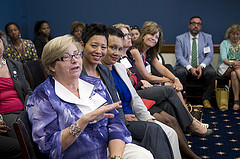
The hearing touched on many of the difficulties WIPP members have experienced when trying to access to capital. The Committee cited increased administrative burdens as a significant cost for small and community banks, a primary lender to small businesses. These regulations have increased the cost of making loans and therefore made it more difficult for banks and borrowers. The result is less capital for entrepreneurs.

The hearing also cited the direct impacts on borrowers. Many that would have qualified pre-recession are no longer able to obtain loans from banks due to tighter lending standards. WIPP’s platform advocates for modernized credit scoring that would level the playing field for women business owners.

Until Dodd-Frank is fully implemented, its complete impact will remain unclear. WIPP continues to review ongoing regulations as well as work with Congress to scale back unnecessary barriers to capital access for women entrepreneurs.

Success: Sole Source Finalized

women_in_business

by Ann Sullivan, WIPP Government Relations 

When you’ve been working on a program for 15 years, it’s almost anti-climatic when you realize you won and it’s over. I suppose lawyers feel this way when they win a big case, or business owners when they close a major contract.

For me, the SBA announcement integrating a sole source component into the WOSB procurement program on October 14, 2015 marks the end of a long campaign by Women Impacting Public Policy (WIPP). First, we fought for eleven years to establish a program that gives a government buying preference to women-owned companies whose industries have been underrepresented. Not an easy fight – we had plenty of Congressional and White House opponents—it wasn’t until the Obama Administration came into power that the program was established. At the time, SBA Administrator Karen Mills made it her number one priority, which we will always be thankful for. We had strong Congressional proponents – Senators Cantwell and Shaheen and Representatives Speier and Graves.

Then, we had to make the program work. That required two major changes to the program in 2013 and 2014. The first change required lifting the award caps the law imposed on the program. The WOSB procurement program limited contract awards through the program to $4 million ($6.5 million for manufacturing). In 2013, Congress helped us get rid of those caps. The last big piece was the sole source piece—allowing contracting officers to award sole source contracts to women-owned companies through the program. This major change gives the program parity with other small business programs and again, required Congressional action. Effective October 14, agencies will be able to use this mechanism to award contracts to women whose companies offer innovative products and services.

As with all government programs, the rules are a little complicated and the ability to self-certify as a woman owned business will eventually have to change, due to Congressional direction in 2014. But for now, self-certification remains the law and women should be actively pursuing contracts through the WOSB procurement program whether or not they are self-certified or certified by a third party.

It is important to note that not all industries (NAICS codes) qualify for the program. You can find a list at http://www.SBA.gov/WOSB. We have developed a one pager that go through the rules of the sole source portion of the program and our GiveMe5 program has comprehensive information on the WOSB program. In addition, our ChallengeHER events are all over the country so that women can find out more about the program. The information can all be found at www.wipp.org.

The WOSB procurement program is in good hands. All the major pieces to make it successful are in place. When we started this effort in 2002, women received 2.7% of government contracts. Since the program has been in place, more than $500 million has been set-aside for women- owned companies. In fact, in 2014 the government awarded 4.7% of its contracts to WOSBs –a 75% increase since 2002. Now women business owners need to know how to use it with the help of SBA, the federal contracting community and organizations, such as WIPP.

Fifteen years seems like a long time, but when you are fighting for something—somehow it doesn’t seem that long. WIPP members and coalition partners were with us every step of the way. For this, I am exceedingly grateful.

Remarkable Advances For Women Business Owners

By Jake Clabaugh, WIPP Government Relations

Annual Mtg 2014 - #2The U.S. Census Bureau Survey of Business Owners (SBO) showed impressive expansion for women-owned businesses. The survey’s latest data, released in August, showed nearly 10 million women-owned firms in the United States. This represents a 27% improvement from the survey’s last results in 2007. In the long term, the number of women-owned companies has increased over 50% since the survey showed 6.5 million firms in 2002.

This growth in women-owned firms is an encouraging economic indicator. Just as important, this progress occurred during the largest recession since the Great Depression. It stands as a testament to the resilience and entrepreneurial spirit of our country’s female business owners.

The SBO is an important tool for assessing the state and growth of businesses, particularly women-owned. The Census Bureau describes this survey as providing “the only source of detailed and comprehensive data on the status, nature, and scope of women-, minority-, and veteran-owned businesses.” While only the preliminary findings have been released, it provides an important preview of the more comprehensive data that will be made available later this year. The complete dataset will include more specified demographic breakdowns of firm ownership characteristics, including women-, minority- and veteran-owned businesses as well as revenues, size, industry-classification data, and geographic information.

It is imperative to use the most complete, comprehensive, and timely data to structure reasoned, directed policy initiatives and make informed decisions, thus, we are looking forward to having the complete survey data later this year. It will be an invaluable tool for guiding our policy direction moving forward, educating government entities and providing useful comparisons for individual firms. We whole-heartedly expect the full dataset to reveal many more successes.

“Fair Pay” Rules Just Aren’t Fair

women comp

By John Stanford, WIPP Government Relations

Women Impacting Public Policy (WIPP) recently submitted comments on proposed regulations that would require federal contractors to disclose labor violations from the past three years. This blog accompanies those comments as a summary of WIPP’s position. For more details or if this impacts your business, I encourage you to read the full comment here.

Last summer, President Obama issued an Executive Order with the goal of barring bad companies from winning federal contracts. WIPP, along with most in the contracting community, agrees that companies that follow the rules should not have to compete against companies that break them for federal contracts.

In May, the Labor Department and the FAR Council (overseers of contracting rulebook, “the FAR”) proposed how the President’s order would be implemented. It turns out, as with most things, the devil is in the details.

The proposed regulations require federal contractors and subcontractors to disclose violations of 14 federal labor laws and equivalent state laws from the previous three years. Exemptions were provided for companies with contracts valued less than $500,000. As proposed, prospective federal contractors would need to declare if they had labor violations in the previous three years when submitting an offer. During an initial evaluation, contracting officers would see that declaration (a simple “yes” or “no”), without any additional detail or explanation.

Later, if a contractor were likely to win an award, the contracting officer would have to decide if the contractor is a responsible company (a requirement of all government contracts already). It is in this phase that details like appeals, remediation, or mitigating factors could be explained. Contracting officers will attempt to identify companies with “serious”, “willful”, “repeated”, and/or “pervasive” violations and not award them contracts. Companies with minor violations could still be considered responsible and win contracts.

WIPP responded to the regulation during the public comment period expressing concerns with the new system and how it could negatively impact women-owned businesses, including those who had no history of unsafe or unfair work practices.

Notably, the proposals were incomplete as the Labor Department and FAR Council chose not to include what state labor law violations must be reported. It is impossible to gauge the impact of a regulation – the reason for comments– when missing significant portions.

What was in the proposals, however, was equally concerning. WIPP’s comment discusses how, in some cases, violations that require reporting will not be be fully adjudicated. That is, companies would have to report decisions against them that may ultimately be overturned – as nearly a third of NLRB decisions have been.

This is compounded by WIPP’s worry that simply having violations on record will “blacklist” companies without providing any opportunity to offer explanation. With limited resources and time, contracting officers may elect to avoid companies with any disclosed violations, despite the intent of the order to only bar violations of a certain severity.

The comment also considers burdens on subcontractors who similarly must report violation history, and the lack of resources the government may face to answer questions about weighing different labor violations. Moreover, the onus to collect and judge subcontractor violations falls to primes, a strategy the Labor Department itself questions.

WIPP’s final concern is that this rule is one of many in a disconcerting trend of new regulations that specifically target federal contractors. Earlier this year, regulations raised the minimum wage solely for workers on federal contracts. New requirements regarding sick leave are expected to come later this year. These make contracting with the federal government more onerous, particularly for women entrepreneurs seeking to enter the market.

Without question, WIPP supports efforts by the federal government to rid the contracting environment of businesses with a history of abusive and neglectful violations. In doing so, the government levels the playing field for the millions of businesses playing by the rules. But the proposals commented on will not achieve this goal. Instead, they will make it harder to be a contractor – pushing the innovative products and services of women-owned businesses out of the federal market.

A Scorecard That Matters

WG Blog

By Sydney Ringer, WIPP Government Relations Intern

Earlier this year, Dell released their 2015 Global Women Entrepreneur Leaders Scorecard, a new data-driven diagnostic tool that identifies the impediments to high-impact entrepreneurship. It also introduces steps that can be taken to improve the conditions for high-impact female entrepreneurship development. Countries were rated on five categories: business environment, gendered access, leadership and rights, pipeline for entrepreneurship, and potential entrepreneur leaders. The United States, France, the United Kingdom, Sweden, Australia, and Canada are at the top of the list.

While the United States was at the top of the rankings system, our rating was still only 71/100 across the categories. Only 13% of start-ups have women on their executive team, and just 3% of start-ups with women CEOs received venture capital funding in 2014.[1] According to Dr. Ruta Aidis, the project director, “if women entrepreneurs were starting growth-oriented businesses at the same rate as men in the United States, we could potentially have 15 million more jobs in the next two years”.[2] The Scored is another reminder of just how challenging it can be for women to succeed even today, and even in countries like the United Sates.

First, female role models in business and government are critically important. In the U.S. only 22% of the female population knows an entrepreneur despite 46% of women believing they have the skills necessary to start a business. Women entrepreneurs can leverage their success to provide real business insights on how to encourage women to start their own businesses. Once Women decide to start their own business they have modest aspirations because access to capital is still a huge barrier. Women-owned companies are 50% less capitalized than their male-owned counterparts.

While this report demonstrates all the growth the United States and other countries still need to do, it also presents some interesting ways to encourage women entrepreneurs. On the international level, the International Trade Centre launched a global initiative to increase the proportion of public procurement contracts being awarded to women owned businesses. The study also suggests corporations diversify their leadership and increase the number of women-owned business vendors in their supply chain.

The media can also play an important role as well. Right now global media only features women as subjects in print, radio and television 25% of the time. Seeing more articles featuring women as the top story on their homepage could inspire women to follow in their footsteps.

Every country in the study, even the top rated, has room for improvement. More than 70% of the countries still rated scored less than 50 out of 100. Despite challenges, women-owned businesses are growing, but they would be growing at an exponentially faster rate if they got some encouragement from their governments, corporations, media, and other entrepreneurs.


[1] CNN Money, “The Best Country For Women Entrepreneurs.” 2015. Available online at http://money.cnn.com/2015/06/30/smallbusiness/women-entrepreneurs-dell/index.html?category=smallbusiness

[2] “Global Women Entrepreneur Scorecard Executive Summary”. 2015. Available online at http://i.dell.com/sites/doccontent/corporate/secure/en/Documents/2015-GWEL-Scorecard-Executive-Summary.pdf