Babson and Other Business Schools Commit to White House to Create ‘Best Practices’ to Give New Opportunities for Women in Business

Graduation cap with coins.

Babson, along with 45 other business schools have committed to a set of best practices, shared with the White House, offering strategies for business schools to help women succeed during and after school. These business practices are designed to prepare female students for the challenges of the changing American workforce.

These best practices have four major area’s of focus:

  • Ensuring access to business schools and business careers;
  • Building a business school experience that prepares students for the workforce of tomorrow;
  • Ensuring career services that go beyond the needs of traditional students;
  • Exemplifying how organizations should be run.

To read more about the set of best practices, click here.

A Scorecard That Matters

WG Blog

By Sydney Ringer, WIPP Government Relations Intern

Earlier this year, Dell released their 2015 Global Women Entrepreneur Leaders Scorecard, a new data-driven diagnostic tool that identifies the impediments to high-impact entrepreneurship. It also introduces steps that can be taken to improve the conditions for high-impact female entrepreneurship development. Countries were rated on five categories: business environment, gendered access, leadership and rights, pipeline for entrepreneurship, and potential entrepreneur leaders. The United States, France, the United Kingdom, Sweden, Australia, and Canada are at the top of the list.

While the United States was at the top of the rankings system, our rating was still only 71/100 across the categories. Only 13% of start-ups have women on their executive team, and just 3% of start-ups with women CEOs received venture capital funding in 2014.[1] According to Dr. Ruta Aidis, the project director, “if women entrepreneurs were starting growth-oriented businesses at the same rate as men in the United States, we could potentially have 15 million more jobs in the next two years”.[2] The Scored is another reminder of just how challenging it can be for women to succeed even today, and even in countries like the United Sates.

First, female role models in business and government are critically important. In the U.S. only 22% of the female population knows an entrepreneur despite 46% of women believing they have the skills necessary to start a business. Women entrepreneurs can leverage their success to provide real business insights on how to encourage women to start their own businesses. Once Women decide to start their own business they have modest aspirations because access to capital is still a huge barrier. Women-owned companies are 50% less capitalized than their male-owned counterparts.

While this report demonstrates all the growth the United States and other countries still need to do, it also presents some interesting ways to encourage women entrepreneurs. On the international level, the International Trade Centre launched a global initiative to increase the proportion of public procurement contracts being awarded to women owned businesses. The study also suggests corporations diversify their leadership and increase the number of women-owned business vendors in their supply chain.

The media can also play an important role as well. Right now global media only features women as subjects in print, radio and television 25% of the time. Seeing more articles featuring women as the top story on their homepage could inspire women to follow in their footsteps.

Every country in the study, even the top rated, has room for improvement. More than 70% of the countries still rated scored less than 50 out of 100. Despite challenges, women-owned businesses are growing, but they would be growing at an exponentially faster rate if they got some encouragement from their governments, corporations, media, and other entrepreneurs.


[1] CNN Money, “The Best Country For Women Entrepreneurs.” 2015. Available online at http://money.cnn.com/2015/06/30/smallbusiness/women-entrepreneurs-dell/index.html?category=smallbusiness

[2] “Global Women Entrepreneur Scorecard Executive Summary”. 2015. Available online at http://i.dell.com/sites/doccontent/corporate/secure/en/Documents/2015-GWEL-Scorecard-Executive-Summary.pdf

SBA’s Announcement of the 2016 InnovateHER Challenge and Summit

FeatureInnovateHER

By Annie Wilson, Intern

On Tuesday, August 4th the Small Business Administration (SBA) announced the launch of the 2016 InnovateHER: Innovating for Women Business Challenge and Summit. In partnership with Microsoft, the 2016 InnovateHER includes the second round of the women’s business competition to feature new, innovative products and services that help to change and empower the lives of women and families. Last year, the SBA engaged over 100 organizations and reached 1000+ entrepreneurs around the country and this year they have expanded their challenge to include a women’s summit.

It is the SBA’s hope that through this summit they can unveil products or services that have a measurable impact on women and their families, fulfill a marketplace need and have potential for commercialization. The SBA recognizes that while women control 80% of the purchasing power in this country they only make up less than 5% of venture capitalists. The InnovateHER Challenge is an effort to bridge that economic standard for women and elevate commercial success for women entrepreneurs and products for women.

The InnovateHER event will kick off in the fall of 2015 in its initial round starting with competitions hosted by universities, accelerators, clusters, scale-up communities, resource partners and other organizations. The SBA is encouraging organizations all across the country to participate in this challenge to provide accessibility to an innovative space for women. A way in which organizations can help the InnovateHER challenge and women entrepreneurs within their community is to host a local business competition and submit the winner to the SBA no later than December 3rd, 2015 for the semi final rounds. The SBA will then select up to 10 semifinalists from their community nominations that will be sent to the final pitch competition. The 2016 InnovateHER and final pitch competition will be held March 16-17th, 2016 in Washington D.C. At the final competition, the remaining contestants will do one final marketing pitch and compete to be one of the top three winners to receive up to $70,000 in prize money.

Make sure to check out last year’s winners: LIA Diagnostics, the Shower Shirt, and Trusst.

If you’d like to learn more about the challenge rules or how to become a host organization, please click here.

If you’d like to learn more about the challenge itself, please click here.

What We Can Learn from High Growth Women Owned Firms

By Annie Wilson, Intern

Last year Susan Coleman D.P.S. and Alicia Robb Ph. D published research prepared for the National Women’s Business Council examining the factors affecting access to capital for high-growth women-owned businesses. In their research, Coleman and Robb found that currently in the business community 30% of businesses were owned by women, however they are mostly small:

  • only 12% of women-owned small businesses (WOSBs) employ anyone other than the business owner;
  • 2% have 10 or more employees; and
  • only 2% have revenues in excess of $1 million.

NWBC Blog Image

This new data shows the need to engage and educate women owned businesses on growth strategies that can expand their businesses.

This report delves deeper into the issues relating to capital accessibility specifically for growth oriented firms, which comparative studies have yet to research thoroughly due to a lack of data.

According to the study, access to capital may be more challenging for women-owned firms than for men for a multitude of reasons:

  • In terms of financial capital, there are considerable gender gaps in the amounts of financing across firms. Men start firms with nearly double the amount of capital that women do and, of high growth firms, men use more than double of what women use. Men also indicated to have used six times the amount of financing that women do.
  • For startup capital, women were found to be more reliant on owner equity and insider financing as opposed to men who used outsider equity predominantly. For women owned firms, a very small fraction of startup capital came from outsider equity regardless of where the firm was on the size spectrum.
  • In terms of credit market experiences, women indicated to have similar loan application rates as men even though there are more unmet credit needs among women. Women were more likely to not apply for the necessary credit due to a fear of a denied loan application. Also, credit scores are generally lower for women.
  • While men and women are on par in terms of education levels, men exceed women in degrees in the STEM fields, which is the industry that experiences more growth.
  • By means of industry experience, as women tend to have lower levels of startup experience, team ownership and hours worked compared to men.
  • Women have higher rates of owning businesses that are home-based due to family commitments and research has indicated that being home based is negatively related to growth.

However, when comparing the top ranking female businesses by employment and growth potential, there are some considerable differentiations that set them aside.

  • They had a higher rate of employment from their startup year onwards.
  • They are more likely to be in tech industries.
  • They were more likely to offer services as opposed to products.
  • They were less likely to be based from the owner’s home.
  • They were more likely to be incorporated and as a result yield higher credit scores.

For leadership traits, women business owners of high growth firms also had some unique characteristics:

  • They were likely to have more years of industry experience and more likely to have more startup experience.
  • They started their businesses with much more capital (even more than the male owned firms overall.)
  • They used more outsider equity for startup capital. However, this was typically still less than their male counterparts.

Learning from these success measures, it is clear that increased capital for women entrepreneurs, specifically in the startup phase of their business, has an important correlation to the trajectory of women owned businesses. In order to foster a more successful environment for women, there must be changes in the business environment to give women the support and resources they need to turn this trend around.

It is clear that the financing gap between men and women business owners is a considerable detriment to the vitality of women-owned firms. In order to ensure stronger female entrepreneurship and make strides towards closing this gap, efforts must be made to strengthen the financial capabilities of women entrepreneurs and encourage accessibility to bank and equity financing. Also, providing more visibility and accessibility to successful female industry professionals and providing more opportunity for women to attain industry experience could help bolster the entrepreneurial confidence that women need to compete with their male competitors. Another important step forward would be an increased use of family-friendly policies, which could give women the flexibility to work outside of their homes and in an environment more conducive to entrepreneurial growth.

Take a look at WIPP’s recently launched Access to Capital platform to address funding gaps and the crisis of capital faced by women entrepreneurs.

To read the full report, click here.

How to Boost Women’s Entrepreneurship

While numbers of women entering labor force are steadily increasing, their participation in entrepreneurship is less favorable. In fact, according to the Kauffman Foundation, an entrepreneurship think tank, women are only half as likely as men to start a business resulting in unrealized potential for their contributions to job creation, innovation, and ultimately economic growth.

UntitledKauffman Foundation released a new study claiming that women would make great entrepreneurs but they often fail to start their own business mostly due to following reasons:

  • Shortage of available mentors;
  • Perception of entrepreneurship as a masculine activity;
  • Additional hurdles maintaining a work-life balance due to parenthood.

However, we can address these barriers as Kauffman highlights 5 ways for policymakers on how to encourage women to start their own business.

  1. Provide more exact, gender based, data on entrepreneurship programs and initiatives to understand how they can better help women entrepreneurs. Collecting data based on gender will help them to make more accurate decisions in assisting women entrepreneurs.
  1. Increase the number of women leading entrepreneurship programs. Women can better lead and support other women entrepreneurs by using their networks for accessing mentors, financial capital, and creating women inclusive events that attract women entrepreneurs.
  1. Increase Small Business Innovation Research (SBIR) awards to women-owned businesses. Although federal agenciesparticipating in the SBIR Seed Fund are encouraging women to engage in federal research/Research and Development, only 15 percent of SBIR awards went to women-owned businesses in 2012. One of the ways to increase this number is to partner with women’s professional organizations and make better effort of reaching out to women entrepreneurs to participate in these programs.
  1. Share stories of successful women entrepreneurs. Celebrating accomplishments of women entrepreneurs will change the false perception that only men are successful entrepreneurs and encourage more women to follow successful women in business.
  1. Decrease the risk of becoming an entrepreneur. Pressure and risks that women as entrepreneurs are facing, especially with young families, can discourage them of starting in the first place. By exploring various policies such as subsidized childcare or preschool, can help alleviate the pressure and create a more favorable environment for women to start their own businesses.

Read the full study here.

The Database of Dames

Choose Possibility

By Annie Wilson, Intern

Last Wednesday, July 15th, CEO and co-founder of online shopping startup Joyus, Sukhinder Singh Cassidy launched a new initiative at Fortune’s Brainstorm conference in Aspen and her goal is simple: to close the gender gap in the tech industry.

Singh Cassidy launched the Choose Possibility Project, which includes the ‘Boardlist,’ a database comprised of vetted, qualified female industry professionals who have been nominated by startup founders, investors and executives. The aim: to make the gender ratio amongst board members for up and coming tech startups more equitable and to increase opportunity for women in tech. Thus far, ‘Boardlist’ has partnered with 50 members of the tech industry, including 18 venture capitalists, to help the project succeed.

Singh Cassidy hopes that the accessible nature of the ‘Boardlist’ will undercut the excuse that many tech leaders use when trying to diversify their board: that there are a limited number of qualified female candidates that they have exposure to. The database itself is already comprised of over 700 women and the hope is that with the increased accessibility to these candidates there will be a positive change in leadership for the tech industry.

Although the industry still has a lot to accomplish for gender equity for their employee demographics, Singh Cassidy believes that focusing on the boardroom could make a substantial impact. “There is in fact a discovery problem,” she said, adding that “this is access to talent, not about filling some quotas,” as diversity efforts are often mistaken.

Click here to read more.

Interested in joining the project and becoming a part of the ‘Boardlist’? Click here.

WIPP Signs Strategic Partnership with International Trade Administration on Exporting Initiatives

img_0179Earlier today, WIPP joined Assistant Secretary Jadotte at the U.S. Department of Commerce to announce a new partnership to increase awareness about exporting in the U.S. business community. Women Impacting Public Policy’s (WIPP) new strategic partnership with Commerce’s International Trade Administration (ITA) will focus on providing education and resources to help small- and medium-sized women-owned businesses succeed in the global marketplace.

Signed this morning, the Memorandum of Agreement explains that, ITA and WIPP will work together on marketing, education programs, and events leveraging our organizations’ expertise to help make U.S. businesses more export savvy. WIPP recently developed Export NOW, a step-by-step program which guides participants — current and new exporters — through the steps to enter new growing markets or to expand their export reach. We’ll also partner with ITA on our Export Now program. Joint activities may include building awareness through outreach at trade shows, collaborative press and digital communications, and online registration for resource support.

As the U.S. marketplace becomes more competitive than ever, it is crucial for businesses — particularly small- and medium-sized businesses — to engage a broader international market for success. WIPP firmly believes that the products and services provided by women-owned businesses belong not just in American hands, but should reach every consumer around the globe. As a leader in educating businesses on ways to build, develop, and expand their companies, WIPP is perfectly positioned to work in concert with ITA to aid women-owned firms in growing their footprint in the global marketplace via export opportunities.

In 2014, U.S. Secretary of Commerce Penny Pritzker announced the National Export Initiative/NEXT (NEI/NEXT), an expanded and revitalized U.S. export strategy. NEI/NEXT focuses on supporting U.S. businesses of all sizes and economic growth in American communities by making it easier for U.S. companies to access export resources and capitalize on growth opportunities around the world. Our partnership with ITA supports this initiative by educating U.S. women-owned businesses about the benefits of exporting and expanding their exports to additional markets. Companies will learn about public and private sector resources to assist them in going global. WIPP joins several of ITA’s Strategic Partners who have connected more than 1,500 companies to federal export assistance to broaden and deepen the U.S. exporter base.

Take Advantage of the Federal Contracts with WIPP

In 2000, the federal government set a goal to award 5% of all contracts to women-owned businesses. In February 2011, after 11 long years of work, the Women-Owned Small Business Federal Contract Program was finally enacted to help make that goal a reality. This program allows federal contracting officers to restrict competition for certain federal contracts to women-owned businesses.

Give Me 5 LogoSince then, our goal was to provide women-owned companies with guidance on how to take advantage of the set asides, which resulted in launch of a specialized program, Give Me 5.

Give Me 5, named for the 5% federal contracting goal for women-owned businesses and created by WIPP and American Express OPEN®, is designed to educate women entrepreneurs on how to successfully navigate the federal contract marketplace through a full range of freely accessible and on-demand online educational courses ranging from contracting basics to more advanced courses.

Give Me 5 has over 90 educational courses, with 20 highly specialized contracting instructors .

We encourage you to join successful women-owned companies and start doing business with federal government. Our next webinars are focused on Understanding Project Accounting and its Impact on Government Contracting and on The Essential Ingredient of All … Relationships!

Also don’t forget to check out WIPP’s other federal contracting education resources:

Explore New Growth Opportunities with Export NOW

If you were hesitating on whether or not to export – here’s the business case for you: U.S. metropolitan areas in 2014 set export highs for the fifth year in a row exceeding $1.44 trillion in goods exports!

As highlighted by U.S. Commerce department: “Today, U.S. businesses are increasingly taking advantage of export opportunities. The data makes it clear. Companies based in the United States that sell their world-class goods to the 96 percent of potential customers who live outside our borders are critical to both the local and national economy. This is evident in today’s release of the 2014 Metropolitan Area Export Overview. The report highlights data on goods exported from U.S. metropolitan areas in 2014. Some of the nation’s most prominent cities are leading in trade and setting new export records.

We will guide you through the process of joining them with an exciting growth opportunity for your Business -> WIPP’s National Export Expansion Education Program. This step-by-step program will lead participants (both current and new exporters) through the steps to enter this growing market, or to expand their export reach.

You don’t have to be big to export – We will help you take a bite of the Export cake
Screen Shot 2015-07-08 at 4.35.07 PM

And Why Export? It’s a big world …

  • 95% of consumers live outside of the U.S.
  • 80% of world economic growth forecasted to occur outside the U.S.
  • $2.3T of U.S. goods and services exported in 2013

… and great Growth Opportunity

  • U.S. exports are in high demand although only 300,000 U.S. companies export – it’s a competitive market
  • Average revenue per firm was $23 M in 2013
  • Exporters report nearly 4 times total revenue per firm
  • Digital technologies enable entrepreneurs to be “micro-multinationals” that sell and source products, services ad ideas across boarders (McKenzie)

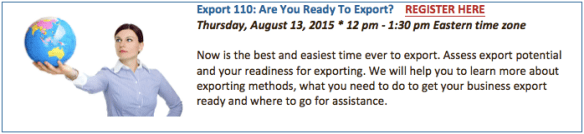
In WIPP’s Annual Survey, 38% of all respondents showed interest in our Export NOW program, so here are ours first webinars for entry-level exporters. Stay tuned for our advanced series! Register for first free webinars:

Screen Shot 2015-07-09 at 3.07.25 PMScreen Shot 2015-07-09 at 3.08.25 PM

The program is in partnership with the U.S. Department of Commerce’s International Trade Administration (ITA) and with the Clinton Global Initiative to make Export NOW an official CGI Commitment to Action.

For more information check out our step by step curriculum and get started today.

Growing your export business?

Export NOWIf you are the owner of a small business interested in the exporting opportunities, it’s not easy! Help is on the way for you with the Export NOW program developed by WIPP.   Export NOW is an advanced program designed for exporters to grow and expand their business to new markets.

Program focuses on:

  • Key considerations involved in export such as finance, IP, logistics, technology, etc.
  • Discusses export sales channels with detailed segments on market analysis and building a market plan, including financing requirements and opportunities.

Export NOW will introduce you to the “experts” from both the public and private sectors to inform, educate and coach in its on-line on demand education program and live regional events.

The program is in partnership with the U.S. Department of Commerce’s International Trade Administration (ITA) and with the Clinton Global Initiative to make Export NOW an official CGI Commitment to Action.

For more information check out our step by step curriculum and get started today.