Critical Updates to WOSB Procurement Program

If you are women-owned small business in the federal contracting arena, please take a look at the following critical updates to the WOSB Procurement Program.

You Need to Know: WOSB Program Update
SBA Certify.gov siteThe WOSB procurement program website is undergoing a facelift. A new website, called SBA ONE, will allow for the electronic submission of SBA forms, as well as a streamlined location to monitor all certifications for your company including the repository. With the change, there are three things you need to know:
  1. All WOSBs will need to create a new login for the new system. The new website is actually an entirely new system and as such all WOSBs will need to create a new account and login (but not reload all documents – see next). The SBA is also asking that after creating a new account, all WOSB/EDWOSB companies submit new Form 2413 (WOSB certification) and/or Form 2414 (EDWOSB certification) electronically. Businesses should do this as soon as possible.
  1. The repository is being migrated, but is currently closed. This is important for two reasons: 1) your documents previously submitted should move to your new account and not require resubmission (except as mentioned above a new electronic Form 2413/2414); and 2) Contracting officers will not be able to view your repository documents for WOSB awards. Instructions for you to provide to a CO about how they can confirm your eligibility is available at the end of this document. This only impacts WOSB/EDWOSBs about to win EDWOSB or WOSB set-aside or sole source awards.
  1. The new site supports self-certification. Self-certification for WOSB/EDWOSBs remains an option until SBA finalizes new certification requirements. The website supports companies electing this option by allowing for the electronic submission of required documents. Third-party certifications can be uploaded as well.

SBA ONE, located at certify.sba.gov, will eventually house all program certifications, but is beginning with the WOSB program. Additional programs will be incorporated onto the site on the following projected timeline: 8(a) Business Development Program (Fall 2016), HUBZone Program (Spring 2017) and Dynamic Small Business Search (DSBS) (Spring 2017).

 * * *

 Information to Share with Contracting Officers
(Direct from SBA)

If you are working with a contract officer on a pending award requiring them to review your status, the following is information provided directly from SBA which you may share with contract officers.

Due to the system upgrade, access to the WOSB Federal Contract Program Repository will be temporarily unavailable for contracting officers (CO), starting on Wednesday, March 23 at 1:00 EDT.  This may be down for several weeks.   During this time, in order to comply with the WOSB Program requirements at 13 CFR 127.301 and FAR 19.1505(e) (specifying that a CO shall verify that an apparent successful offeror has provided all the required documents set forth in 127.300(e) to the WOSB Repository), SBA will review the Repository on behalf of a CO.

A CO may request that SBA review the Repository on their behalf by sending an email to wosb@sba.gov (link sends e-mail) with the following in the subject line:

“PENDING AWARD UNDER FAR 19.505(e) VERIFICATION REQUEST- SOLICITATION NUMBER [insert solicitation number].”

In the body of the email, the CO should provide the following: provide the apparent successful offeror’s DUNS, EIN, FIRM NAME, OWNER NAME; indicate whether the pending award is a WOSB or EDWOSB set-aside or sole source award; specify the NAICS code assigned to the procurement; and identify the State where the CO is located. Within 2 business days, SBA will perform the necessary check to determine whether the apparently successful offeror has filed all the required eligibility documents and provide the CO with an email response which either: (a) notifies the CO that all required documents have been provided or (b) identifies which documents are missing in order to allow the CO to file a status protest in accordance with SBA regulations and the FAR.

Emails for this information will be processed only for Contracting Officers.

 * * *

LEARN MORE
  • Upcoming Webinar:  WIPP is working to arrange for a special webinar with experts from the SBA’s Office of Government Contracting to further review the new site and re-registration process.  More details will follow.
  • If you have any questions about the certification program, or comments on improving the site, please email certify@sba.gov. More details on the transition of repository documents are available atwww.sba.gov/wosb.

Costs and Benefits: Paid Sick Leave For Federal Contractors

By: Jake Clabaugh, WIPP Government Relations

sick leave paidFederal contractors have been hit with a bevy of new regulations over the past few months – everything from increased reporting of labor and safety violations, a raise in minimum wages and increases in mandatory overtime pay. The next shoe will drop in January 2017, when ALL Federal contractors, primes and subs, will have to provide paid sick leave benefits to workers. The Department of Labor (DOL) proposed rules that would implement this change last month.

Contracts issued January 1, 2017 will require all Federal contractors to give employees 1 hour of paid sick leave per 30 hours worked. This rule will only apply to time spent on Federal contracts, so if an employee performs some work for a private sector client, those hours would not count toward sick leave accrual. Additionally, earned sick leave will carry over from one year to the next.

Why just contractors? The President issued an Executive Order to make the change. Like other new regulations pertaining to contractors, the President can make these decisions for his workforce. Congress has been unable to decide if or how to move forward on these issues so the President decided to act on his own. As the Commander in Chief, he can determine procurement policy – including requirements for contractors – without Congress having to pass a law.

While WIPP members support worker benefits in practice, we don’t believe that the DOL gave enough consideration to how this rule will affect small businesses. Without an exception for small businesses, the vast majority of women-owned business will be compelled to provide the same benefits as multi-billion dollar firms.

WIPP’s comments to DOL on the proposed rule can be read in full here.

Major Expansion of WOSB Procurement Program Starts Today

FB Cover photoBy: Ann Sullivan, WIPP Chief Advocate

A landmark week for women entrepreneurs just got better. Just a day after announcing that federal government had finally met their goal of awarding 5% of contracts to Women-Owned Small Businesses (WOSBs), the Small Business Administration (SBA) announced a significant expansion of the WOSB procurement program.  When the last disparity study was completed in 2007, women were found to be underrepresented in federal contracting in 83 industries, thus making them eligible for participation in the WOSB program. In addition to pressing for sole source contracts, WIPP advocated for a new study to update eligible NAICS codes for the program. The study, completed by the Department of Commerce earlier this year, found that 113 industries and their corresponding NAICS codes are now eligible for the program. The changes take place immediately.

The study, The Utilization of Women-Owned Businesses in Federal Prime Contracting, found two very disturbing facts.  One, that women are 21% less likely to get a government contract after solving for factors such as age and size of the business. Second, the industries in which WOSBs are less likely to win contracts account for about 85% of both total contracts and dollars awarded.

Find out whether or not your business is eligible for participation in the WOSB procurement program by checking your NAICS codes. Even though the program has quadrupled since 2011, expansion of the NAICS codes will result in even greater gains for women-owned businesses to participate in the public sector.


Federal Government Meets 5% Federal Contracting Goal for Women-Owned Small Businesses for the First Time in Twenty Years

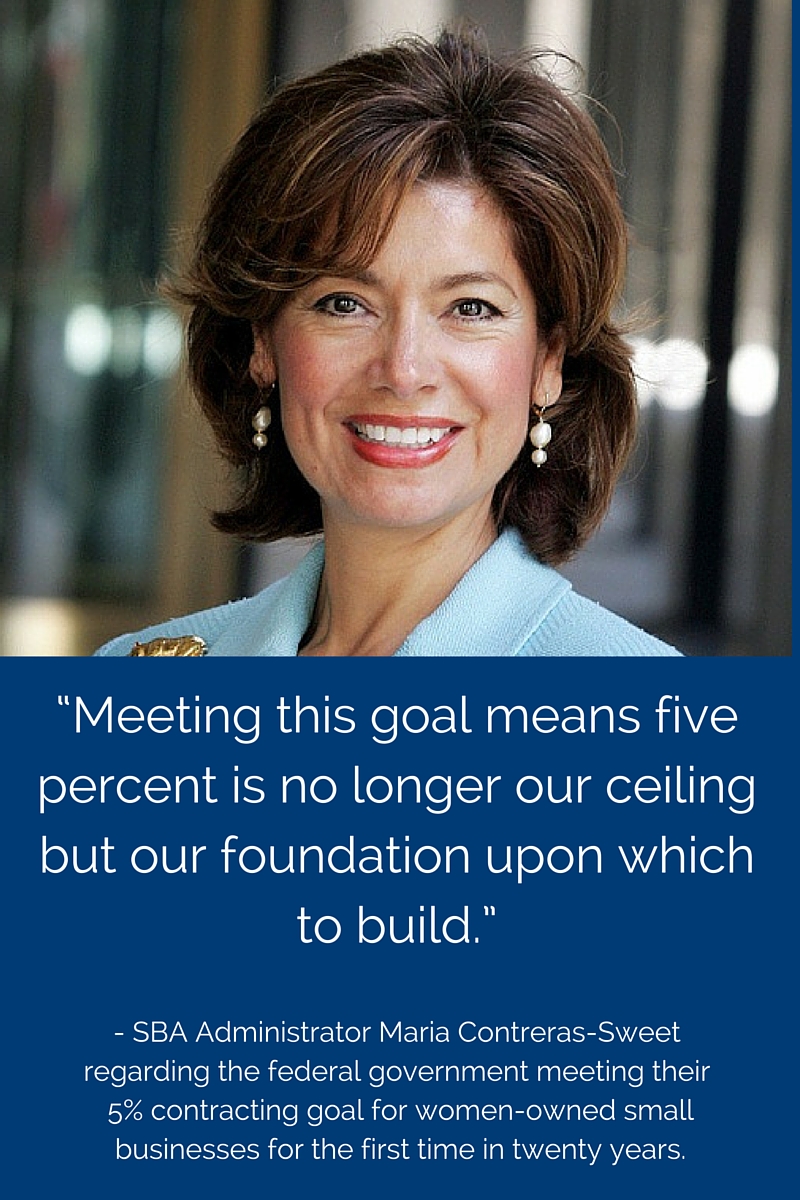
Women Impacting Public Policy (WIPP) is thrilled to celebrate the U.S. Government’s achievement of awarding five percent of its annual federal contracts to women-owned small businesses for the first time since the goal was set more than twenty years ago. The five percent goal was put in place as part of the Federal Acquisition Streamlining Act of 1994 and led to the creation of the Women-Owned Small Business (WOSB) Federal Contract program in the Equity in Contracting for Women Act of 2000.

WIPP, and our partner American Express OPEN are longtime champions of women entrepreneurs in the federal contracting space, creating the Give Me 5 program in 2008 to give women-owned small businesses access to knowledge and resources to help win federal contracts. At the time, just 3.4% of federal contracts were awarded to women-owned small businesses—roughly $13 billion of the approximately $400 billion awarded annually.

In April 2013, WIPP, American Express OPEN and the Small Business Administration (SBA) launched ChallengeHER, a national initiative to boost government contracting opportunities for women-owned small businesses. ChallengeHER delivers free workshops, mentoring and direct access to government buyers. Now entering its fourth year, ChallengeHER has educated more than 5,400 women entrepreneurs at 39 workshops across the country and facilitated more than 1,900 meetings between women small business owners and government officials.

The contracting landscape for women-owned businesses has improved significantly as a result of strong public and private support and bipartisan efforts. In early 2013, due to the efforts of WIPP and their coalition partners, President Obama signed into law the National Defense Authorization Act (NDAA) which removed caps on eligible federal contract awards under the U.S. Small Business Administration’s Women-Owned Small Business (WOSB) Federal Contract program. Before the law was put into place, awards to women-owned small business were capped at $4 million and $6.5 million under the program. WIPP had further success in improving the WOSB Federal Contract Program in 2014 with the passage of a new law that provided federal agencies with statutory authority to award sole-source contracts to women-owned small businesses. The WOSB program was the only major small business contracting program without this authority at the time – putting women entrepreneurs at a distinct disadvantage.

A hearty congratulations and thanks to the folks at SBA, American Express OPEN, the WIPP team, and all of the organizations and women business owners that have helped improve and increase access to the federal marketplace for women-owned small businesses.  Job well done!

WIPP Comments on WOSB Certification Changes

WIPP logo final copyWIPP submitted comments today to the SBA Office of Policy, Planning and Liaison on the SBA Advanced Notice of Proposed Rulemaking (ANPRM) regarding certification in the WOSB Program that was issued on December 18, 2015. The WOSB Program is extremely important in assisting women entrepreneurs entering the federal contracting marketplace. WIPP highlighted the following principles to guide the SBA in their implementation of the changes to the certification process.

Please see a brief outline of the principles below:

  • Third-Party Certification

                 -Keep the Integrity of the Program Intact – we are focused on making sure that    the changes to the certification process do not result in the disruption of the program.

  • State and Federal Agency Certification

                 -Expand Acceptable Certifications in a Uniform Manner – if certification is being accepted from multiple sources then we urge the SBA to have requirements set up so that there is as little duplicative paperwork as possible.

  • SBA WOSB Certification Program

                 -Without Adequate Resources, SBA Certification Will Fail WOSBs  

                 – Strengthen Compliance/Enforce Procedures

To see the submitted comments in their entirety, click here.

ChallengeHER Recognized in Budget Proposal

CH-LogoBudgets are usually just about the numbers, but, every so often, they take respite from tables, spreadsheets, and account balances to acknowledge successful partnerships. Anyone taking a look at the President’s budget, released on February 9, found out who is working on behalf of women business owners when the Small Business Administration (SBA) highlighted the success of WIPP’s ChallengeHER initiative at bringing women-owned businesses into the federal marketplace. Having SBA acknowledge WIPP’s efforts demonstrates just how strong WIPP advocates have been.

Securing a contract with the federal government can double the revenue for a women-owned business and the ChallengeHER program has been providing education to women business owners on how to do just that. In 2013, WIPP partnered with American Express OPEN and SBA to offer events, workshops with access to an online curriculum, and mentoring opportunities that provide women entrepreneurs with knowledge and connections to help them successfully compete for federal contracts.

This year, WIPP is planning 18 ChallengeHER events across the country. For more information and to find the ChallengeHER event closest to you, please visit WIPP’s ChallengeHER site.

FAR Council Embraces Sole Source

By: Jake Clabaugh, WIPP Government Relations

Women Impacting Public Policy (WIPP) recently submitted comments on the interim rule implementing sole source authority into the Federal Acquisition Regulation (FAR).  For more details please read WIPP’s full comment here.

FB Cover photo

WIPP’s 15-year effort to expand contracting opportunities for women entrepreneurs cleared an important hurdle with sole source authority finalized in the government’s contracting rulebook. The Federal Acquisition Regulation (FAR) is the government’s official source for rules when it comes to awarding contracts. Implementing sole source authority into the FAR means that women entrepreneurs wll now be competing on a level playing with other small business contracting programs.

WIPP’s comment on this rule acknowledged the FAR Council for recognizing the “urgent and compelling need” to grant contracting officers this authority. Their recognition is the culmination of years of hard work and advocacy to bring parity for women-owned contracting firms.

Although the Small Business Administration (SBA) published sole source rules last fall, some contracting officers had been waiting for official language to be put into the FAR before they would use sole source authority.  WIPP members have experienced this inconsistency firsthand and WIPP’s comment highlighted how important it is for the FAR to eliminate the conflict.

The FAR Council’s rule became effective on December 31, 2015 – a great way to start the New Year. Contracting officers now have official instructions to award sole source contracts through the WOSB Procurement Program. We encourage women business owners to comment on this important victory for our community. If you wish to echo WIPP’s comments, you can submit them electronically using Regulations.gov and search for “FAR Case 2015-032.” Please use the “Comment Now” option, which will provide instructions for uploading your document and ensure that your voice is heard.


House Committee Passes Bipartisan Federal Contractor Changes

By: Ann Sullivan, WIPP Government Relations


In its first major action of 2016, the House Small Business Committee approved changes to federal contracting which affect small companies who do business with the federal government. Acting in a bipartisan manner is relatively rare in Congress these days, but the Committee unanimously adopted the legislation, The Defending America’s Small Contractors Act of 2016, with over two-thirds of the Committee contributing content to the bill.


For the last three years, the House Small Business Committee has pushed for changes to the government’s buying rules and this week’s legislation was no exception. In our view, the following changes in the bill will prove to be significant to small contractors. One attacks an age-old problem – showing past performance without a government contract. The bill establishes a pilot program that enables contractors to receive a past performance rating by submitting a request to the contracting officer and/or prime contractor.  Second, the bill strengthens agency small business offices to recommend which small business set-aside programs should be used for each contract at their agency.

Anne CrossmanThird, WIPP’s recommendations were incorporated in the legislation, including one made by Anne Crossman, a member of WIPP’s Leadership Advisory Council, in her testimony before the Committee. Anne took the opportunity to highlight WIPP’s “if you list us, use us” policy for prime contractors’ subcontracting plans. This bill incorporates WIPP’s recommendations to clarify the role of commercial market representatives (CMRs) in encouraging prime contractors to work with small businesses. Lastly, the bill takes the first step toward getting a better handle on the actual amount set aside for small businesses by requiring agencies to divulge awards counted toward multiple small business goals.
An amendment offered by Rep. Takai scored a victory for women entrepreneurs by allowing Women’s Business Centers (WBCs) to provide procurement assistance to women participating in the DOD mentor-protégé program. Rep. Takai’s statement on the amendment is available here and includes WIPP’s statement of support.

These improvements set the stage for a productive year of improvements for small contractors. The bill, which passed unanimously, will now be considered by the full House of Representatives. The House Small Business Committee is off to a great start. We can’t wait to see what they do next.

From the Hill: Small Contractors Make Big Gains in New Legislation

By: Jake Clabaugh WIPP Government Relations


ChabotThe House Small Business Committee is leading off 2016 by continuing its
efforts to make federal contracting more accessible to small businesses. Committee Chair Steve Chabot’s (R-OH) legislation, Defending America’s Small Contractors Act of 2016, makes an array of changes to procurement policy.

Although impossible to summarize all of the changes in a few paragraphs, which is why we have the link to the bill above, here are the highlights. The bill tackles transparency by rewriting – in plain English – the requirements for small business procurements. Since getting past performance is an obstacle for contractors getting started in federal contracting, the bill establishes a pilot program that enables them to get a past performance rating by submitting a request to the contracting officer and prime contractor. Offices of Small and Disadvantaged Business Utilization (OSDBUs) will now have increased authority to recommend which small business set-aside programs are most appropriate for each contract at their agency. The Act even touches the Department of Defense (DOD) by requiring that Mentor-Protégé plans in DOD’s program be approved by SBA – an update aimed at adding consistency to Mentor-Protégé Programs government-wide – but controversial since the last time we looked the Defense Department does not generally defer to SBA.

If some of these changes sound familiar, it’s because Anne Crossman, a member of WIPP’s Leadership Advisory Council, proposed several of these improvements during a Subcommittee hearing last fall.  Specifically, Anne noted WIPP’s “if you list us, use us” policy for prime contractors’ subcontracting plans and in her testimony she advocated for prime contractors to be accountable to the subcontractors listed on their plans. This bill incorporates Anne’s recommendations by requiring commercial market representatives (CMRs) assist prime contractors in identifying small business subcontractors and assess the prime’s compliance with their subcontracting plans.

The intent of the legislation is to assist federal agencies in meeting their small business contracting goals. The goal for women owned companies of 5% has never been met. A continued push for data transparency surfaces in the bill as well, requiring agencies to do a better job of reporting the contracting dollars awarded to small businesses.

The Committee is expected to hold a markup to consider this legislation during the week of January 11.  The WIPP Government Relations team will continue to provide updates as the bill moves through Congress.

WOSB Sole Source Takes Final Step

sole sourceThe contracting rulebook used by most federal agencies embraced the new sole source authority for women entrepreneurs. In the final step of a multi-year effort – with WIPP at the helm – the government gave the final green light for contracting officers to award sole source contracts to women business owners.


Deciding that finalizing the sole source authority of the WOSB program was an urgent and compelling need, the FAR Council issued an interim rule on December 31, 2015, to immediately allow contracting officers to award sole source contracts in the WOSB program. While the Small Business Administration (SBA) already finalized their rules for WOSB sole source on September 14, 2015, the FAR Council needed to issue guidance to contracting officers on how to use the program. This rule provides that guidance and is effective immediately. Notably, the FAR Council determined that sole source applies to acquisitions at or below the acquisition threshold.


As a reminder, sole source contracts are allowed in the WOSB program when four conditions are met:


  1. Contract falls in a NAICS code approved for the WOSB program.
  2. The value of the contract, including options, is under $4 million ($6.5 million for manufacturing contracts).
  3. The contract can be awarded at a fair or reasonable price.
  4. The contracting officer does not have a reasonable expectation that two or more WOSBs/EDWOSBs will submit offers at a fair and reasonable price.


The interim rule is available here, with comment due February 29, 2016. While a final rule will ultimately be issued, this rule makes sole source effective in the FAR as of December 31, 2015.