Millennials in the Workplace – What Are Your Thoughts?

Millennials are the largest workforce group since they surpassed Generation X this year and the U.S. Bureau of Labor Statistics preMillennialsdicts they will make up 75% of employees by 2030. Therefore it is no surprise that many reports and articles have been dedicated to the topic of how to get along with and manage this generation at work.

From hiring practices to benefit packages and work-life balance, expectations of this generation are widely different to the ones of Baby Boomers or Generation X.

Towan Isom is a President and CEO of Isom Global Strategies where millennials make up more than 50% of all employees in her company. Since she started the company 15 years ago in her basement, she has accumulated extensive experience and knowledge working with different generations of workers. She shares her insights and often speaks on how to be successful with this intergenerational workforce and on managing millennial employees.

In the end of September, Towan will speak at a conference on Millennials in the workplace, and she offers a unique opportunity to make your insights to be heard. By responding to the quick survey your professional opinion on working with millennials will be shared with her audience and presented in a case study afterwards. The conference will be also recorded and available on Isom Global Strategies website few weeks after the event.

Towan will also share outcomes and her professional views with us here in a guest blog after the conference.

WIPP Signs Strategic Partnership with International Trade Administration on Exporting Initiatives

img_0179Earlier today, WIPP joined Assistant Secretary Jadotte at the U.S. Department of Commerce to announce a new partnership to increase awareness about exporting in the U.S. business community. Women Impacting Public Policy’s (WIPP) new strategic partnership with Commerce’s International Trade Administration (ITA) will focus on providing education and resources to help small- and medium-sized women-owned businesses succeed in the global marketplace.

Signed this morning, the Memorandum of Agreement explains that, ITA and WIPP will work together on marketing, education programs, and events leveraging our organizations’ expertise to help make U.S. businesses more export savvy. WIPP recently developed Export NOW, a step-by-step program which guides participants — current and new exporters — through the steps to enter new growing markets or to expand their export reach. We’ll also partner with ITA on our Export Now program. Joint activities may include building awareness through outreach at trade shows, collaborative press and digital communications, and online registration for resource support.

As the U.S. marketplace becomes more competitive than ever, it is crucial for businesses — particularly small- and medium-sized businesses — to engage a broader international market for success. WIPP firmly believes that the products and services provided by women-owned businesses belong not just in American hands, but should reach every consumer around the globe. As a leader in educating businesses on ways to build, develop, and expand their companies, WIPP is perfectly positioned to work in concert with ITA to aid women-owned firms in growing their footprint in the global marketplace via export opportunities.

In 2014, U.S. Secretary of Commerce Penny Pritzker announced the National Export Initiative/NEXT (NEI/NEXT), an expanded and revitalized U.S. export strategy. NEI/NEXT focuses on supporting U.S. businesses of all sizes and economic growth in American communities by making it easier for U.S. companies to access export resources and capitalize on growth opportunities around the world. Our partnership with ITA supports this initiative by educating U.S. women-owned businesses about the benefits of exporting and expanding their exports to additional markets. Companies will learn about public and private sector resources to assist them in going global. WIPP joins several of ITA’s Strategic Partners who have connected more than 1,500 companies to federal export assistance to broaden and deepen the U.S. exporter base.

Explore New Growth Opportunities with Export NOW

If you were hesitating on whether or not to export – here’s the business case for you: U.S. metropolitan areas in 2014 set export highs for the fifth year in a row exceeding $1.44 trillion in goods exports!

As highlighted by U.S. Commerce department: “Today, U.S. businesses are increasingly taking advantage of export opportunities. The data makes it clear. Companies based in the United States that sell their world-class goods to the 96 percent of potential customers who live outside our borders are critical to both the local and national economy. This is evident in today’s release of the 2014 Metropolitan Area Export Overview. The report highlights data on goods exported from U.S. metropolitan areas in 2014. Some of the nation’s most prominent cities are leading in trade and setting new export records.

We will guide you through the process of joining them with an exciting growth opportunity for your Business -> WIPP’s National Export Expansion Education Program. This step-by-step program will lead participants (both current and new exporters) through the steps to enter this growing market, or to expand their export reach.

You don’t have to be big to export – We will help you take a bite of the Export cake
Screen Shot 2015-07-08 at 4.35.07 PM

And Why Export? It’s a big world …

  • 95% of consumers live outside of the U.S.
  • 80% of world economic growth forecasted to occur outside the U.S.
  • $2.3T of U.S. goods and services exported in 2013

… and great Growth Opportunity

  • U.S. exports are in high demand although only 300,000 U.S. companies export – it’s a competitive market
  • Average revenue per firm was $23 M in 2013
  • Exporters report nearly 4 times total revenue per firm
  • Digital technologies enable entrepreneurs to be “micro-multinationals” that sell and source products, services ad ideas across boarders (McKenzie)

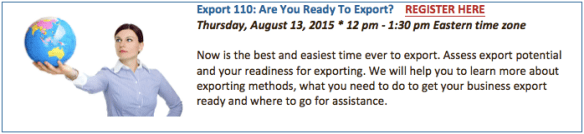
In WIPP’s Annual Survey, 38% of all respondents showed interest in our Export NOW program, so here are ours first webinars for entry-level exporters. Stay tuned for our advanced series! Register for first free webinars:

Screen Shot 2015-07-09 at 3.07.25 PMScreen Shot 2015-07-09 at 3.08.25 PM

The program is in partnership with the U.S. Department of Commerce’s International Trade Administration (ITA) and with the Clinton Global Initiative to make Export NOW an official CGI Commitment to Action.

For more information check out our step by step curriculum and get started today.

Flourishing women with flourishing careers

Start your week with an article on women who continue building their careers in the age which is usually connected with retirement and taking care of grandchildren -> Clinton, Yellen, and Warren all reached their 60s having raised families and built long professional tracks as well.

Statistics also point to a significant rise in entrepreneurship during the “retirement years”. According to Kauffman stFlourishing womenudy, Americans in their fifties and sixties have started businesses at a faster pace over the last decade, while that pace has continuously slowed among Americans in their twenties and early thirties. The article puts a new perspective on the topic: “Perhaps having to wait awhile isn’t an entirely bad thing. If more people in professional and public life had to perform, and keep performing, before they got top posts, all of us might be better off.”

Whether building and expanding professional careers, entering public service, or building that dream business, retirement years are now years of opportunity and excitement for all of us.

Read the whole article here http://theatln.tc/1IF5GHi

It’s Time to Lift America’s Ban On Crude Oil Exports

oilby Barbara Kasoff, WIPP President

Since the start of the year, a surprising amount of support on both sides of the aisle to remove the ban on crude oil exports has emerged. Is this a sign that we are entering into a new era of bipartisan collaboration, specifically to form an energy agenda that will improve the nation’s security and get our economy moving again? While that still may be a ways off, it is clear this is one issue that could lead to historic collaboration on energy policies that will benefit American economy.

The 4.7 million businesswomen across the country that our coalition represents believe we can help secure the nation’s economic future through sound energy policies. We believe exporting our abundant energy resources must be a key part of that future and supporting an update in our crude oil export policy is the correct course of action and would allow our country to prosper at its full potential.

According to a report released this week by Margo Thorning, senior vice president and chief economist for the American Council for Capital Formation (ACCF), and William Shughart a research director for the Independent Institute and J. Fish Smith Professor in Public Choice at the University of Utah, the economic advantages and geopolitical benefits to lifting the ban on crude are clear.

The paper titled, “The Economic Case for Lifting the Crude Oil Export Ban,” cites the findings from five different studies conducted by various institutions such as IHS, Brookings Institute, the Aspen Institute, ICF International, and Resources for the Future, all of which agree that the case to update this policy is strong. Notably, they all conclude the same three major impacts lifting the ban on crude oil exports would have on the economy and consumers, including: job creation, an increase in U.S. GDP, and a downward pressure on consumer fuel prices.

For example, one of the most recently released studies mentioned in the report – by IHS – estimated that lifting the ban on crude oil exports would generate 390,000-859,000 new jobs annually nationwide and increase U.S. GDP between $86 billion and $170 billion over the next fifteen years.

Senator Lisa Murkowski, Chairwoman of the Senate Committee on Energy and Natural Resources, who has been one of the biggest champions of an examination of various U.S. energy policies, including the ban on crude oil exports, also noted the economic “no brainer” we are facing, stating, ““the economics are clear… lifting the ban on crude oil exports will benefit consumers.”

In addition to the much need economic stimulus from removing the ban, revising the current energy exports policy specifically with regard to crude oil, also extends U.S. geopolitical influence by strengthening our international trade relationships. Foreign allies would gain access to a stable and abundant source of crude oil that would overall create a more secure market.

Women thought leaders like Dr. Margo Thorning and Chairwoman Lisa Murkowski understand that repealing the ban on crude represents a fiscally responsible strategy to allow the U.S. to utilize our growing energy abundance.  Simply put, to quote Murkowski herself, “It’s time to lift America’s ban on crude oil exports.”

“Dream Big” This National Small Business Week, May 4-8

MCS Photo

By Maria Contreras-Sweet
Administrator, U.S. Small Business Administration

With apologies to baseball and your mother’s apple pie, nothing is more American than National Small Business Week.

Our country was founded by risk-taking pioneers in search of new horizons. More than two centuries later, what sets America apart in the world is the willingness of our entrepreneurs to take risks. Small businesses allow Americans to be their own boss and improve their lot in life through hard work – a core American value.

Every year since 1963, the President of the United States has issued a proclamation declaring National Small Business Week to recognize the critical contributions of America’s entrepreneurs, who create nearly two out of every three net, new U.S. jobs each year. Federal Reserve Chair Janet Yellen said it was our small businesses that powered our recovery after the Great Recession.

National Small Business Week, themed “SBA: Dream Big, Start Small,” will be held May 4-8. Special events will take place in Miami/Boca Raton, Los Angeles, San Antonio, New York, and Washington. D.C.

Tune in all week for live-streaming, beginning at 1 p.m. ET Monday with a panel discussion on small business financing followed by a conversation with Joyce Rosenberg of the Associated Press. Or join me @MCS4Biz at #DreamSmallBiz. I promise you’ll learn a lot.

America is one of the few countries that give entrepreneurs a seat at the President’s cabinet table. This allows the U.S. Small Business Administration (SBA) to speak with one voice on behalf of 28 million small businesses with divergent interests.

The SBA also offers an extensive national network of small business lenders and counselors that’s unmatched anywhere in the world. Many entrepreneurs with great ideas and great potential do not begin with great wealth, so they need a great government partner to support their success.

The SBA offers the “three Cs” to help the best and brightest start or grow a business, secure capital, and commercialize their ideas to benefit society:

  • Capital: SBA fill gaps in the commercial lending marketplace so success in the small business sector is based on merit, not family wealth. To inquire about a small business loan, click here.
  • Counseling: SBA provides free consultation and advice to help businesses on Main Street succeed. To find a small business counselor near you, click here.
  • Contracts: SBA levels the playing field with big business by helping small businesses capture new revenue and new customers by winning government contracts, joining corporate supply chains, and exporting beyond our borders. To learn about contracting opportunities, click here.

This year, during National Small Business Week, we recommit ourselves to those fearless entrepreneurs who plan well, work hard, and dream big. Every business starts small. Nike, Apple, FedEx, Ben & Jerry’s, Under Armour and Outback Steakhouse were all once small businesses, until they found an SBA lender or investor to work with them.

I came to this country as a 5-year old immigrant who didn’t speak a word of English. Today, I serve in the cabinet of the President of the United States. My story is possible only because of the entrepreneurial spirit.

Success in business comes one small step at a time. So dream big, but take that next small step today, because the next great American success story could be staring back at you in the mirror.

SBA Administrator Maria Contreras-Sweet started three businesses in Los Angeles, including a community bank, before joining President Obama’s cabinet in April 2014.

More Taxes? No Taxes? How About Fair Taxes

By John Stanford, WIPP Government Relations

WIPP recently submitted testimony to the House Small Business Committee on comprehensive tax reform. This blog gives an overview of WIPP’s advocacy efforts. For more details, I encourage you to read the testimony. Our government relations team strives to make official communications as easy-to-read as possible, but should you have questions please reach out to WIPP.   


Women entrepreneurs deserve a tax system that rewards the effort, tenacity, and risk it takes to start and grow a business. Moreover, they deserve a system of revenue collection (because that’s what taxes are) that is simple and fair.

In testimony submitted to the House Small Business Committee, WIPP said just that. Citing reports from the IRS National Taxpayer Advocate as well as the SBA Office of Advocacy, the testimony documents what women business owners already know: the tax system is broken, failing under the weight of complexity, uncertainty and outdated policies. But more importantly, the testimony addresses the impact of possible reforms – and the need for any overhaul to be comprehensive.

What does that mean? It means that the idea to lower the corporate tax rate, favored by the White House and some in Congress, must not happen independently of adjusting individual rates in a similar manner. This distinction matters because so many businesses, including almost 9 in 10 women-owned businesses, are structured as “pass-through” entities paying taxes as individuals (including S-Corps, Sole-proprietorships, partnerships, and LLCs).

Corporate-only reforms would be unfair to these businesses – and for that reason WIPP has always supported comprehensive (corporate + individual) reform. The testimony underscored this important point.

In addition, WIPP identified tax policies that, absent major reforms, would benefit women entrepreneurs. This includes making more small business tax credits and deductions permanent. In recent years, these tax “extenders” have been extended (hence their name) at the last minute, or even retroactively – not a good way for business owners to plan their budgets.

WIPP also asked Congress to consider tax credits that benefit new businesses, helping offset the costs of launching a new company. Another policy request was to avoid changing the Employee Stock Ownership Plan (ESOP) provisions in the tax code, as these have proven to be both popular and good tools to incentivize productivity and long-term business health.

In agreement with the idea that simple businesses (sales – costs = income) should have simple taxes, WIPP also supports simplifying the cash accounting method and expanding its optional use to more small businesses. Finally, with healthcare costs an always-growing burden on employers, WIPP continues its support of expanding the Small Business Health Care Tax Credit so more women entrepreneurs minimize the cost of providing healthcare to employees.

More ideas for reforming the tax system to incentivize entrepreneurship and innovation are out there. WIPP will continue working to identify policies that let women business owners focus more on their business and less on complex tax requirements. At the end of the day, all of these decisions should be made with the basic principles of simplicity and fairness in mind. And that’s exactly what we asked Congress to do.

Growing Women’s Representation in the STEM Fields

By Louisa Brown, WIPP Intern

STEM

Science, Engineering, Technology and Mathematics, known collectively as the STEM fields, are some of the fastest accelerating areas in the U.S economy today. Innovations seem to be springing up all around us, and with them new career opportunities that offer high wages and ample areas of growth. When we look to who are filling these jobs, however, the results are troubling. According to the new report from the American Association of University Women, titled Solving the Equation: The Variables for Women’s Success in Engineering and Computing, only 12% of engineers are women, and women make up only 30% of computing professionals.  Although women are gaining ground in the science and mathematics fields, they are still falling behind in engineering and technology, the fields which have the highest number of opportunities and offer the highest return on investments.

So, why is this happening, and what can we do about it? In a virtual Town Hall meeting today, hosted by the AAUW and STEMconnector®, experts from higher education, industry and nonprofits had the chance to engage with the results of this important report, and discuss the many ways that organizations are already working to advance women in the STEM fields. Christianne Corbett of the AAUW and co-author of the report, started the discussion by advocating for an intersectional perspective which recognizes the ways in which women of color are even more underrepresented in the engineering and computing fields than their white counterparts. Women of all ethnicities, however, are subjected to gender biases and stereotypes that inhibit their ability to obtain and retain jobs in engineering and technology. Such biases and stereotypes are often implicit and culturally ingrained, making them that much harder to confront.

Acknowledging these biases is an essential first step towards equality, for both educators and employers. Rob Denson, of Des Moines Area Community College, highlighted some important ways that colleges and universities are already working with the STEM Higher Ed Council to address biases and better align educational and industry goals. Emphasizing workplace-learning through paid internships and early research experiences are important to retaining women in computer science and engineering majors, while underlining the social impact of such fields helps women commit to these majors and gain access to the career opportunities that come with them.

The virtual Town Hall meeting also included important input from women in the manufacturing, telecommunications and defense industries. Esra Ozer of the Alcoa Foundation, Anne Wintroub of AT&T Aspire and Betty Smith of Lockheed Martin all emphasized the importance of diversity and partnerships in the workplace. A range of educational pathways is essential to creating a representative work force, and strong mentorships give women the professional support they need to succeed in their careers.

Finally, Linda Hallman, the executive director of AAUW provided insight into the Million Women Mentors program which aims to provide women entering the STEM fields with meaningful mentor relationships. This program is just one of the many ways in which organizations across the country are taking tangible steps to improve representation from women in the technology and engineering industries. What are some solutions that you believe can help attract more girls and women into STEM careers?

A Big STEP for Small Business

by Abby Ware, WIPP Government Relations  

Thinking about exporting, but have no idea where to start? Take a look at the Small Business Administration’s State Trade and Export Promotion (STEP) program. As state governments receive funding from the STEP program in coming months, small businesses will have increased access to emerging trade opportunities and export support initiatives. Utilizing the STEP program is what JM Grain of Great Falls, Montana did when it decided it wanted to export lentils and chickpeas. The STEP grant allowed JM Grain to attend a Gulfood Trade Show in Dubai, exposing the small business to new markets and an estimated $600,000 in additional export sales.

The STEP program is a federally funded pilot program with two objectives: 1) increase the number of U.S. exporting small businesses, and 2) increase export value for small businesses that already export. State governments apply and match the funds with a federal to state ratio of 75% to 25% (65% to 35% for high exporting states). STEP activities are then provided and managed at the local level by state government organizations.

Small businesses in the State of Washington in particular have benefitted from STEP, better equipping Washington to incorporate trade-promoting programs such as Export Voucher. The Export Voucher program provides up to $5,000 to small businesses for export-related expenses for companies that want to export.  Washington has also provided financial counseling and targeted support for women, veteran and minority-owned businesses through STEP funding. More information on Washington’s efforts can be found here.

To see if a state already participates and receives STEP grants, go to this link and talk to them about their small business assistance.  Every state deploys its federal STEP program in different ways, so it is important to contact the office listed on the map.