Growth Accelerator Fund Competition

The SBA’s Growth Accelerator Fund Competition is open for applications and ready to award successful incubators and growth accelerators with cash prizes. This competition, which awards the most innovative and promising small business accelerators and incubators, was announced by the Small Business Administration this morning. These prizes will give the winning organizations additional capital and ultimately assist promising start-ups and entrepreneurs.

For more details on the competition, including competition rules and eligibility, please see the SBA’s announcement. Applications are due by June 3, 2016 and can be submitted through Challenge.gov.

Join Us In Celebrating National Small Business Week 2016

It’s that time of year again and National Small Business Week starts this week May 1-6! As a partner and supporter, WIPP is excited to share with you some of this weeks live and online events:

Live Event Locations


Webinars

Monday

  • Taking the Mystery out of Voluntary Benefits
  • The Decline of Magstripe Cards—and What That Means for Your Business

Tuesday

  • Cloud, Mobile, and Social: Great Apps and Services That Will Grow Your Business

Wednesday

  • Access to Capital and Business Loans: Best Practices

Thursday

  • Tips for Getting Your Business Financially Fit

Click here to learn more and to register for these webinars.


To view recent news/press releases and learn how to share with your networks, click here.

We hope that you can join us this week!

Filing Frenzy: Tax Deadline Strikes Today

tax-day

By: Jake Clabaugh, WIPP Government Relations

Tax Day is upon us and woman business owners have been working overtime. Not on growing their firms, planning investments or making important hiring decisions, but on tax compliance. At least, that’s according the House Small Business Committee, which took a look at the burdensome tax.

Forgetting tax liability – the amount a business owes – the Committee focused on how difficult it is for small businesses to satisfactorily comply with dense tax rules. According to the Small Business Administration (SBA), small businesses spend 5.5 billion hours preparing and filing taxes – time that should be spent growing the business. The costs and complexity of calculating tax provisions makes it difficult for smaller businesses to take advantage of incentives designed to reward investment. As a result, larger businesses that can incur the costs of calculation reap the rewards.

As we’ve heard from WIPP members across the country, tax certainty is a top priority. Clarity on what provisions and incentives will be enacted would provide businesses with the ability to plan ahead, rather than adjust to a changing environment. For the last few years, Congress has passed legislation solely for “tax extenders” – deductions and credits that were set to expire at the end of the previous year, but were extended to cover the current tax year. While many of these credits could provide some relief for small businesses, firms spent the entire year without knowing if these provisions would be available. Hardly an efficient way to have to run your business.

A simpler tax code would reduce compliance time and allow owners to focus on their business – not the latest tax rules. Also, small businesses should be able to take advantage of the same incentives that larger businesses can. WIPP will continue to focus our advocacy on the two guiding principles of simplicity and fairness for women-owned businesses.

Could comprehensive reform – not seen since the 1980’s – be on the horizon? House Ways and Means Committee Chair Kevin Brady (R-TX) announced last week that his Committee is planning to release a tax-reform “blueprint” this summer. Additionally, Members of the House and Senate have stirred over international tax reform in the wake of recent corporate mergers. While the conversations are ongoing, comprehensive tax reform in an election year, with an ardently divided Congress seems, at least in our view, unlikely.

For updates on tax policy and other finance issues, please visit WIPP’s Economy and Tax section and WIPP’s Economic Blueprint.


2016 International IP Index is out – Infinite Possibilities

The U.S. Chamber of Commerce released the 4th edition of its International Intellectual Property (IP) index on February 10th, with a promising title – Infinite Possibilities. The ​Index ​provides ​economies ​with ​a ​comprehensive ​road ​map ​to ​harnessing ​the ​benefits ​that ​robust ​IP ​systems ​provide, ​which ​create ​limitless ​possibilities ​to ​attract ​investment ​and ​fuel ​economic ​competitiveness. ​

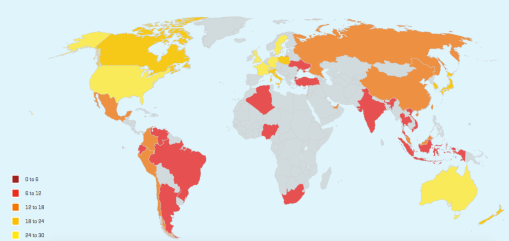
The ​Index ​ maps ​the ​IP ​environment ​in ​38 ​economies (additional 8 added this year), ​based ​on ​30 measurable criteria indicative of ​a ​strong ​IP ​system, such as patents, copyrights and trademarks protections, enforcement, trade secrets and market access, and engagement in international treaties.

The 38 economies account for nearly 85% of global gross domestic product (GDP). The United States again scored the highest, with Venezuela, India and Thailand coming last.

The closer the score to 30 points (red to yellow color scheme), the more robust country is in the IP area (see the interactive map here).

Screen Shot 2016-02-11 at 9.51.04 AM

Many countries have shown significant improvements through investments into innovations compared to last year’s results:

  • The Indonesian government created an online notification system for rights holders to request action against alleged infringing websites.
  • In Israel, a new Index economy, 2014 reforms significantly enhanced the environment for patent protection. In particular, a patent restoration for biopharmaceuticals and regulatory data protection for submitted clinical data.
  • Malaysia’s IP environment has improved gradually over the past four years, resulting in a cumulative increase in the country’s score. As a TPP (Trans-Pacific Partnership) negotiating partner, the IP standards within the agreement—once ratified and implemented—will further strengthen Malaysia’s IP environment.

On the other hand, many countries have still a lot of work to do to improve their IP environment. Brazil, China, Russia, and Indonesia are undermining their overall innovation ecosystem with policies tying market access to sharing of IP and technology, and by enforcing localization. But also high-income western European countries are facing challenges, especially in copyright protection due to absence of policies to more effectively fight online piracy.

Despite United States being on the top of the overall rank, there is still room for improvements. Especially in enforcement area, where it is ranked fifth, due to trade secrets theft and counterfeit seizures.

The index is not only a summary of a findings but it also demonstrates the benefits of a strong IP environment. It includes six new correlations between strong IP rights and socio-economic benefits, and also updates statistical information for 13 of the correlations from the previous edition of the Index. The new correlations include:

  • Access to finance: More robust IP environment attracts more venture capital and private equity funding.
  • High-quality human capital: Countries with stronger IP protection have on average 2.5 more research & development focused employees among their workforce.
  • Foreign direct investment attractiveness: Economies with robust IP systems receive on average a 45% higher Standard and Poor’s credit rating.
  • Inventive activity: The top 10 economies in the Index show patenting rates more than 30 times greater than the Index’s bottom 10 economies.
  • Advanced technology markets: People and firms in economies scoring above the median level of the Index are 30% more likely to enjoy access to the most recent technological developments.
  • Streamlined and enhanced access to creative content: Advanced and easy-access delivery of streaming services is 3 times greater in economies scoring above the median level of the Index, than in those scoring below the median, while access in the top 5 economies is up to 25 times greater than in the lowest 5.

For more information download the print report here, or visit the interactive map at www.uschamber.com/IPIndex to compare the 38 economies on each of the 30 indicators.


Small Business Policy Index 2016

Small Business & Entrepreneurship (SBE) Council released the 20th edition of its annual Small Business Policy Index, “Small Business Policy Index 2016: Ranking the States on Policy Measures and Costs Impacting Entrepreneurship and Small Business Growth.”

The Index ranks all 50 states according to various major government-imposed or government-related costs that have direct or indirect impact on entrepreneurship and business, as well as on start-ups and small growth eager companies.

The Index investigates in total 50 measures, from which:

  • 25 are tax related,
  • 18 relate to rules and regulations,
  • 5 focus on government spending and debt issues, and
  • 2 remaining measures deal with the effectiveness of important government undertakings.

The outcome is accessible through an interactive map displaying states’ ranking in color, with a summary per state provided after selecting a state.

Screen Shot 2016-02-08 at 1.15.31 PM

The most policy-friendly states to entrepreneurs under the “Small Business Policy Index 2016” are: 1) Nevada, 2) Texas, 3) South Dakota, 4) Wyoming, 5) Florida, 6) Washington, 7) Alabama, 8) Arizona, 9) Ohio, 10) Indiana, 11) Colorado, 12) Michigan, 13) Utah, 14) North Dakota, and 15) Virginia.

On the other side of the ranking we can find: 40) Maryland, 41) Maine, 42) Iowa, 43) Oregon, 44) Connecticut, 45) Vermont, 46) Hawaii, 47) Minnesota, 48) New York, 49) New Jersey, and 50) California.

The authors highlight several findings from the report, which are especially interesting to note:

  • Average real annual economic growth of the top 25 states’ was by 29.2 % faster than the average rate for the bottom 25 states.
  • Also, the top 25 states’ average state population growth of 4.9 percent from 2010 to 2015 was double compared to only 2.5 percent for the bottom 25 states.
  • The top 25 states also witnessed positive net domestic migration of a 2.00 million at the expense of the bottom 25 states, which lost 2.03 million people.

The SBE Council President and CEO Karen Kerrigan provides her explanation of the founded facts: “Policy matters for entrepreneurship and small business growth. Quite simply, when elected officials impose weighty tax and regulatory burdens, the increased costs and uncertainties mean reduced risk taking and less economic opportunity. The message from our ‘Small Business Policy Index’ to state officials is clear: If you are serious about helping small business, then reduce barriers to entrepreneurship and government costs imposed on small business.”

To access the Small Business Policy Index 2016 full report please click here.

Small and Medium-Sized Companies in the Focus of Exporting News

Small and medium-sized exporting companies had several reasons for good spirit in the last couple of weeks – especially Trans-Pacific Partnership and Export-Import Bank supporters.

The final agreement on Trans-Pacific Partnership (TPP) got a substantial coverage across the news, as it is the largest regional trade accord in history. As covered a few weeks ago, it encompasses USA together with 11 Pacific Rim nations and addresses many complex issues – from reducing tariffs and quotas, to imposing rigorous environmental, labor and intellectual property standards on partners, easing cross-border data flows, establishing an investor-state dispute settlement mechanism, to free trade in services, and imposing competitive neutrality on state-operated businesses.

There is one particularly important area, which deserves a separate attention – focus of TPP on small and medium-sized enterprises (SMEs).

Last week, National Small Business Association hosted a webinar where Andrew Quin, Deputy Assistant U.S. Trade Representative for Southeast Asia and the Pacific, among other described new chapter of the TPP deal focused on SMEs. The chapter aims to tide together all different elements that benefit SMEs and he highlighted 2 major areas:

  1. Creation of dedicated website for SME exporters by every member country. The websites should pull out all provisions which are particularly relevant to SMEs such as customs, taxation or intellectual property protection topics to make it better understandable and easier to follow in day-to-day exporting trade deals.
  1. Creation of SME committee to continue consultations with SMEs and collect feedback on what works, if benefits are being generated, and on how to continue maximizing benefits to SMEs. The committee will consist of government representatives, however promises to take inputs from SMEs on private sector provisions.

All of the above claims to suggest that TPP is more beneficial to SMEs than any previous trade agreement. Mr. Quin also reassured that TPP will not have any impact on Minority-Owned Small Businesses set aside programs (including the one WOSB program for women).

Another topic that came out after few weeks is the reauthorization of Export-Import Bank (EXIM). As Mr. Quin stated, it is a separate initiative but important piece to allow a full benefit of TPP. EXIM is providing loans, guarantees, and insurance to U.S. exporters and has made SMEs exports the top category supported last year (source) when $10.7 billion of total $27.5 billion worth of U.S. exports went to U.S. small businesses.

EXIM

Many SMEs publicly supported EXIM reauthorization, and they all have now a hope that it might be successful after all. A rare procedural move brought EXIM to the House floor and got a surprising support in the 313-118 vote to renew, including from 127 Republicans.

However, now the supporters will have to secure passage in the Senate but they seem to have a chance through its attachment to another vehicle, such as legislation to renew highway funding (source).

Overall, current news seem to suggest that it is a good time to be an exporter and according to the latest annual report Profile of U.S. Importing and Exporting Companies released by Census Bureau, many SMEs have already realized that as they accounted for 98 percent of the number of U.S. exporters in 2013 and $471 billion in known value of goods exports.

The Trans-Pacific Partnership Trade Deal

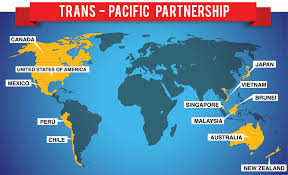
TPPOctober 5, 2015 will be remembered as a day when the United States and other 11 Pacific Rim nations reached final agreement on the largest regional trade accord in history – the conclusion of the Trans-Pacific Partnership (TPP.) The countries form a group with an annual gross domestic product of nearly $28 trillion that represents roughly 40 percent of global G.D.P. and one-third of world trade, which reflects enormity of the deal.

TPP addresses many complex issues from reducing tariffs and quotas, to imposing rigorous Environmental, Labor and Intellectual Property Standards on partners, easing cross-border data flows, establishing an investor-state dispute settlement mechanism, to free trade in services, and imposing competitive neutrality on state-operated businesses.

Together with the U.S. members are Australia, Canada, Japan, Malaysia, Mexico, Peru, Vietnam, Chile, Brunei, Singapore, and New Zealand. Geography would suggest for China to be member as well but though it has expressed interest in talks, it is not among founding countries (causing different speculations and interpretations).

The deal now needs the approval of lawmakers in member countries, including the U.S. Congress where it is expected to be under thorough scrutiny. Public debate is also weighting all pros and cons. Supporters say it will unlock opportunities for exporters but opponents see the partnership as a continuous way of sending manufacturing jobs to low-wage nations.

Similarly to congressional battle in 1993 for NAFTA partnership passage (234 to 200 votes in the House, and 61 to 38 in the Senate), president Obama is expected to face challenges while making it one of his final goals in the office. Similar difficulties are expected in Canada while the process should be straightforward in Japan or Singapore.

TPP is written to ease adoption by additional Asian nations (South Korea is already pressing for swift acceptance), and to provide a potential template to other initiatives underway, like the Transatlantic Trade and Investment Partnership (source NY Times).

Tune to our special webinar with International Trade Administration on December 17 to find out more about the TPP and how it is targeting small businesses.

For additional information on TPP, continue here.

Want Global Economic Growth? Hire a Woman

By Jennifer Bisceglie, WIPP Board Member & WIPP International President

According to the World Bank, the past four years have seen tepid economic growth, with global GDP growing at under 3% annually. While 2.5% growth is far better than the rate of -2.1% that was seen at the low point of the 2009 recession, it doesn’t begin to meet the rates of over 4% that was seen during the mid 1990s and 2000s. Economists have been saying for some time that we are looking at the new economic “normal”. But does that have to be the last word?

IMG_6573[1]Few weeks ago I traveled to São Paulo, Brazil and Ankara, Turkey where I had the opportunity to represent WIPP and WIPP International and our members in critical discussions about global economic development. At both events, leaders from governments, NGOs and the business world took the stage to reiterate the need for gender inclusive growth policies.

In São Paulo, the International Trade Center’s (ITC) Women and Trade Programme hosted the annual Women Vendors Exhibition and Forum (WVEF), which seeks to increase the participation of women owned businesses in global supply chains. According to the ITC, women globally own almost 10 million small and medium-sized enterprises (SMEs) which account for almost 80% of jobs around the world. It is well known that supporting an environment that encourages entrepreneurship spurs job growth.

At the event, ITC Executive Director Arancha González called on world leaders, governments, and the business community to develop economic and procurement policies that will create one million more women entrepreneurs by 2020. The call to action will impact local and global markets by stimulating job creation at record levels.

In Ankara, the G20 launched the Women-20 (W20), an engagement group focused on promoting gender-inclusive economic growth. The group’s mandate is to advance recent G20 commitments on: women’s full economic and social participation (Los Cabos Leaders’ Declaration, 2012); women’s financial inclusion and education (St Petersburg Leaders’ Declaration, 2013); and gap reduction in participation rates between men and women in G20 countries by 25 percent by 2025, taking into account national circumstances (Brisbane Leaders’ Declaration, 2014).

Turkish Prime Minister Ahmet Davutoğlu made an impassioned speech about the potential of the W20 to positively impact the global economy. Today, in the G20, male economic participation is 86%, but only 56% for women. He added that for every 1% rise in female participation, it is estimated the global economy will grow an additional $80 billion and a 10% rise would increase the global GDP by an amount equivalent to Turkey’s annual GDP today.

International Monetary Fund (IMF) Managing Director Christine Lagarde highlighted that data compiled by the World Bank indicates 90% of countries still have laws that discriminate against women. She admitted that the IMF in the past has not had a strong focus on women, but the impact to women and the potential of women in the economy is now considered in every IMF country visit. She added that words are important, but to echo Prime Minister Davutoğlu, it is what gets implemented and the outcomes that are achieved, which really matter.

The important takeaway from these meetings is not that gender inclusive growth policies are the moral or right thing to do, but that they are the smart economic thing to do. Increasing women’s participation in the global economy has the potential to add to the global GDP the economic equivalent of a new China or India. In a time when no one is quite happy with the “new normal” economy, isn’t this the smart thing to do for everyone, both men and women?

Patents, Trademarks, Copyrights … Protect Your Intellectual Property

A spark of an idea is often the start for building a business. Next steps that come to mind to most people are preparing a business plan, sales and distribution model, marketing strategy, plan for building customer base, etc. However one area that is not always as straightforward is protection of the business idea, business name, or an invention from competitors. Or actually protection of everything that is encompassed by one powerful term – Intellectual Property (IP).

We all know the term but what exactly does it incorporates? According to the World Intellectual Property Organization, “IP refers to creations of the mind, such as inventions, literary and artistic works, symbols, names, images, and designs used in commerce.” Globally IP is divided into 2 main groups – Industrial Property (patents, trademarks, industrial designs, and geographical indications) and Copyright that covers literary and artistic works such as novels, films, music, architectural designs and web pages.

USA accounts for the largest share of filed patents and trademarks applications worldwide with 28,7% and 13,8% respectively as reported by the World Intellectual Property Organization.

Screen Shot 2015-09-11 at 11.58.47 AMHowever due to complexity of IP processes small businesses account for only small proportion of the numbers. They are usually not properly protected and thus are more vulnerable to piracy, counterfeiting, and the theft of their intellectual property. Small business owners often simply don’t have access to the IP protection know-how that larger corporations do.

And according to statistics of Small Business Administration this is even truer for small businesses, which are exporting their products overseas. Only 15 percent of exporters realize that a U.S. patent only provides protection in the U.S.

Below are the basics to be followed for protecting IP overseas:

  • Overseas Patents – Almost every country has its own patent law with specific patent application process, which needs to be followed. More information about filing for an overseas patent can be found here .
  • International Trademarks – in certain countries (defined by the Madrid Protocol) trademark registration can be filed via a single application, if you are already a qualified owner of a trademark application pending before the U.S. Patent Office. If you want to protect your trademark overseas you’ll need to file for international trademark protection. More information is available here

And why is it so important to protect ones business intangibles?

Intellectual Property protection is a critical part of small business success and its current or future growth. According to the U.S. Patent and Trademark Office’s stopfakes.gov web site, companies that protect their intellectual property drive more economic growth in the U.S. than any other single sector. In general, IP rights reward creativity, that fuels progress, innovation, spurs economical growth and creates jobs in return.

There are many different resources, to help you gather information on where and how to protect your intellectual property, sba.gov or export.gov are a good start.

We have also a unique opportunity for you to learn more about it during our free webinar on September 21st, which will be led by expert in the IP field, Partner at Holland & Knight law firm, Thomas W. Brooke. Registration is free and open.

Overtime Rule is Over The Top

By John Stanford, WIPP Government RelationsOvertime pic

The Department of Labor, it would appear, is working overtime. Two weeks ago, WIPP responded to the agency’s proposal to require labor history for federal contractors. Now, WIPP is addressing a different proposed regulation – this one making changes to overtime pay. Both proposals were well intentioned, and both pose risks to women entrepreneurs.

Disclaimer: this blog is a brief summary, so if your business may be affected I encourage you to read WIPP’s comment in its entirety.

It all began last spring, when President Obama directed the Labor Department to update overtime regulations, saying the standards for some employees had “not kept up with the modern economy.” Specifically, the so-called white-collar exemption was out of date. The exemption allows employers to avoid paying overtime (required anytime an employee works more than 40 hours a week) for executive, administrative, and professional employees because they typically have better pay, benefits, and privileges.

The exemption has three criteria. First, the employee must be salaried. Second, the salary must be above a certain threshold. Third, the employee duties must meet certain criteria – basically, you cannot just give someone a manager’s title and exempt them; they must be acting as a manager.

To answer the President’s call for modernization, the Labor Department proposed to update the second piece, the salary threshold, from roughly $24,000 to $50,440 and index it to economic growth. Essentially, this qualifies white-collar employees who make less than $50,000 a year for overtime pay if they work more than forty hours a week.

WIPP agrees with the President that our regulations do not match a 21st century economy, and we should work on updating these requirements for a fair and modern workplace. Moreover, companies that are purposefully skirting the rules on overtime pay and cheating otherwise qualified employees should be held accountable.

Nonetheless, simply doubling the salary threshold goes too far and achieves too little. While large companies in large cities may be able to afford a $50,000 salary floor, the entrepreneurial community is left with bad options: possibly cut employees to afford a minimum salary for others, or restrict working hours and set up an hourly tracking system. Notably, the Labor Department estimated only a quarter of employees will likely see higher paychecks. Others may see reduced hours.

In the comment, WIPP highlighted concerns about the cost to implement the rule, difficulties in application of the rule, and the dangerous impact on employee wages and benefits.

The Labor Department predicted that simply implementing this change would cost small businesses, including the vast majority of the nearly ten million women-owned firms, between $130-$180 million in the first year alone. That does not include the more than $500 million in increased wages small businesses are expected to pay. The Labor Department itself mentions that business could cut hours and benefits to make up for this loss.

Moreover, to ensure compliance with these new regulations, businesses will begin closely monitoring and tracking their employees’ work hours. Tracking and monitoring employee hours is very difficult, if not impossible, given the evolving dynamics of the workforce. Many white collar employees have flexible schedules, work from home, check and answer emails from smartphones or tablets and are no longer restricted by a rigid 9-5 schedule.

It also isn’t just companies. Non-profits face the same requirements. An exception for them (as well as small businesses) is so narrowly crafted it may not cover many mission-oriented organizations or the smallest of businesses. Both are places where working above and beyond forty hours a week may be more about commitment to a cause than a bigger paycheck. For this reason, WIPP asked that the exception be broadened to actually apply to small businesses and non-profits.

The idea that our regulations need to be updated is not political – it’s common sense. But often the regulatory pendulum swings too far as it has here. As proposed, women entrepreneurs could face the arduous tasks of transitioning current employees from salaried to hourly workers and possibly cutting benefits to make payroll all while tracking and limiting employee hours. Talk about working overtime.