Flourishing women with flourishing careers

Start your week with an article on women who continue building their careers in the age which is usually connected with retirement and taking care of grandchildren -> Clinton, Yellen, and Warren all reached their 60s having raised families and built long professional tracks as well.

Statistics also point to a significant rise in entrepreneurship during the “retirement years”. According to Kauffman stFlourishing womenudy, Americans in their fifties and sixties have started businesses at a faster pace over the last decade, while that pace has continuously slowed among Americans in their twenties and early thirties. The article puts a new perspective on the topic: “Perhaps having to wait awhile isn’t an entirely bad thing. If more people in professional and public life had to perform, and keep performing, before they got top posts, all of us might be better off.”

Whether building and expanding professional careers, entering public service, or building that dream business, retirement years are now years of opportunity and excitement for all of us.

Read the whole article here http://theatln.tc/1IF5GHi

ChallengeHER 2015 Tour Update

CH-LogoWomen Impacting Public Policy (WIPP) is happy to provide women business owners with the guidance to better compete for Federal Contracts under the Women-Owned Small Business (WOSB) Federal Contract Program. In order to educate and get women business owners together with federal buyers, ChallengeHER programs are being held in several cities and states throughout 2015. There have already been 3 events held – in Washington D.C., New York City, and Dallas and many more in the upcoming months. I’d like to share some highlights with you, as we have had many great hosts and speakers with outstanding presentations.

For those of you, who are not familiar with the program, here is some basic information:

ChallengeHER, an initiative from the U. S. Small Business Administration (SBA), WIPP, and American Express OPEN (OPEN), is designed to strengthen and promote the Women-Owned Small Business (WOSB) Federal Contract Program. ChallengeHER offers women business owners important information to established and new businesses on working with the federal government. Further, these events enable more women business owners to take advantage of contracting opportunities so they can boost their businesses and help propel the success of the WOSB Procurement Program.

The agenda of the ChallengeHER events is structured to provide women around all the United States the most important, standardized knowledge and guidance in federal marketplace. In ChallengeHER, WOSB federal contractors have a unique opportunity to:

  • Learn about the WOSB set aside program and how to market their business using this set aside.
  • Learn from experiences of successful WOSBs working as federal contractors.
  • Learn from federal buyers how to do business with their agency in Contracting Officers Panel.
  • Network with peer mentors and other WOSB and Economically Disadvantaged Women-Owned Small Business (EDWOSB) firms.

In addition, each event is filled with different speakers and moderators with substantial insights and specific topics.

Washington D.C. hosted by SBA

The first event this year was held in Washington, D.C. on May 11 at the SBA Headquarters. We kicked off with WOSB Strategic Research and Marketing presented by Sean Crean from the SBA. A panel of successful women entrepreneurs shared their experiences and a panel of contracting officers provided insight on planning for federal contracting, underlining the core mission of ChallengeHER – to share and educate women in federal procurement business.

New York City filled with extraordinary speakers

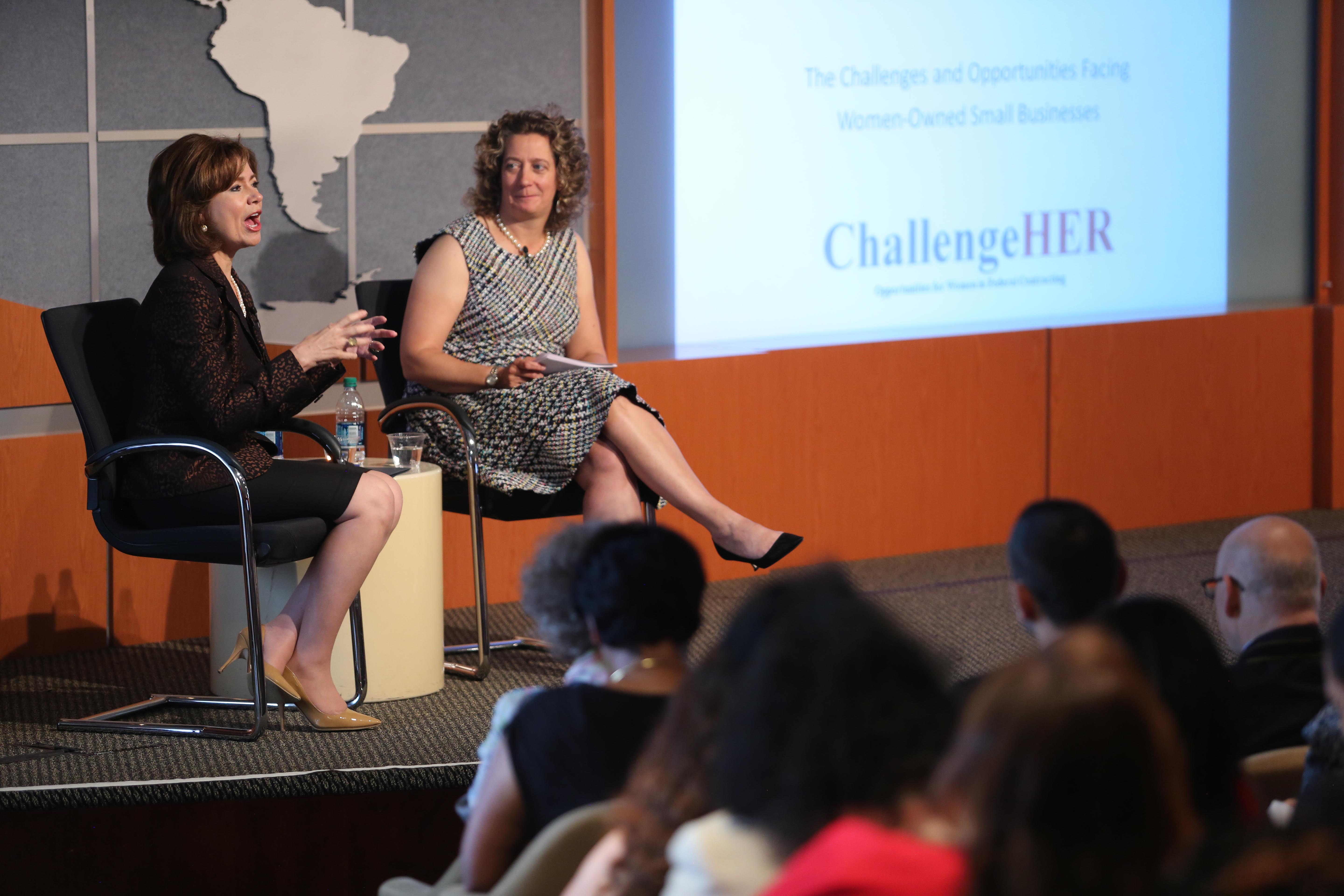
Amex_ChallengeHer_2015-74After Washington, we moved to New York City where we had the great pleasure to listen to an armchair discussion between The Honorable Maria Contreras-Sweet, Administrator, U. S. Small Business Administration and Denise Pickett, President, American Express OPEN, on Fueling the Small Business Economy and Growing Women-Owned Small Business. The discussion was very informative and we learned many new facts regarding the WOSB program and about other SBA initiatives including guarantees for loans to small business owners and thus eliminating some of the risk to the lending partners under Guaranteed Loan Programs (Debt Financing).

Another highlight in NYC was one-to-one matchmaking sessions between Federal Buyers and Contractors, where on top of the panel discussions, women entrepreneurs had a unique opportunity to directly discuss their business proposals with federal contracting officers.

Dallas Questions & Answers Storm

Just a week later, we headed to stormy Dallas for a special ChallengeHER with the U. S. Environmental Protection Agency (EPA). Despite the severe weather forecasts the event day was bright and sunny and well attended! The Dallas audience was very interactive and we had more than 4 hours of sessions filled with questions and active discussions with the speakers and panelists.

We have had a great start to this year’s ChallengeHER “tour” and more summer events are announced for July in Atlanta and for August in Cincinnati and New Hampshire! We can’t wait to meet new women entrepreneurs and help them get new insights for enhancing their businesses.

Stay tuned for upcoming events and visit our website for more information and announcements.

Arianna’s world

Arianna Huffingtion profileToday I came across a very inspiring profile story on Arianna Huffington who we all recognize as an  “Internet Media Pioneer”. The article provides great overview of her story, explains why she is being known as “the Internet’s most improbable media pioneer” and how her career led to creation of the Huffington Post.
Great article for anyone who is interested in online news and wants to learn from one of the pioneers in the field! Read more in New York Times.

Help is on the way!

Export NOWIf you are the owner of a small business interested in the potential exporting opportunity, it’s not easy! There is no central point of entry, much less an easy step-by-step process to follow.   We hear over and over that it is overwhelming with trade development resources and guides often disbursed throughout several agencies and their departments.

Help is on the way for you with the Export NOW program developed by WIPP.   Whether you are considering export, or looking to expand your markets, we have the experts to guide you.   For more information check out our step by step curriculum and get started today.

It’s Time to Lift America’s Ban On Crude Oil Exports

oilby Barbara Kasoff, WIPP President

Since the start of the year, a surprising amount of support on both sides of the aisle to remove the ban on crude oil exports has emerged. Is this a sign that we are entering into a new era of bipartisan collaboration, specifically to form an energy agenda that will improve the nation’s security and get our economy moving again? While that still may be a ways off, it is clear this is one issue that could lead to historic collaboration on energy policies that will benefit American economy.

The 4.7 million businesswomen across the country that our coalition represents believe we can help secure the nation’s economic future through sound energy policies. We believe exporting our abundant energy resources must be a key part of that future and supporting an update in our crude oil export policy is the correct course of action and would allow our country to prosper at its full potential.

According to a report released this week by Margo Thorning, senior vice president and chief economist for the American Council for Capital Formation (ACCF), and William Shughart a research director for the Independent Institute and J. Fish Smith Professor in Public Choice at the University of Utah, the economic advantages and geopolitical benefits to lifting the ban on crude are clear.

The paper titled, “The Economic Case for Lifting the Crude Oil Export Ban,” cites the findings from five different studies conducted by various institutions such as IHS, Brookings Institute, the Aspen Institute, ICF International, and Resources for the Future, all of which agree that the case to update this policy is strong. Notably, they all conclude the same three major impacts lifting the ban on crude oil exports would have on the economy and consumers, including: job creation, an increase in U.S. GDP, and a downward pressure on consumer fuel prices.

For example, one of the most recently released studies mentioned in the report – by IHS – estimated that lifting the ban on crude oil exports would generate 390,000-859,000 new jobs annually nationwide and increase U.S. GDP between $86 billion and $170 billion over the next fifteen years.

Senator Lisa Murkowski, Chairwoman of the Senate Committee on Energy and Natural Resources, who has been one of the biggest champions of an examination of various U.S. energy policies, including the ban on crude oil exports, also noted the economic “no brainer” we are facing, stating, ““the economics are clear… lifting the ban on crude oil exports will benefit consumers.”

In addition to the much need economic stimulus from removing the ban, revising the current energy exports policy specifically with regard to crude oil, also extends U.S. geopolitical influence by strengthening our international trade relationships. Foreign allies would gain access to a stable and abundant source of crude oil that would overall create a more secure market.

Women thought leaders like Dr. Margo Thorning and Chairwoman Lisa Murkowski understand that repealing the ban on crude represents a fiscally responsible strategy to allow the U.S. to utilize our growing energy abundance.  Simply put, to quote Murkowski herself, “It’s time to lift America’s ban on crude oil exports.”

WIPP’s Next Battle

A2C

For the better part of two decades, WIPP championed the effort to help bring women into the lucrative federal market. As many of you know, we accomplished much of what we set out to do with the addition of sole source authority. Since then, however, WIPP’s team in Washington has focused on a statistic that kept repeating in our brains: women receive only $1 out of every $23 that is being loaned to small businesses. How was that possible?

For months WIPP devoted time to researching the landscape of business finance, capital access, and small business lending. What we found was that there are many policy ideas about how to stimulate lending to women – ultimately growing the economy because we all know the economic impact of women-owned businesses.

But we have a long way to go. In 2013, more than two in three loan applications for women-owned firms were denied. WIPP’s annual membership survey regularly finds that women must make multiple attempts to secure bank loans or lines of credit – with a full 40% never succeeding. All this despite women making up one-third of business owners, generating more than $1 trillion annually in receipts, and growing at 1.5 times the rate of average businesses.

The platform WIPP released today, Breaking the Bank: Women Entrepreneurs & the Need for Capital, will hopefully change that. The solutions span three main themes: changing the capital infrastructure, supporting small lending institutions, and strengthening government investment. The platform has four solutions that will change the capital infrastructure. For example, WIPP wants the government lending programs to consider FICO’s alternative credit scoring system. This system modernizes the way credit is calculated to provide new opportunities for women entrepreneurs trying to obtain loans. WIPP also wants to support small lending institutions by pushing for an end to a “one-size-fits-all” approach to regulation. Removing these burdens on small banks will allow them to return their focus to lending.

Changes to government policies are an important part of the platform. WIPP believes a small business seat at the Securities & Exchange Commission will ensure that smaller women-owned firms have an advocate as the next generation of alternative lending, like CrowdFunding, is eventually put into place. Modernizing the Microloan Program, where women are the majority of loan recipients will also make a difference. Women owned small businesses are growing at 1.5 times the rate of average businesses, but they will never get off the ground if they cannot obtain early stage capital.

WIPP does not have a monopoly on good ideas but we have an important voice in public policy. Over time, we may add to this platform to ensure that all policy solutions improving access to funding for women entrepreneurs can become part of the debate in Washington. We ask you today to look through WIPP’s access to capital platform and share it with one other woman you know. If our successes in Washington in the 15 years WIPP has been an organization are any example, we will need a lot of women behind us to make this platform a reality.

Women in Media CAN Get Ahead

by Barbara Kasoff, WIPP President 

I like to kick off my mornings reading Kristen Bellstrom’s The Broadsheet, a daily published dish on the world’s most powerful women. The articles give you timely and thought provoking insight into what powerful women are doing to shape the world. Recently one in particular caught my eye that I thought would be worth sharing – although most of them are worth reading. This one offers tips women in the media – however the tips really extend far beyond the media industry sector: “A Message to Women in Media”.  First, the bad news: We women who work in the media make 83% of what our male counterparts earn. The good news? The author of the article and Morning Joe co-host, Mika Brzezinski has some tips on how to get ahead.
Related links:

House Passes Permanent Internet Tax Freedom Act – GUEST POST

by Rob Shrum, myWireless.org

Good news from the U.S. House of Representatives!

myWireless logoThe House voted to pass the Permanent Internet Tax Freedom Act (H.R. 235), which is strongly supported bipartisan legislation that permanently protects consumers from having to pay taxes on Internet access.

Now it’s time for the Senate to do the same. The Internet Tax Freedom Forever Act (S. 431), as it’s called in the Senate, is the companion to the bill passed by the House today.

The Internet Tax Freedom Act, as both bills are commonly known, was originally passed in 1998 to foster and encourage the continued expansion of Internet use in the U.S. As we all know, the Internet has revolutionized the way we are able to communicate, learn and do business. This legislation has been incrementally extended over the years, and is scheduled to expire October 1, 2015.

Please take a moment to write your Senators today and urge them to pass S. 431.

Let’s work together to make sure Internet access remains affordable and accessible to everyone, and tax-free forever!

See the original post at:  http://bit.ly/1NFX4DF


Bonds: An Important Weapon In Any Contractor’s Arsenal

It is vital that construction contractors, regardless of tier or trade, understand the basic principles of contract surety bonds. An understanding of how bonds are used in construction; and, importantly, how the surety company prequalifies the contractor is critical.   Surety Bonds are mandated by various federal, state and local laws, but may also be required by the private sector as well. Recently, as part of WIPP’s Give Me 5 webinar series, bonding specialist Ellen Neylan, along with construction counsel, Jennifer M. Horn and Maria Panichelli, discussed these issues in detail. Below are some highlights of the discussion.

The Performance Bond secures the contractor’s promise to perform the contract in accordance with its terms and conditions, at the agreed upon price, and within the time allowed. The Payment Bond protects certain laborers, material suppliers and subcontractors against nonpayment. Since mechanic’s liens cannot be placed against public property, the payment bond may be the only protection these claimants have if they are not paid for the goods and services they provide to the project.

In order to obtain a bond, the contractor must be prequalified. Sureties should not bond a contractor that does not meet their prequalification standards. The surety company’s pre-qualification process carefully analyzes the contractor’s entire business operation, much like a bank, because the surety is backing the promise that the contractor will perform the contract. The surety determines the contractor’s ability to meet current and future contract and financial obligations.

The parameters of bonding on a project are often dictated by the law. For example, the Federal Miller Act requires surety bonds for the “construction, alteration, or repair of any public building or public work of the United States for an amount greater than $100,000.” When filing surety claims against Miller Act bonds, subcontractors should be aware that timing is critical. Even though no notice is required, first tier subcontractors must wait 90 days from non-payment to give the bond principal a chance to make payments. In addition, all suits must be filed within one year of last work performed or materials supplied. It’s very important that the claim notice clearly state the amount being claimed, the name of the party to whom labor or supplies were provided, and that the subcontractor is making a formal claim against the bond principal.

The Surety will not pay claims without regard to their merits, but it should be expected to respond to claims promptly and, if denying a claim, offer an explanation. Finally, the Surety, with the aid of legal counsel, can assert all defenses of its bond principal, unless precluded by bond or contract language. Examples of defenses might include: breach of contract; recoupment/setoff; and failure to mitigate damages.

For more detailed information about this important topic, tune in to the recent webinar:

Give Me 5 Logo

Give Me 5: Construction Unit – Bonding and Liens 

As a federal contractor in the construction industry, it is imperative that you obtain proper bonding – but this is a highly complicated subject that could end up costing you an incredible amount of money if you don’t fully understand the nuances and ramifications. This webinar unravels the most important aspects of bonding and liens providing you with important guidelines for success.

Course Instructors: Jennifer Horn, Partner, Cohen Seglias Pallas Greenhall & Furman PC & Maria Panichelli, Associate, Cohen Seglias Pallas Greenhall & Furman PC and Special Guest: Ellen Neylan, Founder, Surety Bonds Associates

Listen to the Podcast | View the Presentation

June 2015 WIPP National Partner of the Month

Ann Rama

Anjali “Ann” Ramakumaran

Founder and CEO of Ampcus Inc

Website Address- www.ampcus.com

Company was founded – 2004

WIPP sat down with Ann to hear a little bit more about her business and relationship with WIPP:

Tell us a little about your company and its mission.

  • Ampcus is a Business and a Technology consulting and a staff augmentation company headquartered in Chantilly VA 25 miles West of Washington DC. For a decade we have been supporting various fortune 1000 corporations and federal agencies on various mission critical projects of theirs.
  • Our mission is todevelop and deliver innovative  and effective workforce solutions that make a difference in the life of our customers and employees.

Ampcus is one of the very few women and minority owned company who has all the process certifications required in this field. Ampcus is an ISO 9001:2008; ISO 27001:2005; ISO 20000:2005; and SEI CMMi Level 3 certified Company. Ampcus has been growing at a rate of 40% and maintain high employee retention of over 94%.

Have you always been an entrepreneur?  If not, what, or who, inspired you to take this leap? I think Entrepreneurship is imbedded in me. I did work with a small women owned business and as an employee I would work as though it was my own company. I was also recognized by my employer for that.

How are you engaged in your community (or state or national scene) in philanthropic or political causes? 

Philanthropic activities:

  • Contributions to American Cancer Society
  • Contributions made for pediatric cancer research
  • Providing Scholarship to Underprivileged student through USPAACC Education foundation for college education
  • Supporting various non profit organizations like WBENC, WPEO, USPAACC , CRMSDC( Co-chairs and Presenting Sponsors) and sponsoring various events of theirs to promote other Women owned business , small business and minority owned business.

Boards/Leadership Committee:

  • Advisory Board Member- MBE Advisor MBN USA
  • Brain trust and Leadership Committee Member- USPAACC

What value/resources has WIPP brought you (training or education, member or political connections/access, awareness of policies that affect your business and its growth, etc.) that have been helpful to you? WIPP has helped us a lot as we get access to lot of training material, get access to political members, webinars have always helped us.

Ann’s Bio

Ann is the Founder and CEO of Ampcus Inc, a technology savvy entrepreneur with more than 10 years of contribution towards the design and development of software services and delivery of Information Technology services. Under her leadership she has grown Ampcus Inc into a fast growing consulting and professional services firm.

She has been awarded as the top Asian American owned businesses by USPAACC for 2009, 2010, 2011, 2012, 2013 and 2014 and 50 fastest growing women owned businesses in the CONUS by the Women Presidents Organization for the years 2010, 2011, 2012, 2013 and 2014, 2015. Ampcus Inc made the Inc500/5000 list for the years 2010, 2011, 2012, 2013 and 2014. Ampcus Inc has also been recognized as the Top diversity business for the years 2010, 2011, 2012, 2013 and 2014.

She has helped fortune 2000 companies with their enterprise-wide customized solutions. She reports to the board and drives the company to attain its vision of being one of the largest Professional services companies globally. She has been involved in executing a consultative methodology to define, qualify, and quantify the clients’ targeted and strategic IT and business objectives and from this developed solutions to proactively address current and evolving needs and projects.

In 2014 Ann was awarded Women in Technology Entrepreneur of the year by Women in Technology and in 2015 Ampcus was awarded the growth award by Astra WBENC. They were also awarded Washington Technology Fast 50.

Ann holds her Bachelor’s and Master’s degrees in business and commercial management from India. She has also completed an executive management program from Robins School of Business, University of Richmond.