How to Boost Women’s Entrepreneurship

While numbers of women entering labor force are steadily increasing, their participation in entrepreneurship is less favorable. In fact, according to the Kauffman Foundation, an entrepreneurship think tank, women are only half as likely as men to start a business resulting in unrealized potential for their contributions to job creation, innovation, and ultimately economic growth.

UntitledKauffman Foundation released a new study claiming that women would make great entrepreneurs but they often fail to start their own business mostly due to following reasons:

  • Shortage of available mentors;
  • Perception of entrepreneurship as a masculine activity;
  • Additional hurdles maintaining a work-life balance due to parenthood.

However, we can address these barriers as Kauffman highlights 5 ways for policymakers on how to encourage women to start their own business.

  1. Provide more exact, gender based, data on entrepreneurship programs and initiatives to understand how they can better help women entrepreneurs. Collecting data based on gender will help them to make more accurate decisions in assisting women entrepreneurs.
  1. Increase the number of women leading entrepreneurship programs. Women can better lead and support other women entrepreneurs by using their networks for accessing mentors, financial capital, and creating women inclusive events that attract women entrepreneurs.
  1. Increase Small Business Innovation Research (SBIR) awards to women-owned businesses. Although federal agenciesparticipating in the SBIR Seed Fund are encouraging women to engage in federal research/Research and Development, only 15 percent of SBIR awards went to women-owned businesses in 2012. One of the ways to increase this number is to partner with women’s professional organizations and make better effort of reaching out to women entrepreneurs to participate in these programs.
  1. Share stories of successful women entrepreneurs. Celebrating accomplishments of women entrepreneurs will change the false perception that only men are successful entrepreneurs and encourage more women to follow successful women in business.
  1. Decrease the risk of becoming an entrepreneur. Pressure and risks that women as entrepreneurs are facing, especially with young families, can discourage them of starting in the first place. By exploring various policies such as subsidized childcare or preschool, can help alleviate the pressure and create a more favorable environment for women to start their own businesses.

Read the full study here.

Natural Gas Exports: The Next Step for America’s Energy Revolution

By Barbara Kasoff, re-blog from Morning Consult

At a Washington gathering last month, Energy Secretary Ernest Moniz offered a high-level view of the “challenges, vulnerabilities and opportunities” that America’s energy revolution is now bringing us. One of those opportunities, he told the assembled industry, government and academic experts, was the need for a modernized energy infrastructure that lives up to our new status as the number one producer of oil and gas in the world.

Moniz highlighted the role of the Department of Energy (DOE) in approving federal permits for exports of liquefied natural gas (LNG). That’s all well and good, but we have to streamline this process so we can make the remarkable output of domestic natural gas from shale deposits available to global markets hungry for new sources of energy. In just a few short years, America has literally reversed the flow of natural gas from dependence on foreign sources to the promise of a robust export market.

“Moth-balled LNG import facilities from the 2000s are being re-purposed and the U.S. will likely begin exporting LNG early next year,” Moniz said. “In fact, if all the facilities were built pursuant to DOE’s cumulative approved export permits or those that could be approved over the next year, the U.S. would be in the same league as Qatar, the world’s largest LNG exporter – while still sustaining ample supplies for domestic use.”

Harvard University recently published a study that adds more urgency to this positive outlook for LNG. “The potential size of the LNG export market is uncertain,” the Harvard experts wrote, “but we estimate that in a favorable price environment, it could reach 3.1 trillion cubic feet by 2030, or 14 percent of total U.S. production, and contribute an additional $18 billion in GDP.”

One of the “immediate action steps” proposed in the Harvard study is to remove the regulatory restrictions that are slowing the permitting process that Moniz oversees. The foot dragging on LNG, much like the current ban on crude oil exports, is a vestige of a bygone energy era characterized by worries of scarcity and dependence on foreign energy resources. The American energy revolution has swept those concerns away.

As it was just announced this week, things are moving forward partially for crude oil, as The Senate Committee on Energy and Natural Resources will meet within the next two weeks to consider lifting the 40-year-old ban on exporting crude oil.

Modernizing the regulatory process for LNG exports is a bipartisan issue that Congress, the domestic energy industry and the Obama administration can get behind. That would represent an important first step toward a new era of bipartisan collaboration on U.S. energy policies. Sen. John Barrasso, a Wyoming Republican, offered an amendment to the National Defense Authorization Act in beginning of July that would do just that.

“If President Obama is serious about helping the people of Ukraine, he will immediately expedite the approval process for liquefied natural gas exports,” Barrasso said last year, shortly after President Obama said there would be “costs” for Russia’s actions. “American natural gas exports would help Ukraine free itself from Russian energy and Putin’s political manipulation,” Barrasso added. And though the amendment was not included, it is initiatives such as this that we cannot overlook.

Indeed, the 2015 Economic Report of the President noted that “an increase in U.S. exports of natural gas, and the resulting price changes, would have a number of mostly beneficial effects on natural gas producers, employment, U.S. geopolitical security and the environment.” Not only would significant exports of American LNG reduce European dependence on Russia and Iran – the current primary suppliers for that region – but the increased trade could support as many as 65,000 American jobs.

In February, North America’s first LNG export terminal, Cheniere Energy Inc.’s Sabine Pass on the Gulf Coast, is expected to send its first shipments to buyers in Lithuania, Reuters reported. The Baltic states and Poland are looking to imports from the United States to reduce their dependence on supplies from Russia.

Speeding LNG exports is something we can all get behind. It’s the cleaner burning energy that our friendly trading partners need, and a way to create jobs and strengthen our economic rebound at home. Now, let’s get busy in Washington to clear the regulatory roadblocks.

The Database of Dames

Choose Possibility

By Annie Wilson, Intern

Last Wednesday, July 15th, CEO and co-founder of online shopping startup Joyus, Sukhinder Singh Cassidy launched a new initiative at Fortune’s Brainstorm conference in Aspen and her goal is simple: to close the gender gap in the tech industry.

Singh Cassidy launched the Choose Possibility Project, which includes the ‘Boardlist,’ a database comprised of vetted, qualified female industry professionals who have been nominated by startup founders, investors and executives. The aim: to make the gender ratio amongst board members for up and coming tech startups more equitable and to increase opportunity for women in tech. Thus far, ‘Boardlist’ has partnered with 50 members of the tech industry, including 18 venture capitalists, to help the project succeed.

Singh Cassidy hopes that the accessible nature of the ‘Boardlist’ will undercut the excuse that many tech leaders use when trying to diversify their board: that there are a limited number of qualified female candidates that they have exposure to. The database itself is already comprised of over 700 women and the hope is that with the increased accessibility to these candidates there will be a positive change in leadership for the tech industry.

Although the industry still has a lot to accomplish for gender equity for their employee demographics, Singh Cassidy believes that focusing on the boardroom could make a substantial impact. “There is in fact a discovery problem,” she said, adding that “this is access to talent, not about filling some quotas,” as diversity efforts are often mistaken.

Click here to read more.

Interested in joining the project and becoming a part of the ‘Boardlist’? Click here.

WIPP Signs Strategic Partnership with International Trade Administration on Exporting Initiatives

img_0179Earlier today, WIPP joined Assistant Secretary Jadotte at the U.S. Department of Commerce to announce a new partnership to increase awareness about exporting in the U.S. business community. Women Impacting Public Policy’s (WIPP) new strategic partnership with Commerce’s International Trade Administration (ITA) will focus on providing education and resources to help small- and medium-sized women-owned businesses succeed in the global marketplace.

Signed this morning, the Memorandum of Agreement explains that, ITA and WIPP will work together on marketing, education programs, and events leveraging our organizations’ expertise to help make U.S. businesses more export savvy. WIPP recently developed Export NOW, a step-by-step program which guides participants — current and new exporters — through the steps to enter new growing markets or to expand their export reach. We’ll also partner with ITA on our Export Now program. Joint activities may include building awareness through outreach at trade shows, collaborative press and digital communications, and online registration for resource support.

As the U.S. marketplace becomes more competitive than ever, it is crucial for businesses — particularly small- and medium-sized businesses — to engage a broader international market for success. WIPP firmly believes that the products and services provided by women-owned businesses belong not just in American hands, but should reach every consumer around the globe. As a leader in educating businesses on ways to build, develop, and expand their companies, WIPP is perfectly positioned to work in concert with ITA to aid women-owned firms in growing their footprint in the global marketplace via export opportunities.

In 2014, U.S. Secretary of Commerce Penny Pritzker announced the National Export Initiative/NEXT (NEI/NEXT), an expanded and revitalized U.S. export strategy. NEI/NEXT focuses on supporting U.S. businesses of all sizes and economic growth in American communities by making it easier for U.S. companies to access export resources and capitalize on growth opportunities around the world. Our partnership with ITA supports this initiative by educating U.S. women-owned businesses about the benefits of exporting and expanding their exports to additional markets. Companies will learn about public and private sector resources to assist them in going global. WIPP joins several of ITA’s Strategic Partners who have connected more than 1,500 companies to federal export assistance to broaden and deepen the U.S. exporter base.

Walmart Global Women’s Forum Library

WalmartWIPP Corporate Partner, Walmart, held their inaugural Global Women’s Forum in April, a live event broadcast online to more than 5,200 locations across 29 states in the U.S., and internationally in ten locations, while eight additional countries held their own event on the same day.

The event featured female leaders such as Academy Award Winner Geena Davis, PepsiCo’s Chairman and CEO Indra Nooyi and BBC World News anchor and author, Katty Kay. The Forum was part of Walmart’s President’s Global Council of Women Leaders’ Global Women’s Development Series, which helps develop the future women leaders of Walmart.

Walmart is making content from the Global Women’s Forum available to women worldwide with a new digital library. I encourage you to log on and visit the library, which features speeches and panel discussions among top women leaders offering their advice and encouragement for female professionals worldwide. You’ll notice three topics are prominent throughout the videos: confidence, mentoring and work/life integration. All of these topics are critical to us as women to learn about and develop, as they can open doors to endless opportunities.

As the world’s largest retailer, women make up more than half (57 percent) of Walmart associates and Walmart has twice the rate of female corporate officers (32 percent) as the Fortune 500, which puts the company in a position to make a real impact on women in the workforce.

Click here to visit the new digital library and be sure to share with your friends and colleagues: Walmart Global Women’s Forum Library.

Take Advantage of the Federal Contracts with WIPP

In 2000, the federal government set a goal to award 5% of all contracts to women-owned businesses. In February 2011, after 11 long years of work, the Women-Owned Small Business Federal Contract Program was finally enacted to help make that goal a reality. This program allows federal contracting officers to restrict competition for certain federal contracts to women-owned businesses.

Give Me 5 LogoSince then, our goal was to provide women-owned companies with guidance on how to take advantage of the set asides, which resulted in launch of a specialized program, Give Me 5.

Give Me 5, named for the 5% federal contracting goal for women-owned businesses and created by WIPP and American Express OPEN®, is designed to educate women entrepreneurs on how to successfully navigate the federal contract marketplace through a full range of freely accessible and on-demand online educational courses ranging from contracting basics to more advanced courses.

Give Me 5 has over 90 educational courses, with 20 highly specialized contracting instructors .

We encourage you to join successful women-owned companies and start doing business with federal government. Our next webinars are focused on Understanding Project Accounting and its Impact on Government Contracting and on The Essential Ingredient of All … Relationships!

Also don’t forget to check out WIPP’s other federal contracting education resources:

Explore New Growth Opportunities with Export NOW

If you were hesitating on whether or not to export – here’s the business case for you: U.S. metropolitan areas in 2014 set export highs for the fifth year in a row exceeding $1.44 trillion in goods exports!

As highlighted by U.S. Commerce department: “Today, U.S. businesses are increasingly taking advantage of export opportunities. The data makes it clear. Companies based in the United States that sell their world-class goods to the 96 percent of potential customers who live outside our borders are critical to both the local and national economy. This is evident in today’s release of the 2014 Metropolitan Area Export Overview. The report highlights data on goods exported from U.S. metropolitan areas in 2014. Some of the nation’s most prominent cities are leading in trade and setting new export records.

We will guide you through the process of joining them with an exciting growth opportunity for your Business -> WIPP’s National Export Expansion Education Program. This step-by-step program will lead participants (both current and new exporters) through the steps to enter this growing market, or to expand their export reach.

You don’t have to be big to export – We will help you take a bite of the Export cake
Screen Shot 2015-07-08 at 4.35.07 PM

And Why Export? It’s a big world …

  • 95% of consumers live outside of the U.S.
  • 80% of world economic growth forecasted to occur outside the U.S.
  • $2.3T of U.S. goods and services exported in 2013

… and great Growth Opportunity

  • U.S. exports are in high demand although only 300,000 U.S. companies export – it’s a competitive market
  • Average revenue per firm was $23 M in 2013
  • Exporters report nearly 4 times total revenue per firm
  • Digital technologies enable entrepreneurs to be “micro-multinationals” that sell and source products, services ad ideas across boarders (McKenzie)

In WIPP’s Annual Survey, 38% of all respondents showed interest in our Export NOW program, so here are ours first webinars for entry-level exporters. Stay tuned for our advanced series! Register for first free webinars:

Screen Shot 2015-07-09 at 3.07.25 PMScreen Shot 2015-07-09 at 3.08.25 PM

The program is in partnership with the U.S. Department of Commerce’s International Trade Administration (ITA) and with the Clinton Global Initiative to make Export NOW an official CGI Commitment to Action.

For more information check out our step by step curriculum and get started today.

Time for Congress to Move a Neutral Net into Drive

WIPP infographic II

Capital investment is a solid predictor of economic health. That’s why recent news in the communications policy arena deserves Congress’ attention.

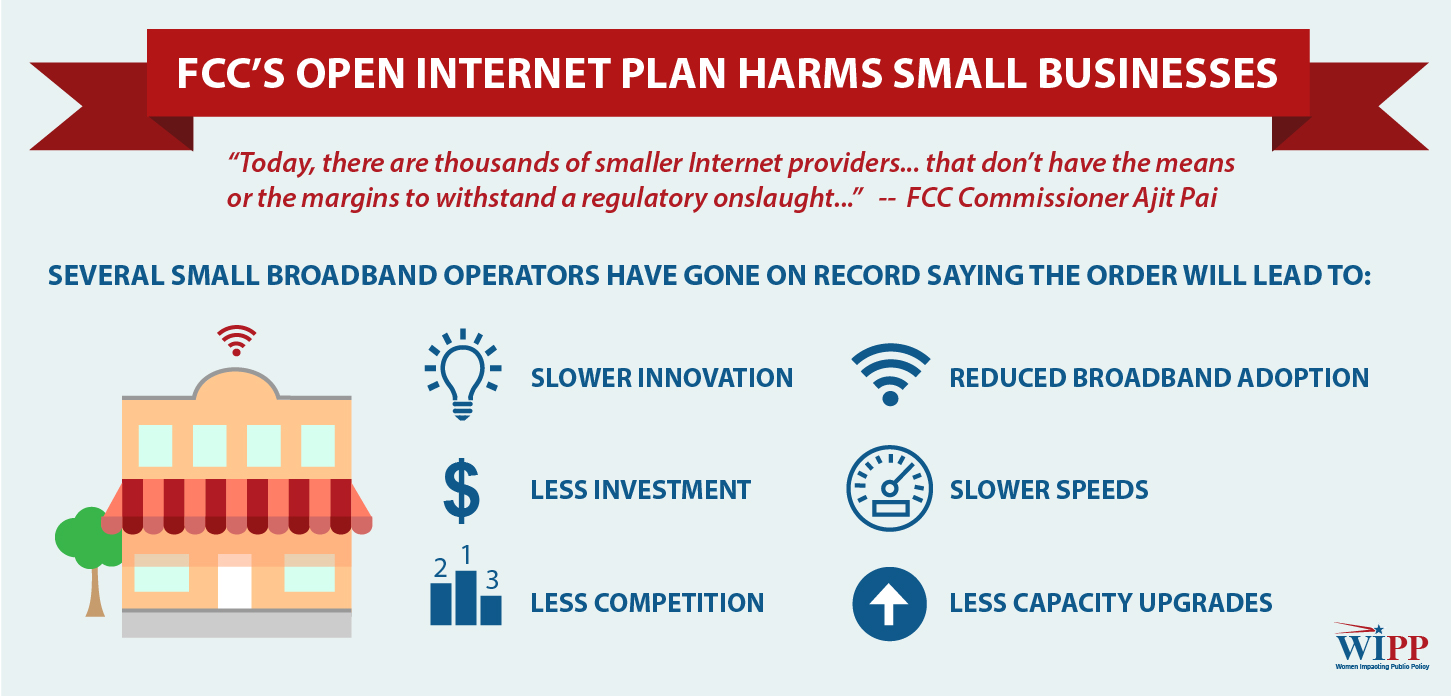
Last week, a new regulatory regime over the Internet took effect. But before these rules came to life, a half-dozen small Internet providers in the Midwest, South and Pacific Northwest told federal officials that they had been forced to cut back on expanding faster broadband service because of the FCC’s recent decision to begin micromanaging the Internet.

All six of these Internet providers specialize in serving small towns and underserved areas; none have the size or scale to accommodate the new regulations’ expenses without budget cuts elsewhere. Moreover, their statements were made under threat of perjury.

For women in particular, this issue should raise serious concerns. Almost half of women-owned businesses are home-based. Anything that slows home broadband deployment has a potential to impact the full economic participation of women.

These verified reports about higher regulatory costs and less money for investment are a clear “canary in the coal mine” warning to Congress about the FCC’s decision to regulate the Internet with Title II regulations written in 1934. That 3-2 party line vote on February 26 overturned decades of successful experience about the benefits of “light touch” rules for the Internet.

Prior to that ill-fated FCC vote, federal Internet policy was both an area of broad agreement and a shining example of successfully encouraging an important new industry. The lack of federal micromanagement that was a hallmark of federal policy since Bill Clinton’s Presidency was key to unleashing a tidal wave of communications investment — $1.3 trillion since 1996 and $75 billion just in 2013.

The results speak for themselves, especially when compared with other countries’ experiences. The U.S. has a huge lead over Europe in both fiber optic deployment and high-speed 4G LTE broadband. Americans spend more time talking on their mobile phones than people in any developed country in the world.

This investment also produced jobs – lots of them. The growth of the mobile app economy, which developed because of America’s high-speed wireless networks, sustains more than 750,000 U.S. jobs, according to the Progressive Policy Institute.

The FCC’s decision to regulate the Internet as a public utility with outdated Title II rules undercuts the very policies that helped spur this success. The FCC’s action is as inexplicable as it is wrongheaded.

Indeed, the Commission’s efforts to explain this action border on the comical. As Hal Singer noted in a recent Forbes commentary, the FCC’s own economic analysis of its action is almost amusing. For example, the agency claimed that the broadband industry’s strong record of investment in 2010 showed that its regulations encourage investment, despite the fact that the Commission’s vote on a more reasonable set of Internet rules occurred on December 21, 2010.

Ultimately, the key reason that Congress must update America’s communications laws is to protect the people who lost an opportunity for better Internet service, because the FCC’s action added pointless new expenses and legal uncertainties to broadband deployment.

The 8,000 St. Louis-area residents served by Wisper ISP, a Missouri-based Internet provider, have felt the negative impact of these utility style regulations. As a result of the FCC’s decision, Wisper estimates that compliance costs will grow to 10% of its operating revenue. It has already had to cut investment, resulting in what the company calls “slower broadband speeds, less dense coverage, and absence of expansion into new areas.”

It is a testament to the bipartisan, light-touch policies implemented back when Internet access meant a 56 KB modem that consumers enjoy so much today. Yet, at just the time when the United States was poised to run the table in a 21st century economy, the FCC pulled the rug out from under small businesses. The FCC’s February vote, and last week’s rules enactment, undid the phenomenal success of the modern Internet.

It is time for Congress to set things right again. We hope that members of both parties come together to enact common-sense legislation that both protects the Internet and reinstitutes the wise telecom policy that has brought us the Internet we use and enjoy today.

Growing your export business?

Export NOWIf you are the owner of a small business interested in the exporting opportunities, it’s not easy! Help is on the way for you with the Export NOW program developed by WIPP.   Export NOW is an advanced program designed for exporters to grow and expand their business to new markets.

Program focuses on:

  • Key considerations involved in export such as finance, IP, logistics, technology, etc.
  • Discusses export sales channels with detailed segments on market analysis and building a market plan, including financing requirements and opportunities.

Export NOW will introduce you to the “experts” from both the public and private sectors to inform, educate and coach in its on-line on demand education program and live regional events.

The program is in partnership with the U.S. Department of Commerce’s International Trade Administration (ITA) and with the Clinton Global Initiative to make Export NOW an official CGI Commitment to Action.

For more information check out our step by step curriculum and get started today.

July 2015 WIPP National Partner of the Month: Juli Betwee

Julie B WIPP’s July 2015 National Partner of the Month: Juli Betwee

Managing Partner at Pivot Point Partners of San Francisco, CA

WIPP sat down with Juli to hear more about her company and relationship with WIPP.

I work with leaders of mid-sized companies to grow and scale their business.  The analogy I often use is:  Strategic planning is like a commitment to a gym membership.  The membership is the intention to set a goal and follow through.  Consistent follow-through is the tough part… when most people bail from their intention.  I work with companies for 2-3 years enabling them to compete in markets and with services, necessary for sustainable, profitable growth but not usually attainable if they keep doing what they have always done.

Tell us a little about your company and its mission. I am the Managing Partner at Pivot Point Partners. It is hard give you a short explanation so I have put together a little piece about Pivot Point.

Have you always been an entrepreneur?  If not, what, or who, inspired you to take this leap?  I have always been entrepreneurial. I often bring a fresh and different perspective to what I do. It is the advantage I bring to the people with whom I work.

How are you engaged in your community (or state or national scene) in philanthropic or political causes? I am on the board of The Center for Social Entrepreneurship at Santa Clara University. I have plans to teach an undergraduate business course in 2015-16. I am working with WIPP to develop their growth strategy and am on the board of The Women Presidents Organization. I contribute to GLIDE, as I believe in their model of social justice.

Have you advocated for an issue or a cause important to you? I advocate for issues that impact women in business.

What value/resources has WIPP brought you (training or education, member or political connections/access, awareness of policies that affect your business and its growth, etc.) that have been helpful to you?  Being Involved with WIPP has given me deeper insight into public policy and how it works. I am amazed at the work you accomplish and inroads you are making for women business leaders.