A Scorecard That Matters

WG Blog

By Sydney Ringer, WIPP Government Relations Intern

Earlier this year, Dell released their 2015 Global Women Entrepreneur Leaders Scorecard, a new data-driven diagnostic tool that identifies the impediments to high-impact entrepreneurship. It also introduces steps that can be taken to improve the conditions for high-impact female entrepreneurship development. Countries were rated on five categories: business environment, gendered access, leadership and rights, pipeline for entrepreneurship, and potential entrepreneur leaders. The United States, France, the United Kingdom, Sweden, Australia, and Canada are at the top of the list.

While the United States was at the top of the rankings system, our rating was still only 71/100 across the categories. Only 13% of start-ups have women on their executive team, and just 3% of start-ups with women CEOs received venture capital funding in 2014.[1] According to Dr. Ruta Aidis, the project director, “if women entrepreneurs were starting growth-oriented businesses at the same rate as men in the United States, we could potentially have 15 million more jobs in the next two years”.[2] The Scored is another reminder of just how challenging it can be for women to succeed even today, and even in countries like the United Sates.

First, female role models in business and government are critically important. In the U.S. only 22% of the female population knows an entrepreneur despite 46% of women believing they have the skills necessary to start a business. Women entrepreneurs can leverage their success to provide real business insights on how to encourage women to start their own businesses. Once Women decide to start their own business they have modest aspirations because access to capital is still a huge barrier. Women-owned companies are 50% less capitalized than their male-owned counterparts.

While this report demonstrates all the growth the United States and other countries still need to do, it also presents some interesting ways to encourage women entrepreneurs. On the international level, the International Trade Centre launched a global initiative to increase the proportion of public procurement contracts being awarded to women owned businesses. The study also suggests corporations diversify their leadership and increase the number of women-owned business vendors in their supply chain.

The media can also play an important role as well. Right now global media only features women as subjects in print, radio and television 25% of the time. Seeing more articles featuring women as the top story on their homepage could inspire women to follow in their footsteps.

Every country in the study, even the top rated, has room for improvement. More than 70% of the countries still rated scored less than 50 out of 100. Despite challenges, women-owned businesses are growing, but they would be growing at an exponentially faster rate if they got some encouragement from their governments, corporations, media, and other entrepreneurs.


[1] CNN Money, “The Best Country For Women Entrepreneurs.” 2015. Available online at http://money.cnn.com/2015/06/30/smallbusiness/women-entrepreneurs-dell/index.html?category=smallbusiness

[2] “Global Women Entrepreneur Scorecard Executive Summary”. 2015. Available online at http://i.dell.com/sites/doccontent/corporate/secure/en/Documents/2015-GWEL-Scorecard-Executive-Summary.pdf
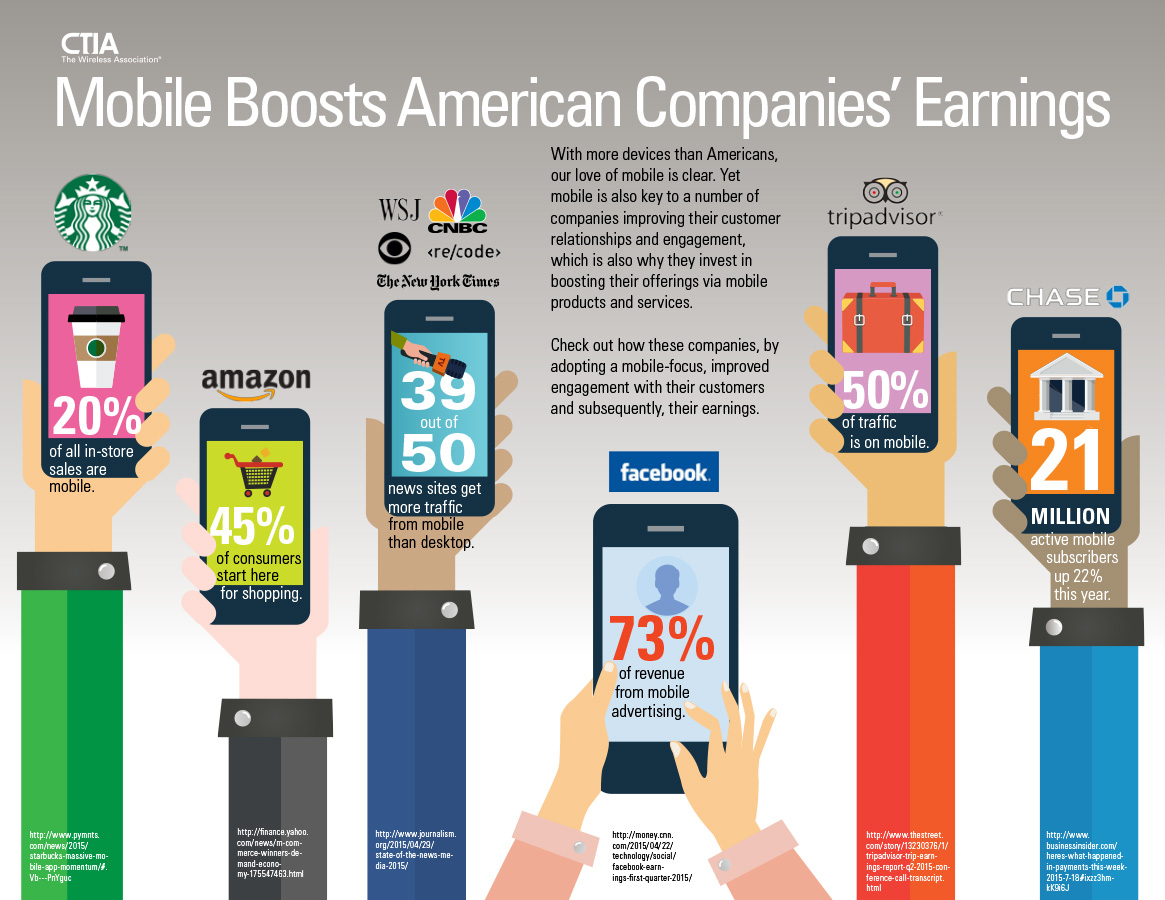
INFOGRAPHIC: Mobile Technology Boosts American Companies’ Earnings

Check out this infographic from CTIA – the Wireless Association on how mobile helps companies with their customer relationships and engagement, helping their bottom lines.

mobile-boosts-american-companies'-earnings

SBA’s Announcement of the 2016 InnovateHER Challenge and Summit

FeatureInnovateHER

By Annie Wilson, Intern

On Tuesday, August 4th the Small Business Administration (SBA) announced the launch of the 2016 InnovateHER: Innovating for Women Business Challenge and Summit. In partnership with Microsoft, the 2016 InnovateHER includes the second round of the women’s business competition to feature new, innovative products and services that help to change and empower the lives of women and families. Last year, the SBA engaged over 100 organizations and reached 1000+ entrepreneurs around the country and this year they have expanded their challenge to include a women’s summit.

It is the SBA’s hope that through this summit they can unveil products or services that have a measurable impact on women and their families, fulfill a marketplace need and have potential for commercialization. The SBA recognizes that while women control 80% of the purchasing power in this country they only make up less than 5% of venture capitalists. The InnovateHER Challenge is an effort to bridge that economic standard for women and elevate commercial success for women entrepreneurs and products for women.

The InnovateHER event will kick off in the fall of 2015 in its initial round starting with competitions hosted by universities, accelerators, clusters, scale-up communities, resource partners and other organizations. The SBA is encouraging organizations all across the country to participate in this challenge to provide accessibility to an innovative space for women. A way in which organizations can help the InnovateHER challenge and women entrepreneurs within their community is to host a local business competition and submit the winner to the SBA no later than December 3rd, 2015 for the semi final rounds. The SBA will then select up to 10 semifinalists from their community nominations that will be sent to the final pitch competition. The 2016 InnovateHER and final pitch competition will be held March 16-17th, 2016 in Washington D.C. At the final competition, the remaining contestants will do one final marketing pitch and compete to be one of the top three winners to receive up to $70,000 in prize money.

Make sure to check out last year’s winners: LIA Diagnostics, the Shower Shirt, and Trusst.

If you’d like to learn more about the challenge rules or how to become a host organization, please click here.

If you’d like to learn more about the challenge itself, please click here.

General Assembly Fellowship Opportunity

GA ATT blog

WIPP sponsor, AT&T, is partnering with General Assembly to support the General Assembly Opportunity Fund, a fellowship program aimed at providing hands-on education and career opportunities in technology to underrepresented groups across the globe. The Opportunity Fund specifically supports women, people of color, military veterans, and low-income individuals.  GA’s Opportunity Fund scholarship program will provide 20 youth and veterans an opportunity to take GA’s full-time, 12 week Web Development Immersive (WDI) and 10 week User Experience Design (UXDI) courses in San Francisco, Atlanta and Washington, D.C. and 50 scholarships for an online web design course. You can read more at CGI America here.

Deadline for all applications is August 15th.

Momentum of Women in Tech

Women in the tech industry is getting more and more coverage in last couple of weeks and days, from the #ILookLikeAnEngineer tweet storm to the White House Demo Day event resulting in tech giants announcing plans to hire more women and minorities. Intel went even further, offering their employees bigger referral bonuses when recommending a woman candidate.

mar_310_women_in_tech_sf

It is all part of a long-term public discussion about women in technology, or rather, addressing the fact that there is not enough women working in the technology sector. Despite high profile stories on successful women leading tech giants, the numbers are actually getting worse. In last two decades, there was a steady decline of women working in tech industry – from 35% in 1990 to just 26% in 2013. Some blame the pipeline, other the unfriendly “bro” culture or not favorable family policies that prevent women from building long-term careers in the tech industry. But the overall outcome is the same – 41% of women end up leaving tech jobs after couple of years.

Rachel Tomas provides deep insight into the topic in her latest story for medium.com. As a programmer, she discusses components of the tech culture which she states led her to leave her tech career, citing unconscious bias against women.

Ms. Tomas highlights several statistics from studies on gender disparities in the tech industry:

How can the tech industry make positive changes to be more inclusive of women? Ms. Tomas makes several recommendations:

  • More comprehensive training of managers, especially in fast growing companies where engineers are often being promoted without any training at all.
  • More formal hiring and promotion criteria to avoid decisions based on “gut feel” which is often unconsciously biased as learned from the above studies.
  • Strong leadership implementing concrete measures to support unbiased culture and diversity.
  • Regular audits on employee data such as comparison and evaluation of earnings, promotions, performance reviews, and attrition rates among genders.
  • Cease encouraging and rewarding employees to stay late at work which besides risk of burnouts leads to discrimination of people with families.
  • Create a collaborative environment instead of competitive one.
  • Offer adequate maternity leave without compromises as requiring participation on teleconferences during leave.

Read Rachel Tomas’s full piece here.

What We Can Learn from High Growth Women Owned Firms

By Annie Wilson, Intern

Last year Susan Coleman D.P.S. and Alicia Robb Ph. D published research prepared for the National Women’s Business Council examining the factors affecting access to capital for high-growth women-owned businesses. In their research, Coleman and Robb found that currently in the business community 30% of businesses were owned by women, however they are mostly small:

  • only 12% of women-owned small businesses (WOSBs) employ anyone other than the business owner;
  • 2% have 10 or more employees; and
  • only 2% have revenues in excess of $1 million.

NWBC Blog Image

This new data shows the need to engage and educate women owned businesses on growth strategies that can expand their businesses.

This report delves deeper into the issues relating to capital accessibility specifically for growth oriented firms, which comparative studies have yet to research thoroughly due to a lack of data.

According to the study, access to capital may be more challenging for women-owned firms than for men for a multitude of reasons:

  • In terms of financial capital, there are considerable gender gaps in the amounts of financing across firms. Men start firms with nearly double the amount of capital that women do and, of high growth firms, men use more than double of what women use. Men also indicated to have used six times the amount of financing that women do.
  • For startup capital, women were found to be more reliant on owner equity and insider financing as opposed to men who used outsider equity predominantly. For women owned firms, a very small fraction of startup capital came from outsider equity regardless of where the firm was on the size spectrum.
  • In terms of credit market experiences, women indicated to have similar loan application rates as men even though there are more unmet credit needs among women. Women were more likely to not apply for the necessary credit due to a fear of a denied loan application. Also, credit scores are generally lower for women.
  • While men and women are on par in terms of education levels, men exceed women in degrees in the STEM fields, which is the industry that experiences more growth.
  • By means of industry experience, as women tend to have lower levels of startup experience, team ownership and hours worked compared to men.
  • Women have higher rates of owning businesses that are home-based due to family commitments and research has indicated that being home based is negatively related to growth.

However, when comparing the top ranking female businesses by employment and growth potential, there are some considerable differentiations that set them aside.

  • They had a higher rate of employment from their startup year onwards.
  • They are more likely to be in tech industries.
  • They were more likely to offer services as opposed to products.
  • They were less likely to be based from the owner’s home.
  • They were more likely to be incorporated and as a result yield higher credit scores.

For leadership traits, women business owners of high growth firms also had some unique characteristics:

  • They were likely to have more years of industry experience and more likely to have more startup experience.
  • They started their businesses with much more capital (even more than the male owned firms overall.)
  • They used more outsider equity for startup capital. However, this was typically still less than their male counterparts.

Learning from these success measures, it is clear that increased capital for women entrepreneurs, specifically in the startup phase of their business, has an important correlation to the trajectory of women owned businesses. In order to foster a more successful environment for women, there must be changes in the business environment to give women the support and resources they need to turn this trend around.

It is clear that the financing gap between men and women business owners is a considerable detriment to the vitality of women-owned firms. In order to ensure stronger female entrepreneurship and make strides towards closing this gap, efforts must be made to strengthen the financial capabilities of women entrepreneurs and encourage accessibility to bank and equity financing. Also, providing more visibility and accessibility to successful female industry professionals and providing more opportunity for women to attain industry experience could help bolster the entrepreneurial confidence that women need to compete with their male competitors. Another important step forward would be an increased use of family-friendly policies, which could give women the flexibility to work outside of their homes and in an environment more conducive to entrepreneurial growth.

Take a look at WIPP’s recently launched Access to Capital platform to address funding gaps and the crisis of capital faced by women entrepreneurs.

To read the full report, click here.

August 2015 WIPP National Partner of the Month

Lynn Sutton

August WIPP National Partner of the Month: Lynn Sutton 

WIPP sat down with Lynn to hear a little bit more about her business and relationship with WIPP…


Tell us a little about your company and its mission.

Advantage Building Contractors, Inc. is a federal government contractor specializing in design build, general construction, and facilities support.  The company was founded by Patricia Summers and I in 2002 as a residential roofing specialty trades contractor. In 2010 Advantage made its way into the federal arena and within a year, Advantage was awarded the first WOSB set aside contract in construction. Like most other small businesses getting started with the federal government, Advantage faced the brutal challenges of developing business in the absence of no relevant past performance and, specific to construction, little bonding capacity. We were able to build our capabilities through sole source opportunities, teaming partners and relentless follow-up with agencies. Our Mission Statement is “We’re on a mission to make our customer’s job easier.”

Have you always been an entrepreneur?  If not, what, or who, inspired you to take this leap? 

I grew up in Philadelphia and was raised within a family who valued an intense work ethic and entrepreneurship. My grandfather was a shoemaker in the early 1900’s and my grandmother worked tirelessly at home raising seven children while instilling in them to pursue and achieve all of their dreams. My father played the single most influential role in inspiring me to be an entrepreneur. He had several businesses and influenced me to create my own opportunities. I began by selling greeting cards before the age of nine and shortly thereafter I worked for my Father who was an Amway Distributor until I was able to start my own Distributorship.


How are you engaged in your community (or state or national scene) in philanthropic or political causes?

Since I have experienced success in federal contracting, many other small business owners, especially women, have come to me looking for guidance. I am Editor of Hattie’s Hammer, a blog that serves as a resource to help women and disadvantaged groups navigate the federal market by providing information regarding current events, programs, opportunities, and legislation. Hattie’s Hammer is a local and national platform in which I contribute to the collective social conscience by promoting awareness of the need for small businesses to participate in federal contracting as a means to overcome many of the socioeconomic challenges women and disadvantaged businesses face on a daily basis. I must add all of us have the ability to engage by supporting organizations that are advocating on their behalf and respond to sources sought when possible.


Have you advocated for an issue or a cause important to you (for example:  called or written to your elected official, spoken publicly, or written an op-ed).

One of the most impactful highlights of my life was having the opportunity to represent WIPP by providing testimony to the US Senate in support of the Women’s Small Business Parity Act and Sole Source Authority in July 2014.

My first major cause was participating in a campaign to stop a Mayor from being elected in Philadelphia. Decades later, I was a community organizer for the National Organization for Women for the rally to support The Violence Against Women Act in Washington, DC. Prior to that I at the National Gay and Lesbian Task Force. We had many critical issues to tackle. I am humbled to have been a contributor to equal rights and marriage for LGBT couples. Trish and I have been partners for almost twenty years and we were finally able to get married on June 29, 2015.


What value/resources has WIPP brought you (training or education, member or political connections/access, awareness of policies that affect your business and its growth, etc.) that have been helpful to you?

One of the most incredible resources WIPP has brought to both me personally and my business, is the network of professionals that have provided support and information that has been invaluable. Through connections of WIPP members and Board Members, I have been able to meet with key agency decision makers, exponentially increase our bonding capacity, and enhance my company’s exposure to opportunities through multiple teaming partnerships. My life has changed with great relationships and role models that take my breath away. I’ll affirm for everyone that the value, resources, education, connections, or whatever you desire is happening for you right now. I am just starting on this path and look forward to contribute as I grow.


Click here to read Lynn’s full bio.


A Causal Effect: Business Innovation and Political Activism

By Annie Wilson, Intern

Earlier this year, researchers from the Queensland University of Technology and HEC, a graduate school for business in Paris, published their article “Political activism and firm innovation.” In their article, Alexei Ovtchinnikov, Syed Reza and Yanhui Wu delved into a myriad of research and data, but their findings, stated simply, were that political activism positively affects firm innovation. The paper’s overarching findings state that increased involvement in political activity reduces political uncertainty, which fosters innovation, and politically active firms successfully time future legislation to set their innovation goals, which typically yields more innovative success. We find that WIPP members who understand policy and its impact on their business growth, and who participate in calls for action, are those that are among the most successful. activism1

The paper examines two distinct hypotheses to explain the relationship:

  1. Political activism increases the role of political intelligence with respects to supplying market-moving information. Because innovation is costly and highly uncertain, firms with no access to political information innovate less to reduce their systematic risk. If a firm has a more confident assessment of the future of the market they are entering into, they will have increased confidence in their newfound innovation.
  2. Political activism increases opportunity and accessibility to government procurement. The study theorizes that politically active firms will also innovate more if the firm has a deeper understanding of the benefits of federal contracting. This will open up more opportunities for firms that can yield more success with projects that requires access to government permits, licenses and other approvals.

In the study’s findings, researchers found overwhelming data to support that firm innovation is strongly positively related to political activism and that these findings are consistent with these two hypotheses.

These findings hold importance for three reasons.

  1. It gives a more holistic understanding of how political activism can positively affect firms with a newfound respect to both fiscal and innovation investment.
  2. It explains that political activism is an important determinant of innovation.
  3. It demonstrates how political intelligence may be utilized for not only external investment but internal investment decisions.

When looking at your company’s innovation process, do these findings run parallel? Do you think your company would benefit from increased advocacy efforts during your innovative process? Comment below.

To read the full article, click here.

The Future of Spectrum

Spectrum

By Annie Wilson, Intern

On The Hill July 21st, Meredith Attwell Baker, president of The Wireless Association (CTIA) gave an overview on the future of wireless spectrum in context of the increasing demand for smartphone wireless connection. In her piece, posted on the Congress Blog, Baker outlines the steps needed to ensure that the mobile broadband structure remains steady and reliable with increasing projected use over time.

Spectrum, for the majority who are unfamiliar with the concept, are the radio frequencies that allow for us to operate wirelessly and have access to all of the data we have at our disposal when using our smartphones. Smartphones run on and have their infrastructure built on spectrum; it is a necessary component of a smartphone’s basic operations.

Looking at today’s mobile climate, more than half of the internet traffic comes from mobile phones and the US leads the world in 4G services and applications. According to Baker, more than 1/3 of Americans claim that the first thing they do when they wake up in the morning is check their mobile device, before brushing their teeth and having a cup of coffee. By 2019, wireless companies estimate that this data-traffic will increase six-fold over record 2014 levels.

Some measures have already been taken to accommodate this trend. Wireless carriers continue to improve their networks and invest in their services (adding up to over $32 billion last year overall) and they aggressively deployed 4G LTE all over the country. However, in order to maintain this growing trend, more steps are needed to ensure spectrum security overtime; Congress has recognized this need.

In 2012, Congress directed the FCC to conduct an incentive auction in an effort to repurpose existing spectrum being used by broadcasters and as a test to market spectrum. However, instead of bidding on empty spectrum bands wireless providers have to meet the price of television broadcasters in order to free up spectrum. In order for this endeavor to succeed, Baker foresees three necessary steps:

  1. The FCC must maximize the amount of unused licensed spectrum made available
  2. The FCC must make an effort to minimize uncertainty when wireless companies are making bids. If companies are potentially investing billions in this spectrum, it requires the necessary due diligence on the part of the FCC to make sure that investors know what they’re bidding for.
  3. The FCC must make sure that wireless carriers can access their purchased spectrum as quickly as possible and without unnecessary hoops to jump through. Baker sees this as a necessary measure to instill confidence in their investors and promote the necessary participation in the auction for it to thrive and succeed.

Baker is hoping that this auction model will accommodate for the new generation and demand for mobile technology, while also raising billions to reduce the deficit.

To read the full article, please click here.

#TheNew10

TheNew10

By Annie Wilson, Intern

When Rosie Rios assumed office in 2009 as the 43rd Treasurer of the United States she was confronted with a difficult, existing reality: the under-representation of women in the finance industry. For Rios, a clear solution to providing more opportunities for women was to create a more visible and widely circulated message: that women have a place in the finance sector.

Her proposal: put a woman on the U.S. currency.

Last month this dream finally became a reality for Rios as the Treasury Department announced that a woman of historical significance will be featured on the next $10 note by 2020, a date that coincides with the 100th anniversary for voting rights for women. For Rios this is a huge step forward in bridging the gender gap.

In an effort to pick the best candidate for the bill, the Treasury Department is opening their selection process to the public. Treasury Secretary Jack Lew believes that the public’s input is an important and valuable part of the bill’s design process and encourages public dialogue as to how the $10 note can display the best female representation. Lew encourages the public to express their ideas via the #TheNew10 on social medias or through their website directly.

So far, the leading contenders for the selected female figurehead are Harriet Tubman, Eleanor Roosevelt and Rosa Parks. Rios has yet to express who her top pick is, but when asked to name a political role model of hers she was quick to name Shirley Chisholm, the first African American Congresswomen.

#TheNew10 is one of many initiatives started by Rios in an attempt to integrate more women into the finance world. In 2010, she pushed for the first Women in Finance Symposium, which is now an annual event. She was also an active voice in redecorating a stretch of the Treasury Department to be a “Gallery of Women in Treasury,” intended to highlight female contributions at the Treasury.

For more information on the campaign, click here.

To read more about Rosie Rios’ advocacy for the campaign, click here.