
Regulatory Race to the Finish

By Debbie Kobrin, WIPP Government Relations

173414-425x283-government_regulationsWith the party conventions right around the corner, and a few months to a new President, you might think the current administration would be slowing down. But things are moving in the opposite direction. The Administration is churning out plenty of new contracting rules, and shows no signs of stopping anytime.

In June, SBA finalized a new subcontracting rule which will help WOSBs with subcontracting requirements, by easing the “50 percent rule” to allow a WOSB to do less than 50 percent of the work on a contract, as long as the WOSB subcontracts to other WOSBs. The rule also shifts the limitations on subcontracting from requiring a prime to perform at least 50 percent of the labor on the contract, to requiring a prime perform at least 50 percent of the dollar amount of the contract. The rule also contains changes to subcontracting plans, roles for Procurement Center Representatives (PCR), Joint Ventures and more.

Also last month,  the GSA finalized a new regulation requiring contractors to report transaction or task order level data on goods and services to GSA. Under the transactional data rule, businesses are required to tell GSA what federal agencies purchase through GSA. This rule applies to GSA contracts including the Federal Supply Schedule (FSS) and Government-wide Acquisition Contracts (GWAC).

Last week, the FAR Council finalized a rule strengthening subcontracting regulations by finalizing the “ list us, use us” requiring for prime contractors to make a good faith effort to utilize small subcontractors to the same degree as listed in the bid or proposal. WIPP has supported this change for a number of years, and testified on its value to women business owners. The rule also requires prime contractors to assign NAICS codes to subcontracts, and restricts prime contractors from prohibiting a subcontractor from discussing payment issues with the contracting officer.

In addition to what we have seen over the past several months, SBA is expected to release a new Mentor-Protégé Program for all-small-businesses any day now. The SBA is also expected to work on rules associated with lower-tier subcontracting credit, WOSB certification, and the WBC program.

The FAR Council continues to work through its back-log and plans to release new rules that include creating a government-wide definition for consolidation and bundling, providing subcontractors with additional payment protections, and implementing the Department of Labor Fair Pay, Safe Workplaces Executive Order.

As we enter the home stretch of the Obama Administration, there is a clear impetus to do as much as possible over the next several months. As new information about rules becomes available, WIPP is committed to keeping you informed.

 Let us know what you think about Regulations by taking We Decide 2016 Quick Poll.
Are Regulations Discouraging Entrepreneurship?

By: Jake Clabaugh, WIPP Government Relations

Is the federal regulatory process stacked against entrepreneurs? The Joint Economic Committee sought to answer this question during a hearing entitled “Encouraging Entrepreneurship: Building Business, Not Bureaucracy.” The Committee’s Vice-Chair, Pat Tiberi (R-OH) opened the hearing with this direct question to witnesses: Is the thicket of government bureaucracy strangling private initiative?

Before taking on the Vice-Chair’s question, the witnesses began by framing the landscape. Entrepreneurship – the birth of new firms – has been trending downward since President Jimmy Carter’s Administration in the 1970’s. Dr. Tim Kane, a Research Fellow at Stanford University’s Hoover Institution, highlighted the decline in the number of startup firms from 16% of total firms in the U.S. in 1977 to just 8% today.

Despite the decline in overall start-ups, National Women’s Business Council (NWBC) Chair Carla Harris lauded the growth in women-owned businesses. Since 2002, the number of women-owned firms has leaped from 6.5 million to 10 million. Women are creating businesses at 2 -1/2 times the national average. The progress made by women business owners provided a bright spot in otherwise gloomy testimony on the outlook for entrepreneurs.

When the witnesses were asked what regulations were causing the most headaches, the Affordable Care Act (ACA) was the most commonly cited culprit. Specifically, the ACA defines a full-time employee as an individual working thirty hours a week instead of the traditional forty. This definition determines whether a business is exempt from the employer mandate. The witnesses echoed the experiences of many WIPP members who have found the thirty-hour workweek definition detrimental.

To tackle this and other regulatory challenges, WIPP partnered with the National Association of Manufacturers, Small Business & Entrepreneurship Council and International Franchise Association to launch Rethink Red Tape.  As part of this initiative, WIPP will be calling on policymakers to produce better, fairer rules. In the opinion of the Joint Economic Committee and WIPP Members alike, regulatory reform will be a win for entrepreneurship.

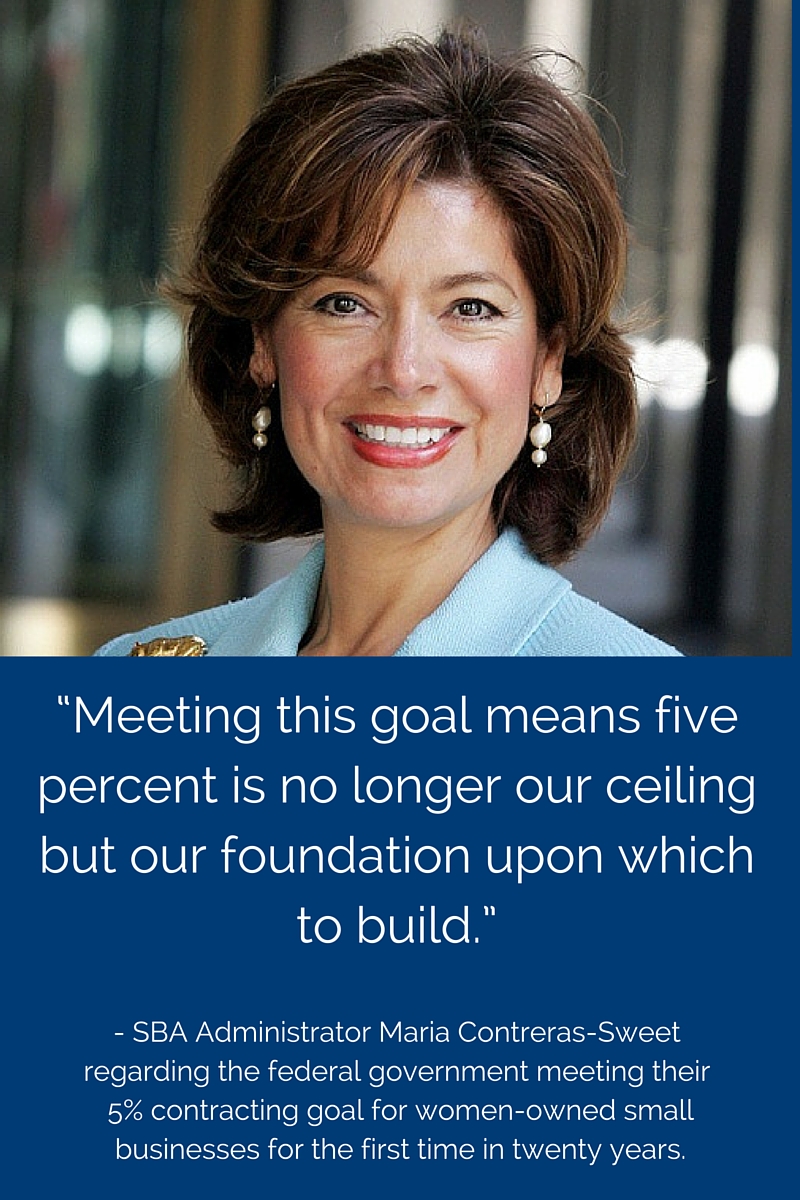
Federal Government Meets 5% Federal Contracting Goal for Women-Owned Small Businesses for the First Time in Twenty Years

Women Impacting Public Policy (WIPP) is thrilled to celebrate the U.S. Government’s achievement of awarding five percent of its annual federal contracts to women-owned small businesses for the first time since the goal was set more than twenty years ago. The five percent goal was put in place as part of the Federal Acquisition Streamlining Act of 1994 and led to the creation of the Women-Owned Small Business (WOSB) Federal Contract program in the Equity in Contracting for Women Act of 2000.

WIPP, and our partner American Express OPEN are longtime champions of women entrepreneurs in the federal contracting space, creating the Give Me 5 program in 2008 to give women-owned small businesses access to knowledge and resources to help win federal contracts. At the time, just 3.4% of federal contracts were awarded to women-owned small businesses—roughly $13 billion of the approximately $400 billion awarded annually.

In April 2013, WIPP, American Express OPEN and the Small Business Administration (SBA) launched ChallengeHER, a national initiative to boost government contracting opportunities for women-owned small businesses. ChallengeHER delivers free workshops, mentoring and direct access to government buyers. Now entering its fourth year, ChallengeHER has educated more than 5,400 women entrepreneurs at 39 workshops across the country and facilitated more than 1,900 meetings between women small business owners and government officials.

The contracting landscape for women-owned businesses has improved significantly as a result of strong public and private support and bipartisan efforts. In early 2013, due to the efforts of WIPP and their coalition partners, President Obama signed into law the National Defense Authorization Act (NDAA) which removed caps on eligible federal contract awards under the U.S. Small Business Administration’s Women-Owned Small Business (WOSB) Federal Contract program. Before the law was put into place, awards to women-owned small business were capped at $4 million and $6.5 million under the program. WIPP had further success in improving the WOSB Federal Contract Program in 2014 with the passage of a new law that provided federal agencies with statutory authority to award sole-source contracts to women-owned small businesses. The WOSB program was the only major small business contracting program without this authority at the time – putting women entrepreneurs at a distinct disadvantage.

A hearty congratulations and thanks to the folks at SBA, American Express OPEN, the WIPP team, and all of the organizations and women business owners that have helped improve and increase access to the federal marketplace for women-owned small businesses.  Job well done!

WIPP’s Next Battle

A2C

For the better part of two decades, WIPP championed the effort to help bring women into the lucrative federal market. As many of you know, we accomplished much of what we set out to do with the addition of sole source authority. Since then, however, WIPP’s team in Washington has focused on a statistic that kept repeating in our brains: women receive only $1 out of every $23 that is being loaned to small businesses. How was that possible?

For months WIPP devoted time to researching the landscape of business finance, capital access, and small business lending. What we found was that there are many policy ideas about how to stimulate lending to women – ultimately growing the economy because we all know the economic impact of women-owned businesses.

But we have a long way to go. In 2013, more than two in three loan applications for women-owned firms were denied. WIPP’s annual membership survey regularly finds that women must make multiple attempts to secure bank loans or lines of credit – with a full 40% never succeeding. All this despite women making up one-third of business owners, generating more than $1 trillion annually in receipts, and growing at 1.5 times the rate of average businesses.

The platform WIPP released today, Breaking the Bank: Women Entrepreneurs & the Need for Capital, will hopefully change that. The solutions span three main themes: changing the capital infrastructure, supporting small lending institutions, and strengthening government investment. The platform has four solutions that will change the capital infrastructure. For example, WIPP wants the government lending programs to consider FICO’s alternative credit scoring system. This system modernizes the way credit is calculated to provide new opportunities for women entrepreneurs trying to obtain loans. WIPP also wants to support small lending institutions by pushing for an end to a “one-size-fits-all” approach to regulation. Removing these burdens on small banks will allow them to return their focus to lending.

Changes to government policies are an important part of the platform. WIPP believes a small business seat at the Securities & Exchange Commission will ensure that smaller women-owned firms have an advocate as the next generation of alternative lending, like CrowdFunding, is eventually put into place. Modernizing the Microloan Program, where women are the majority of loan recipients will also make a difference. Women owned small businesses are growing at 1.5 times the rate of average businesses, but they will never get off the ground if they cannot obtain early stage capital.

WIPP does not have a monopoly on good ideas but we have an important voice in public policy. Over time, we may add to this platform to ensure that all policy solutions improving access to funding for women entrepreneurs can become part of the debate in Washington. We ask you today to look through WIPP’s access to capital platform and share it with one other woman you know. If our successes in Washington in the 15 years WIPP has been an organization are any example, we will need a lot of women behind us to make this platform a reality.