ChallengeHER 2015 Tour Update

CH-LogoWomen Impacting Public Policy (WIPP) is happy to provide women business owners with the guidance to better compete for Federal Contracts under the Women-Owned Small Business (WOSB) Federal Contract Program. In order to educate and get women business owners together with federal buyers, ChallengeHER programs are being held in several cities and states throughout 2015. There have already been 3 events held – in Washington D.C., New York City, and Dallas and many more in the upcoming months. I’d like to share some highlights with you, as we have had many great hosts and speakers with outstanding presentations.

For those of you, who are not familiar with the program, here is some basic information:

ChallengeHER, an initiative from the U. S. Small Business Administration (SBA), WIPP, and American Express OPEN (OPEN), is designed to strengthen and promote the Women-Owned Small Business (WOSB) Federal Contract Program. ChallengeHER offers women business owners important information to established and new businesses on working with the federal government. Further, these events enable more women business owners to take advantage of contracting opportunities so they can boost their businesses and help propel the success of the WOSB Procurement Program.

The agenda of the ChallengeHER events is structured to provide women around all the United States the most important, standardized knowledge and guidance in federal marketplace. In ChallengeHER, WOSB federal contractors have a unique opportunity to:

  • Learn about the WOSB set aside program and how to market their business using this set aside.
  • Learn from experiences of successful WOSBs working as federal contractors.
  • Learn from federal buyers how to do business with their agency in Contracting Officers Panel.
  • Network with peer mentors and other WOSB and Economically Disadvantaged Women-Owned Small Business (EDWOSB) firms.

In addition, each event is filled with different speakers and moderators with substantial insights and specific topics.

Washington D.C. hosted by SBA

The first event this year was held in Washington, D.C. on May 11 at the SBA Headquarters. We kicked off with WOSB Strategic Research and Marketing presented by Sean Crean from the SBA. A panel of successful women entrepreneurs shared their experiences and a panel of contracting officers provided insight on planning for federal contracting, underlining the core mission of ChallengeHER – to share and educate women in federal procurement business.

New York City filled with extraordinary speakers
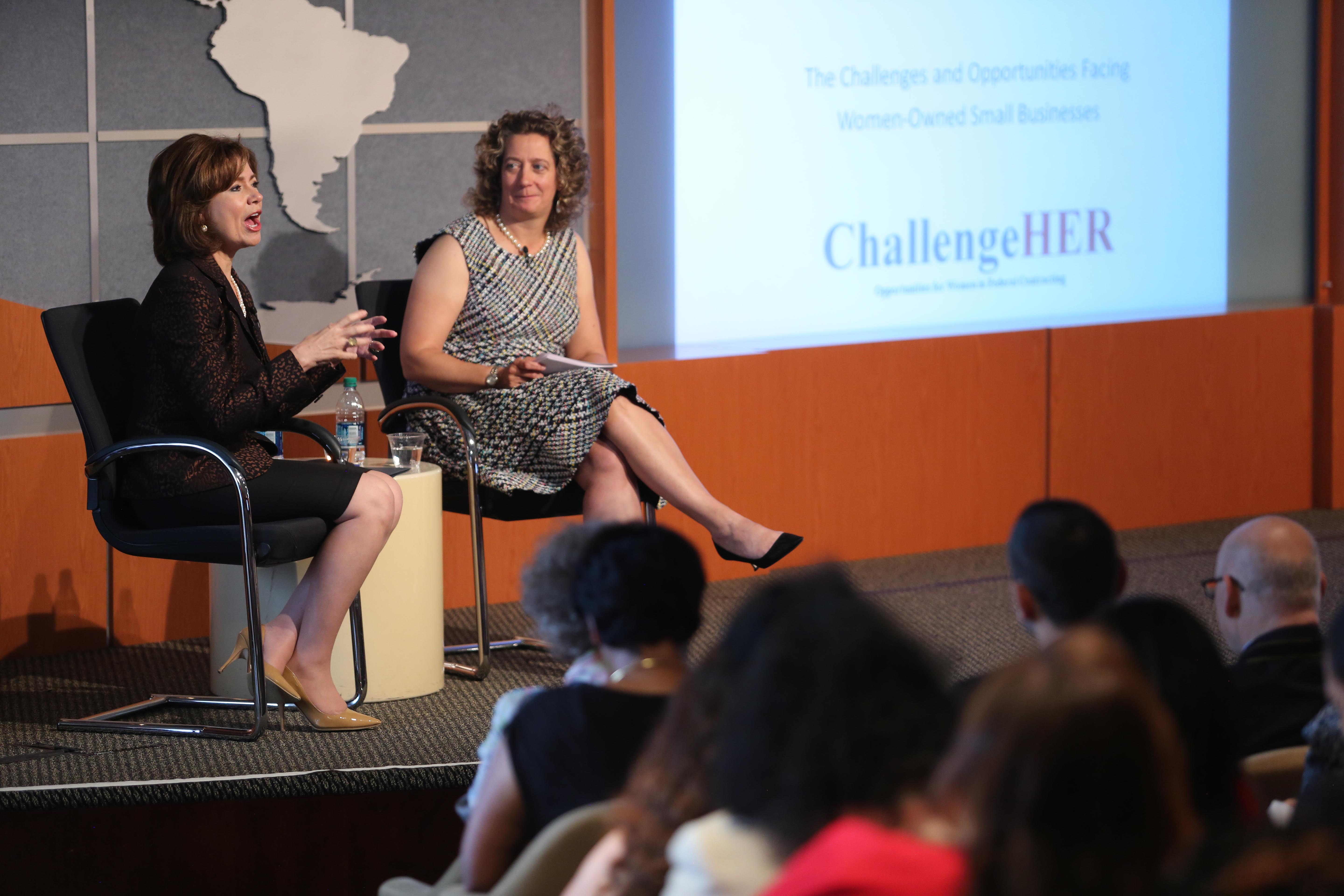
Amex_ChallengeHer_2015-74After Washington, we moved to New York City where we had the great pleasure to listen to an armchair discussion between The Honorable Maria Contreras-Sweet, Administrator, U. S. Small Business Administration and Denise Pickett, President, American Express OPEN, on Fueling the Small Business Economy and Growing Women-Owned Small Business. The discussion was very informative and we learned many new facts regarding the WOSB program and about other SBA initiatives including guarantees for loans to small business owners and thus eliminating some of the risk to the lending partners under Guaranteed Loan Programs (Debt Financing).

Another highlight in NYC was one-to-one matchmaking sessions between Federal Buyers and Contractors, where on top of the panel discussions, women entrepreneurs had a unique opportunity to directly discuss their business proposals with federal contracting officers.

Dallas Questions & Answers Storm

Just a week later, we headed to stormy Dallas for a special ChallengeHER with the U. S. Environmental Protection Agency (EPA). Despite the severe weather forecasts the event day was bright and sunny and well attended! The Dallas audience was very interactive and we had more than 4 hours of sessions filled with questions and active discussions with the speakers and panelists.

We have had a great start to this year’s ChallengeHER “tour” and more summer events are announced for July in Atlanta and for August in Cincinnati and New Hampshire! We can’t wait to meet new women entrepreneurs and help them get new insights for enhancing their businesses.

Stay tuned for upcoming events and visit our website for more information and announcements.
Bonds: An Important Weapon In Any Contractor’s Arsenal

It is vital that construction contractors, regardless of tier or trade, understand the basic principles of contract surety bonds. An understanding of how bonds are used in construction; and, importantly, how the surety company prequalifies the contractor is critical.   Surety Bonds are mandated by various federal, state and local laws, but may also be required by the private sector as well. Recently, as part of WIPP’s Give Me 5 webinar series, bonding specialist Ellen Neylan, along with construction counsel, Jennifer M. Horn and Maria Panichelli, discussed these issues in detail. Below are some highlights of the discussion.

The Performance Bond secures the contractor’s promise to perform the contract in accordance with its terms and conditions, at the agreed upon price, and within the time allowed. The Payment Bond protects certain laborers, material suppliers and subcontractors against nonpayment. Since mechanic’s liens cannot be placed against public property, the payment bond may be the only protection these claimants have if they are not paid for the goods and services they provide to the project.

In order to obtain a bond, the contractor must be prequalified. Sureties should not bond a contractor that does not meet their prequalification standards. The surety company’s pre-qualification process carefully analyzes the contractor’s entire business operation, much like a bank, because the surety is backing the promise that the contractor will perform the contract. The surety determines the contractor’s ability to meet current and future contract and financial obligations.

The parameters of bonding on a project are often dictated by the law. For example, the Federal Miller Act requires surety bonds for the “construction, alteration, or repair of any public building or public work of the United States for an amount greater than $100,000.” When filing surety claims against Miller Act bonds, subcontractors should be aware that timing is critical. Even though no notice is required, first tier subcontractors must wait 90 days from non-payment to give the bond principal a chance to make payments. In addition, all suits must be filed within one year of last work performed or materials supplied. It’s very important that the claim notice clearly state the amount being claimed, the name of the party to whom labor or supplies were provided, and that the subcontractor is making a formal claim against the bond principal.

The Surety will not pay claims without regard to their merits, but it should be expected to respond to claims promptly and, if denying a claim, offer an explanation. Finally, the Surety, with the aid of legal counsel, can assert all defenses of its bond principal, unless precluded by bond or contract language. Examples of defenses might include: breach of contract; recoupment/setoff; and failure to mitigate damages.

For more detailed information about this important topic, tune in to the recent webinar:

Give Me 5 Logo

Give Me 5: Construction Unit – Bonding and Liens 

As a federal contractor in the construction industry, it is imperative that you obtain proper bonding – but this is a highly complicated subject that could end up costing you an incredible amount of money if you don’t fully understand the nuances and ramifications. This webinar unravels the most important aspects of bonding and liens providing you with important guidelines for success.

Course Instructors: Jennifer Horn, Partner, Cohen Seglias Pallas Greenhall & Furman PC & Maria Panichelli, Associate, Cohen Seglias Pallas Greenhall & Furman PC and Special Guest: Ellen Neylan, Founder, Surety Bonds Associates

Listen to the Podcast | View the Presentation

It’s Here! WIPP’s National Directory of Women Federal Contractors

WOSB Directory

WIPP is excited to announce the launch of its National Directory of Women-Owned Small Businesses (WOSB) in the federal contracting arena. This directory is a great resource, which allows you to find qualified women contractors across the US. In order to be listed, you must first be a WIPP member and complete the WIPP Federal Contracting Certificate Program, a step-by-step training program for women business owners ready to become more involved in federal contracting or are already an experienced contractor with past performance. If you are looking to fill contract opportunities or are seeking a teaming partner, WIPP’s National WOSB Directory can help you find the highly qualified WOSB contractors with credible past performance to fit all of your contracting needs.

The goal of this directory is to build and promote a list of qualified WOMEN contractors so that at least 5% of federal contracts will be going to women-owned businesses. There are currently over 110 women-owned small businesses in the federal contracting arena listed in the WIPP National Directory. Help us reach our goal and complete the Certificate Program or check out the list today.

Also don’t forget to check out WIPP’s other federal contracting education resources:

For more information about the WIPP Federal Contracting Certificate Program or WIPP’s National WOSB Directory please contact Lin Stuart, WIPP’s Procurement Manager at lstuart@wipp.org.

Share WIPP’s Directory on Twitter: WIPP Launches National WOSB Directory n the Federal Contracting Arena http://bit.ly/1FnlxKp #WOSB #WIPP #FederalContracting #WomeninBizBlog

Sole Source Marches Forward

by Ann Sullivan, WIPP Government Relations

Just a few days ago, the Small Business Administration announced a proposed regulation that puts in motion sole source authority for the WOSB procurement program.

SBA did a very wise thing—it separated out the sole source authority piece from the certification portions of the law. Why? Because sole source authority is standard language included in the HUBZone and Service-Disable Veterans programs. It is not a heavy lift to basically cut and paste the language into the WOSB program.

The certification piece, on the other hand, is not standard language. Each small business program administered by SBA has different certification requirements. The law also reads that SBA doesn’t have to put in place a certification program for WOSBs. SBA can choose to accept other federal agency, state certifications or 3rd party certifications. Or, SBA could establish its own certification for WOSBs if it so chooses.

This determination will require a thorough examination of resources SBA can devote to establishing and policing the certification and whether it could launch a program without significant delays as have been experienced in other programs.

Yet another consideration SBA will have to make is what to do with the tens of thousands of women who self-certified for the program. Without a proper transition, the program would be thrown into chaos.

For these reasons, the certification part of the law needs much more consideration and public comment than does the sole source portion of the law.

Now you need to take action. If you agree with SBA’s expeditious implementation of sole source, you need to let your voice be heard. Go to www.regulations.gov. Keyword: SBA. Click on the regulation and you will see the opportunity to comment. Let the SBA know that women business owners are waiting excitedly on this change.

In case you are not familiar with sole source authority, it allows contracting officers to award a sole source award through the WOSB procurement program, given the contracting officer does not have a reasonable expectation that two or more businesses will submit offers. Sole source contracts through the program are limited to $4-6.5 million depending on the industry.

SBA has taken the first step toward putting the WOSB procurement program on equal footing with other SBA programs. We expected no less.