Federal Government Meets 5% Federal Contracting Goal for Women-Owned Small Businesses for the First Time in Twenty Years

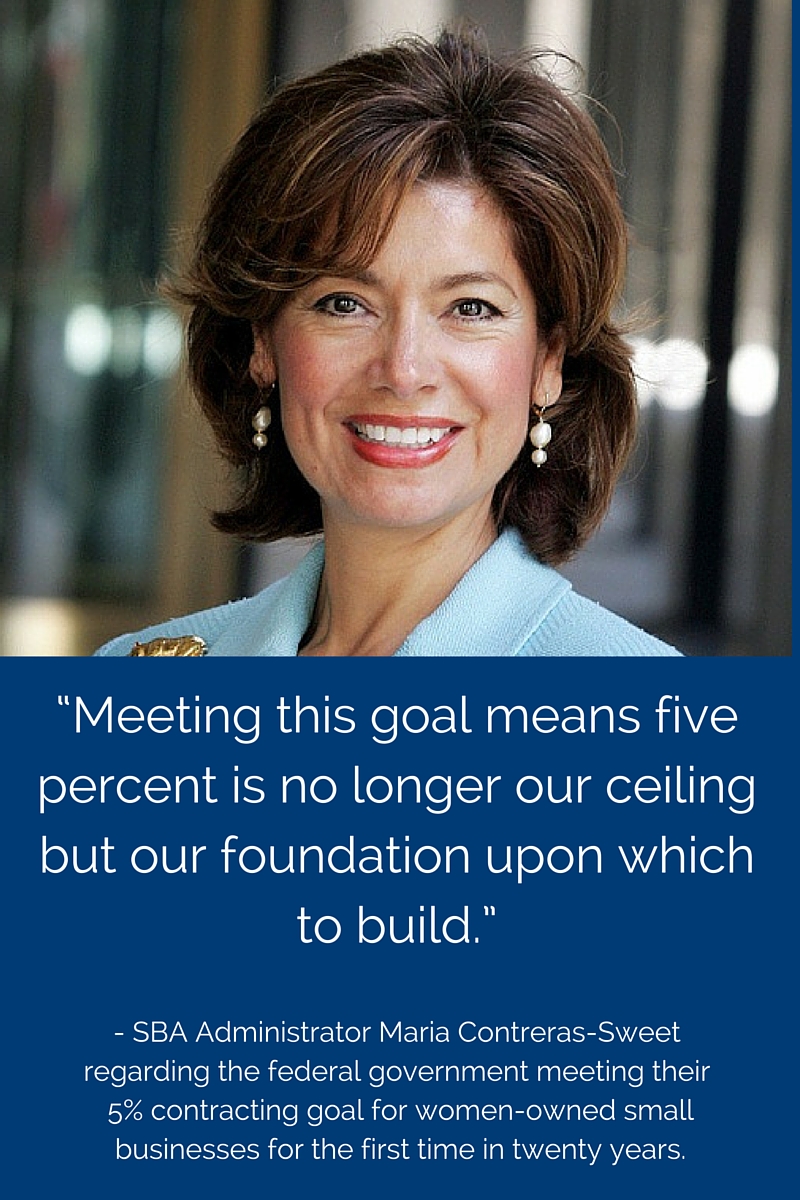
Women Impacting Public Policy (WIPP) is thrilled to celebrate the U.S. Government’s achievement of awarding five percent of its annual federal contracts to women-owned small businesses for the first time since the goal was set more than twenty years ago. The five percent goal was put in place as part of the Federal Acquisition Streamlining Act of 1994 and led to the creation of the Women-Owned Small Business (WOSB) Federal Contract program in the Equity in Contracting for Women Act of 2000.

WIPP, and our partner American Express OPEN are longtime champions of women entrepreneurs in the federal contracting space, creating the Give Me 5 program in 2008 to give women-owned small businesses access to knowledge and resources to help win federal contracts. At the time, just 3.4% of federal contracts were awarded to women-owned small businesses—roughly $13 billion of the approximately $400 billion awarded annually.

In April 2013, WIPP, American Express OPEN and the Small Business Administration (SBA) launched ChallengeHER, a national initiative to boost government contracting opportunities for women-owned small businesses. ChallengeHER delivers free workshops, mentoring and direct access to government buyers. Now entering its fourth year, ChallengeHER has educated more than 5,400 women entrepreneurs at 39 workshops across the country and facilitated more than 1,900 meetings between women small business owners and government officials.

The contracting landscape for women-owned businesses has improved significantly as a result of strong public and private support and bipartisan efforts. In early 2013, due to the efforts of WIPP and their coalition partners, President Obama signed into law the National Defense Authorization Act (NDAA) which removed caps on eligible federal contract awards under the U.S. Small Business Administration’s Women-Owned Small Business (WOSB) Federal Contract program. Before the law was put into place, awards to women-owned small business were capped at $4 million and $6.5 million under the program. WIPP had further success in improving the WOSB Federal Contract Program in 2014 with the passage of a new law that provided federal agencies with statutory authority to award sole-source contracts to women-owned small businesses. The WOSB program was the only major small business contracting program without this authority at the time – putting women entrepreneurs at a distinct disadvantage.

A hearty congratulations and thanks to the folks at SBA, American Express OPEN, the WIPP team, and all of the organizations and women business owners that have helped improve and increase access to the federal marketplace for women-owned small businesses.  Job well done!

Shop Small This Holiday Season and Through the Year

Shop Small Graphic - Get Connected CP Newsletter - 10-30-14We hope you all were able to participate in Small Business Saturday on November 28th, and support your local small businesses by doing some holiday shopping.

Small Business Saturday was founded with a simple goal, to help small businesses by providing what they need most — more customers — and with a simple purpose — when small business thrive, communities thrive.  Since 2011 Women Impacting Public Policy (WIPP) has been proud to lead the Small Business Saturday Coalition, and this year’s results tell an amazing success story:

  • According to the Small Business Saturday Consumer Insights Survey, total spending among U.S. consumers who were aware of Small Business Saturday reached $16.2 billion at independent retailers and restaurants on the day, an increase of 14 percent from $14.3 billion in 2014. 
  • Among those who shopped on Small Business Saturday, 31 percent attended a community event on the day and 81 percent encouraged family and friends to support their local small businesses.
  • There were 85 million social media engagements in support of Small Business Saturday.

WIPP’s work with the Coalition provides the foundation for Small Business Saturday.  Our efforts resulted in the following:

  • Engaging over 425 organizations and community groups in supporting and amplifying the message;
  • In rallying over 275 Congressional and Administration officials — including President Obama;
  • In helping coordinate over 4,100 community events;
  • Over 80 city economic development offices;
  • 551 Mayoral offices in issuing proclamations;
  • The U.S. Senate unanimously passed a resolution designating November 28th, 2015 as Small Business Saturday; and
  • 14 Public Service Announcements encouraging the public to “Shop Small” were recorded by government officials across the nation.

Please take a moment to watch and share the 2015 Small Business Saturday video shot with WIPP’s San Francisco office team: https://youtu.be/3W-8dsb-LuM

We could not be more proud of WIPP’s role in leading the Small Business Saturday Coalition and the hard work of WIPP’s team in their dedicated effort to make the day a success.  A special thank you goes to our partners, members and friends for their support of Small Business Saturday and local business.

As we enter December and 2016, we encourage everyone to Shop Small this holiday season and into the coming year.  In addition, we ask that you seek out other women-owned firms to partner with and do business with in the year ahead.  So add to your new year’s resolutions that this year you will make an extra effort to seek out other women-owned small business because “when women support each other, incredible things can happen.”

Regulation or Innovation? Congress Will Weigh In On FCC Regs That Can Impact Advances In Technology And Wireless Access

19109887010_40b0dfa987_mOn November 17th, all five FCC commissioners are scheduled to appear at a Congressional hearing during which they will discuss the Commission’s work including the upcoming incentive auction and the open Internet order passed earlier this year.  This hearing is a very important opportunity for Congress to ensure the FCC’s recent actions on these issues serve the interests of the American people and our economy.

The economic landscape has changed drastically over the past few decades.  Advances in technology and broadband are changing consumer demand, and businesses and entrepreneurs must evolve in order to compete and thrive in today’s marketplace.  However, current FCC regulations are failing to keep up with these changes, and as a result are interfering with competitive industries’ efforts to innovate and grow.

For business owners, access to high-speed broadband enables increased efficiency of business operations, improved customer service, reduced cost, and the ability to reach new customers and markets.  Entrepreneurs also gain the flexibility to start and grow their businesses, whether they are working from an office, their home, or on the move.

The benefits of today’s broadband technology exist because of the hands-off regulatory approach the government applied to the Internet over twenty years ago.  This framework has a proven record of increasing private investment in new networks, enabling innovation to thrive, and expanding access to the highest quality broadband services to more consumers and businesses.

Unfortunately, the FCC could hurt this track record of success by changing course and adopting old regulations that were meant for the old telephone monopoly.  By saddling the Internet with price regulation micromanagement, among other things, the FCC is discouraging companies from building out their broadband infrastructures.  Similar policies have failed in Canada and the European Union.

The FCC’s regulatory overreach is a high-risk gamble. It puts consumers and businesses in harm’s way, risking the choice and lower costs we have experienced and benefitted from in the modern, broadband-connected world. Instead, we need to maintain the long-held, light touch policy. This approach will generate even more innovation and investment in our broadband infrastructure, crucial for business owners throughout the country.

Congress needs to hold the FCC to a high standard this Tuesday and ensure its actions help foster an innovative and competitive business environment.  This is the only way wants to provide consumers and business owners with access to the high-quality, affordable broadband services they need, while helping to grow our overall economy.

SEC Finalizes Equity Crowdfunding Rules Opening the Door to Additional Capital for Small Businesses

crowdfundingCrowdfunding is not new to businesses.  You have likely seen or participated in campaigns to help companies bring their idea to market or to grow their business.  In return for a small investment, you receive a product, gift or service in exchange.  This is known as rewards-based crowdfunding, which began to become a viable avenue for raising funds for businesses in 2009 with the launch of a number of crowdfunding platforms like Kickstarter and Indiegogo.

With new rules from the SEC, crowdfunding is now getting an upgrade.  Equity crowdfunding allows a business to seek capital from a diverse group of investors through a “funding portal” and provides investors with an equity stake or stock in the business. Crowdfunding transactions are exempt from the complex and expensive securities registration process. These transactions could be a simpler equity financing option for small businesses; however, the total costs that small firms will incur from a crowdfunding offering are still unclear.

The Securities and Exchange Commission (SEC), who oversees the process, issued a long-awaited final rule on equity crowdfunding that will be effective January 29, 2016.  Highlights of the new requirement include:

  • Small businesses can raise up to $1 million in a twelve-month period and must disclose:
    • Financial statements
    • How the proceeds from the offering will be used
    • Corporate officers and directors
  • Limits the amount an investor can spend to:
    • Greater of $2,000 or 5% of their annual income or net worth (whichever is less) if both are below $100,000
    • 10% of their annual income or net worth (whichever is less) if both are equal to or more than $100,000
    • A total of $100,000 aggregate investments during a 12-month period
  • Requires funding portals to register with the Financial Industry Regulatory authority (FINRA) and:
    • Provide educational materials on how the funding portal operates
    • Disclose how the portal is compensated
    • Provide disclosures from the offering business

WIPP has been a strong advocate for finalized crowdfunding rules, having included the priority in the recently issued Access to Capital Platform. The SEC’s rule will allow small businesses to raise capital through investment without triggering federal securities laws and registration requirements.

For more information, please see SEC Chair Mary Jo White’s statement on Crowdfunding regulation.

Additional resources:

Last Chance! Vote for WIPP Leaders in the 2015 Small Business Influencer Awards

Vote-120x240-aWe are proud to announce that Barbara Kasoff (WIPP President Emeritus),  Ann Sullivan (WIPP’s Chief Advocate) and Dr. Sharon Hadary (WIPP Leadership Advisory Council Member) have been nominated for the 2015 Small Business Influencer Awards in the category of Leaders.

The Small Business Influencer Awards honor those who are influential to small businesses in North America, through the products, services, knowledge, information, or support they provide to the small business market.  The Awards are designed to recognize the unsung heroes of small businesses – those who support and encourage entrepreneurs and small business owners, and help them achieve success and stay successful.

Please cast your vote by November 5, 2015 in support for one of these fantastic WIPP leaders:

The Awards can be found on the Web at: http://influencers.smallbiztrends.com/

Don’t forget to vote!

Walmart Global Women’s Forum Library

WalmartWIPP Corporate Partner, Walmart, held their inaugural Global Women’s Forum in April, a live event broadcast online to more than 5,200 locations across 29 states in the U.S., and internationally in ten locations, while eight additional countries held their own event on the same day.

The event featured female leaders such as Academy Award Winner Geena Davis, PepsiCo’s Chairman and CEO Indra Nooyi and BBC World News anchor and author, Katty Kay. The Forum was part of Walmart’s President’s Global Council of Women Leaders’ Global Women’s Development Series, which helps develop the future women leaders of Walmart.

Walmart is making content from the Global Women’s Forum available to women worldwide with a new digital library. I encourage you to log on and visit the library, which features speeches and panel discussions among top women leaders offering their advice and encouragement for female professionals worldwide. You’ll notice three topics are prominent throughout the videos: confidence, mentoring and work/life integration. All of these topics are critical to us as women to learn about and develop, as they can open doors to endless opportunities.

As the world’s largest retailer, women make up more than half (57 percent) of Walmart associates and Walmart has twice the rate of female corporate officers (32 percent) as the Fortune 500, which puts the company in a position to make a real impact on women in the workforce.

Click here to visit the new digital library and be sure to share with your friends and colleagues: Walmart Global Women’s Forum Library.

Why it is Important to Recognize Equal Pay Day

Equal PayToday, April 14, 2015, we recognize Equal Pay Day. This day marks how far into the year American women must work to earn what American men earned in the previous year. The National Committee on Pay Equality put Equal Pay Day into place in 1996 as a public awareness event to alert people of the gap between men and women’s wages.  The White House estimates that full-time working women only earn 77% of what their male counterparts earn. This means women need to work about 60 EXTRA days to earn what men have earned in the previous year! In short, it is important to remember this day each year, as long as this gap continues to exist.

Please check out this list of resources on Equal Pay Day:

A Women’s Place is On the Money

Women on 20sIt seems ironic that while women control as much as 80 percent of the consumer buying decisions in this country and increasingly are taking the helm at businesses large and small, they are not represented on the bills in our wallets. There’s one woman who’s on a mission to change that — WIPP member Barbara Ortiz Howard and her nonprofit Women On 20s.

This week, in conjunction with the start of Women’s History Month, Barbara and her team hope Americans everywhere will visit the website, www.womenon20s.org to have them vote on their choice for the woman to replace Andrew Jackson on the $20 bill. Treasury code requires that portraits on paper currency be of individuals of great stature, but they have to be deceased. Changing one of those faces can be ordered by the Treasury Secretary or the President without an act of Congress. Last August, President Obama tipped his hat toward the idea of featuring more women on U.S. currency in an off-the-cuff remark during a speech in Ohio. Barbara’s strategy is to encourage him to take the next step with a public mandate achieved through this online referendum. Barbara believes that having a woman’s portrait on our paper money “can become a symbol of greater changes to come.”  Recognizing women’s historical accomplishments and contributions to our society by “elevating them to their rightful place alongside men on our money,” she says, “is something that’s long overdue.”

Part of the Women On 20s mission is to have the new “woman’s bill” issued in time for the 100th anniversary in 2020 of the passage of the 19th Amendment giving women the right to vote. While no Congressional approval is required, the process of producing a new issue can take several years, from commissioning to design to minting. The organization believes the $20 bill is ripe for change. It’s due for a redesign in keeping with efforts to prevent counterfeiting.

Barbara, owner of All County Restoration, a roofing company outside of New York City, is no stranger to the challenges of working in a male-dominated business. She has long been irked by the absence of a woman’s image on our paper money. About a year ago she decided to try and do something about it by launching the Women On 20s campaign. She took her inspiration from her daughter and her athletic, “sporty-girl” friends. She explained, “as they grew up I wanted to honor their individuality, pride and expectations that they’ll be valued as women who can and will succeed on a level playing field with men.”

Women On 20s Executive Director Susan Ades Stone says she shaped the campaign not only to achieve the goal of getting a woman’s portrait on the $20 bill, but to educate and stimulate conversation, “not just a national conversation, but conversation at every dinner table in America.” By recognizing the accomplishments of the 15 women on the slate of candidates, she said, “we hope to honor all women. The idea is to give as many Americans as possible a chance to take part in something so much larger than just changing a face on a bill.”

WIPP supports the Women On 20s mission and we hope our trail-blazing members will cast their votes beginning March 1st and take to Facebook, Twitter and other social media to spread the word. As the campaign’s slogan states — and we wholeheartedly agree, “A Woman’s Place is on The Money.