Access to Capital: It’s Time to Aggressively Reduce the Gap for Women Owned Businesses

By JeFreda R Brown, CEO, Goshen Business Group LLC, WIPP National Partner

JeFreda BrownAs a woman who owns a business and has clients that are women owned businesses, I have personal experience with the issues that we face in accessing capital. Several of my female clients have had this fear of seeking capital for their business because of the strict requirements by banks and other financial institutions. There are so many other companies coming to the forefront to offer capital to businesses. However, some of their requirements may not be the best for business owners. The interest rates and repayment options may not be the most favorable for businesses.

In a report prepared for the National Women’s Business Council (NWBC), it was stated that women owned business owners raise small amounts of capital to fund their companies and therefore are more reliant on personal sources of financing. It also stated that because of this, it diminishes their prospects of growing their companies. This is because we know that it takes money to make money. The NWBC also reported that there is a gender gap in equity financing. Men owned companies have received .4% of venture capital funding whereas women owned companies have only received .1% of venture capital funding. The NWBC also reported that only 5.5% of women owned companies use loans from banks or other financial institutions in comparison to 11.4% of men owned companies.

We can clearly see that women owned companies are the fastest growing segment of all businesses. So why is there such a problem with these women obtaining capital for their businesses? What needs to be done to reduce some of the restrictions that exist and cause barriers for women owned businesses? It’s time to reduce this gap for women entrepreneurs.

It is not discussed much as I can see, but from personal experience in dealing with women entrepreneurs directly, past financial hardships are big barrier that causes some women to fear even trying to obtain funding. Things like personal bankruptcy makes it basically impossible to obtain capital for a business. Many women have gone through divorce, loss of job, medical issues, and more, and these life changes have caused financial hardship. Some women have had to file bankruptcy or have had credit issues from these financial hardships. As these women have worked hard to turn things around, something like a bankruptcy automatically denies them for financing. In my discussions with women entrepreneurs that have experienced these things, it would be very encouraging to have programs in place that will help these women obtain funding and help them rebuild their credit at the same time. The programs would provide some type of micro loans that also include financial literacy education and steps that the borrowers would have to take to progress in the program. With mortgage loans, some lenders require borrowers to take homebuyer education courses before being approved for a mortgage loan. Something similar to this would be great for women entrepreneurs who have had some credit challenges.

Another barrier for women entrepreneurs to obtain capital has been the restrictions placed on home based businesses. It’s quite obvious that if these women could obtain the capital they need to efficiently operate their companies, they would more than likely have brick and mortar offices for their businesses. A home based business basically has next to none overhead expenses. It’s the easiest way for someone to begin a business. However, being home based shouldn’t be a punishment and be a barrier to obtain funding. Data exists to show that more women entrepreneurs have home based businesses than men.

Another issue that seems to be a barrier for women entrepreneurs in obtaining capital is the industry the business is in. Studies have shown that businesses in high tech industries tend to obtain more capital. There are specialized types of funding that exist for technology and innovative products and services. There seems to be restrictions on service based companies that have varying revenues each month. These restrictions need to be removed. Supply and demand does dictate how consumers will purchase goods and services, however; there should be no restrictions on funding based on the type of industry a business is in.

We know that small businesses are the backbone of America. Many of the large companies that exist today started out as a small business. The federal Government needs to address the issues that women entrepreneurs face in obtaining capital more. It seems only logical that with women owned businesses being the fasted growing segment that there should be more support for us in obtaining capital. The success of our businesses is very crucial for the American economy. When a woman owned business is able to grow, it can put dollars into the economy and stimulate the economy. It can also provide jobs and reduce the unemployment rate.

We implore the presidential candidates to make this issue a major part of their platforms. We implore members of Congress to make this issue a major part of discussions and plans going forward. There needs to be more education available to women who want to start a business. This education needs to be strategic with the focus on financial and business compliance. Right now, there is not enough of this. Companies like mine provide this type of consulting. I believe the federal Government should also partner with companies like mine and other subject matter experts in developing solutions to this issue in obtaining capital. Talking to those of us who are out here in the struggle is the only way to understand the problems that exist and develop suitable solutions for all women owned entrepreneurs. Another way the Government can get involved is to work with larger women owned businesses that have been successful to start a mentor protégé program to help smaller women owned businesses develop. The program has been successful for federal contracting. I believe it would be a huge help for smaller women owned businesses and at the same time help the large businesses in having additional capabilities to provide to their customers and clients. It’s time to be more assertive in reducing and eventually removing the gap for women entrepreneurs in obtaining capital.

Share your view on Access to Capital and its impact on your business by taking quick poll.

Momentum and Capital

magdalah-silva-11By Magdalah R. Silva

If money is the momentum that makes the world go round, and women represent approximately 40% of the global labor market, control over $20 trillion of total consumer spending globally, and are starting businesses at twice the rate of male owned businesses, then where is the capital momentum for women? In this decisive election cycle, we should definitely be keeping our eye on which candidates will drive momentum. Let’s first agree on some basic fundamentals on the women’s entrepreneurship ecosystem. 1) The growth of women businesses is good for the economy, 2) Unconscious bias plays a significant role in accessing capital, and, 3) The control and disbursement of capital is not in the hands of women. To balance this ecosystem and create momentum candidates need to agree first and foremost that getting money in the hands of women business owners is not a “women’s issue”, it is an American competitiveness issue and that capital remains among the highest predictors of a company success.

  • Growth of women’s business is good for the economy. That’s where all of us come in. Whether you are a policy expert, journalist or blogger we can heavily influence the priorities of a new administration. If the conversation about supporting the growth of women businesses is stimulated in public conversation than it is highly likely that the markets will also see it as a strategy for economic growth, and job creation. This branding concept can result in exponential growth of new business, a greater appreciation by investors of the women’s market and establishment of new policies aimed at the support of women’s entrepreneurship.
  • Unconscious bias plays a significant role in accessing capital. Gender bias, including gender discrimination, conscious and unconscious, is real. Many studies have revealed that unconscious beliefs about women and their business capabilities have manifested itself in various phases of the American culture specifically in raising venture capital. These biases make assumptions relative to capabilities and types of businesses men and women launch resulting in types of investments they ultimately receive. The good news is, according to a study by Babson College, “Venture capital firms with women partners are twice as likely to invest in companies with a woman on the management team (34% of firms with a woman partner versus 13% of firms without a woman partner).” We need programs aimed at preparing more women to be VC’s!
  • The control and disbursement of capital is not currently in the hands of women. Though this is currently true, there is a shift taking place where technology is having a significant impact on the ability to access capital in many forms such as mobile banking, global peer-to-peer lending and trusted transactions conducted on the web through blockchain. The advent of blockchain, where two or more people don’t need to know each other to conduct a trusted business transaction will be revolutionary. This technology is behind digital currencies such as Bitcoin, and will disrupt the current models we have today. This will allow for breakthrough applications that run without banks while cutting cost and saving transaction time. It will ultimately change the dynamic between companies and their consumers while allowing new entrants into the lending business. The system will be built on social and economic capital controlled by individuals rather than intermediaries. If the women’s market makes a shift in that direction it could have a significant impact on how traditional lending is currently done.

So how about some fun facts to close off my blog to encourage the rise of a Momentum Capital Movement for Women, here you go:

  • The average ROE of companies with at least one woman on the board over a six-year period is 16%; ROE of companies with no female board representation over the same period is 12%. Source: Credit Suisse
  • Women entrepreneurs have an estimated credit gap of between $285 billion and $320 billion, depending on geography, and an estimated 70 percent of women-led SMEs are either unserved or underserved financially. – International Finance Corporation (IFC)
  • Women control over $20 trillion of total consumer spending globally. Women make or influence up to 80 percent of buying decisions worldwide, on everything from appliances to cars to medical services. – Dalberg
  • When women earn income, they reinvest 90 percent of it in their families, as compared to men who invest only 30 to 40 percent. This ‘multiplier effect’ boosts social and economic outcomes for entire communities. – Half the Sky

Share your view on Access to Capital and its impact on your business by taking quick poll.

Why Women Business Owners Need Better Access to Capital

dimenco-emilia-picBy Emilia DiMenco, President & CEO, Women’s Business Development Center

As a retired banker and now President and CEO of the Women’s Business Development Center, I have focused my entire professional career on helping small business owners access capital for growth. As any business owner will tell you, financing is critical to business growth.

Traditional bank financing is attractive because of its typically low interest rates. Yet women business owners – who generate more than $1 trillion annually in receipts, and are growing at 1.5 times the rate of average businesses – are consistently denied bank loans. In 2013, less than one in three loan applications for women-owned firms were approved.

A 2014 report issued by the Senate Committee on Small Business & Entrepreneurship on barriers to women’s entrepreneurship found that women receive only 16 percent of conventional small business loans. This amounts to 4.4 percent of the total dollar value of all small business loans, leaving women-owned firms with only $1 out of every $23 that is being loaned to small businesses.

WBDC observes this problem firsthand when a fast-growing female entrepreneur wins a corporate or government contract, then has trouble getting the capital she needs to fill the order. If she’s denied loans, she has a couple of options: she either turns to unregulated, predatory merchant cash-advance lenders or other high-interest sources of capital, or her business stagnates.

The real solution lies in the hands of federal policymakers who have a responsibility to make changes which will help women get capital at a fair interest rate. As a start, policymakers must improve the SBA 7A program’s standards to allow sales from new and prospective contracts to be taken into consideration when approving a loan — not simply a company’s historic cash flow. Next, they must Increase funding for non-profit alternative lenders such as Community Development Financial Institutions and micro-lenders. Finally, they must provide transparency and disclosure for small business lending so that small businesses are informed upfront of interest rates, fees, and other terms.

New measures are desperately needed now to remove the barriers to financing that most women entrepreneurs face. Until that happens, woman-owned businesses won’t grow at the speed and to the levels they could. Sadly, that will impact all of us.

Emilia DiMenco is president and CEO of the Womens Business Development Center, a Chicago-based economic empowerment organization serving a nine-state Midwest region, which provides programs and services to prospective, emerging and established women business owners. For more information, visit www.wbdc.org.

Share your view on Access to Capital and its impact on your business by taking quick poll.

Bringing Water to the Women’s Capital Desert

chadwell-tracy-picTracy Killoren Chadwell, Founder and Partner of 1843 Capital, WIPP Friend

Water makes things grow. Capital makes companies grow. Companies grow jobs.

If job growth is a priority for the U.S. government, then investing in women led startups should be a priority. Women led startups are one of the highest growing categories for job growth. Women start 1,000 businesses every day. Women have added 1,290,245 jobs over the last 10 years. They contribute $1.4 Trillion dollars in receipts annually to the U.S. economy. According to BusinessDynamics Statistics (U.S. Census) existing companies are net job killers (1 million per year) and startups are net job growers (more than 3 million per year). Women are the gardeners and women are starting companies at 1.5 times the average rate.

Women founded companies are seeing a tremendous amount of support at the seed stage. Women focused incubators, accelerators, grant programs, mentors, seed investors and grant programs are in place. They are doing a great job of getting the seeds planted and the companies’ roots to take hold. However, there is a big component missing. The capital is lacking to take the companies from seed stage to a place where they can achieve profitability. Companies reach a place where they are finding traction, gaining customers and hiring people and they are left to wither for lack of funding. Venture capital, the traditional source of capital to grow, goes disproportionately to companies that have all male teams. According to the Diana report, women led companies only receive 3% of total venture capital dollars. 97% goes to male teams. Researchers at the MIT Sloan School, Harvard Business School, and Wharton Business School found that, given the same pitch, men were 40 percent more likely to receive funding than a woman presenting the same pitch. Some may argue that the companies led by men are somehow “better.” We finally have great data that says that isn’t true. A study by First Round Capital, of 300 of it’s portfolio companies, shows that a company with at least one female founder on the team outperformed the traditional all male companies by 63%. A study by Stamford University shows that female led venture backed companies out perform by 35% and have 12% more revenues.

The story on the debt side isn’t any better. Women led businesses received 4% of commercial loans. Loan approval rates for women owed companies are 15-20% lower than for companies with traditional all male teams. When they do get access to loans, they are often subject to higher interest rates.

Amazingly enough, high growth women led companies are not all technology based (although a wise woman once said “all businesses are technology businesses”). They are health care, service, manufacturing and consumer products, every garden variety.

The solutions to this problem are readily accessible. We can empower more female fund managers with capital. We can expand business education and counseling for women. We can change the way credit is created and monitored. We can support and expand small business lending. Women traditionally have achieved so much more with less. On average, women grow their businesses with less than half the capital than men. A little water will yield a bumper crop of new jobs.

Uncle Sam, Mrs. American Startup is here to rescue you. All we need is a little water for the desert.

Tracy Killoren Chadwell is the Founder and Partner of 1843 Capital, an early stage venture capital fund focused on women led companies. 1843 was the year Ada Lovelace (the only legitimate daughter of Lord Byron) wrote the first computer program. http://www.1843capital.com

Share your view on Access to Capital and its impact on your business by taking quick poll.

Access to Capital – Critical for Business

mullins-thompson-sallie-picSallie Mullins-Thompson, Principal, Sallie Mullins Thompson CPA PLLC, WIPP Member

Over the past 20+ years, while conducting my accounting, tax preparation, financial planning, and business management consulting practice, I have had the opportunity and pleasure to work with and mentor the owners of many small businesses – the majority of which have been women.

Time and time again, I find that even though women business owners are fabulous entrepreneurs with high levels of skills, education, and experience in their profession or industry, they are not always given the same chances, as compared to male business owners, particularly in the area of access to capital. The statistics in this area are quite disheartening; for example in 2013, less than 1 in 3 loan applications for women-owned firms were approved and resulting in only 4.4% of the total dollar value of all small business loans.  That’s $1 out of every $23 being loaned to small businesses.

I wonder why that is, given that women-owned small businesses (WOSBs) constitute close to 40% of all small businesses, generate over $1.6 trillion in gross revenues, are growing at four times the rate of men-owned business, and employ approximately 9 million people. Thus, these WOSBs have a huge impact on the economy, especially as it continues to recover from the 2008 recession.

Having capital to start or grow a business is extremely critical. As a matter of fact, not having enough cash is the major reason small businesses fail or are unable to move to the next level. So, as many agree, since small businesses are the economic engine of the economy and WOSBs represent over 1/3 of that population, then I think that the major federal candidates running for office in the upcoming 2016 election need to be talking about the access to capital for women entrepreneurs.

After all women generally vote in higher numbers than men, with the increase growing larger in each election cycle. Plus, women currently make up a majority of the electorate at 51%. Therefore, women are a constituency that these candidates should want to hear from. And, it’s up to us to make sure they do!

WIPP has put together a most impressive program of action in its Economic Blueprint. Check out the Access to Capital Principles section to learn more about these comprehensive policy solutions. Then, let’s see if we can begin the process of changing the conversation of the 2016 candidates as Election Day draws nearer.

Share your view on Access to Capital and its impact on your business by taking quick poll.

Access to Capital – Cut the Red Tape

Coins and plant, isolated on white background

Concept of a plant and a lot of golden coins isolated on white background

By Jeanette Prenger, President, EccoSelect, WIPP Board Member

Twenty years ago I founded my company in a way that a lot of entrepreneurs do when entering the service industry; I created a business plan to provide services in a field that I had a lot of experience in – IT. Growing up as a software engineer and earning promotions into management gave me the confidence that I could offer the same type of service as more expensive firms supplying contractors in technology. I was my first billable contractor and did not quit my ‘day job’ until I had the security of knowing I would still have a paycheck coming into our household. By paying myself a salary similar to what I was earning in corporate America and saving the profits, I was able to self-fund a dozen contractors over the next year.

Fast forward twenty years later. We have several million dollars available in a line of credit. I still own 100% of my company but I have a dilemma. In order to accelerate into the next level, I need to look at funding mechanisms other than my line of credit. Those dollars are already spoken for by our accounts receivable.

So what’s the problem? Banks are hesitant to provide traditional loans to grow businesses if the business can get funding elsewhere. The SBA provides loans, of which I leveraged after 9/11, but the price was high. The interest was over 7%, the paperwork extremely time consuming and required outside assistance to help make sure that we could get a loan needed to cover losses incurred by bad receivables.

I’ve seen other companies similar to flourish with a couple of observations. One, they had investor money put into the company and the culture was driven by a quick ROI back to the investors. Ownership was diluted but the investments allowed the company to hire the type of expertise needed to grow the business. Secondly, the businesses had executives who understood how to access capita including what was needed was preparation, where to go and what the risk / rewards could be.

As a woman and a minority, my education did not prepare me to go the route of seeking investors. Nor, do I really understand how to navigate through all the red tape that banks have discussed with me if I want to borrow money to acquire another business similar to mine. Education, especially to small business owners and to disadvantaged businesses (minority, women, vets….) through the SBA, local banks, and community banks on how we can grow businesses with shared risk would be a tool that many businesses would welcome. Banks and traditional lenders were already risk adverse prior to the new regulations and oversight that have caused them to decrease loans to small businesses for growth. They are hesitant to assist in providing education to actually gain capital and yet banks, and the government, bail out big businesses.

Our elected officials need to look at the stimulus they could facilitate if small businesses and disadvantaged businesses had access to capital. If incentives were given to lenders to educate businesses about loans, the types that work best for their companies and actually provided the capital needed.

If small business is truly the ‘engine of our country’ let’s provide some fuel!

Share your view on Access to Capital and its impact on your business by taking quick poll.

2016 International IP Index is out – Infinite Possibilities

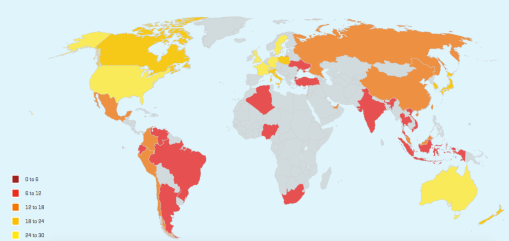
The U.S. Chamber of Commerce released the 4th edition of its International Intellectual Property (IP) index on February 10th, with a promising title – Infinite Possibilities. The ​Index ​provides ​economies ​with ​a ​comprehensive ​road ​map ​to ​harnessing ​the ​benefits ​that ​robust ​IP ​systems ​provide, ​which ​create ​limitless ​possibilities ​to ​attract ​investment ​and ​fuel ​economic ​competitiveness. ​

The ​Index ​ maps ​the ​IP ​environment ​in ​38 ​economies (additional 8 added this year), ​based ​on ​30 measurable criteria indicative of ​a ​strong ​IP ​system, such as patents, copyrights and trademarks protections, enforcement, trade secrets and market access, and engagement in international treaties.

The 38 economies account for nearly 85% of global gross domestic product (GDP). The United States again scored the highest, with Venezuela, India and Thailand coming last.

The closer the score to 30 points (red to yellow color scheme), the more robust country is in the IP area (see the interactive map here).

Screen Shot 2016-02-11 at 9.51.04 AM

Many countries have shown significant improvements through investments into innovations compared to last year’s results:

  • The Indonesian government created an online notification system for rights holders to request action against alleged infringing websites.
  • In Israel, a new Index economy, 2014 reforms significantly enhanced the environment for patent protection. In particular, a patent restoration for biopharmaceuticals and regulatory data protection for submitted clinical data.
  • Malaysia’s IP environment has improved gradually over the past four years, resulting in a cumulative increase in the country’s score. As a TPP (Trans-Pacific Partnership) negotiating partner, the IP standards within the agreement—once ratified and implemented—will further strengthen Malaysia’s IP environment.

On the other hand, many countries have still a lot of work to do to improve their IP environment. Brazil, China, Russia, and Indonesia are undermining their overall innovation ecosystem with policies tying market access to sharing of IP and technology, and by enforcing localization. But also high-income western European countries are facing challenges, especially in copyright protection due to absence of policies to more effectively fight online piracy.

Despite United States being on the top of the overall rank, there is still room for improvements. Especially in enforcement area, where it is ranked fifth, due to trade secrets theft and counterfeit seizures.

The index is not only a summary of a findings but it also demonstrates the benefits of a strong IP environment. It includes six new correlations between strong IP rights and socio-economic benefits, and also updates statistical information for 13 of the correlations from the previous edition of the Index. The new correlations include:

  • Access to finance: More robust IP environment attracts more venture capital and private equity funding.
  • High-quality human capital: Countries with stronger IP protection have on average 2.5 more research & development focused employees among their workforce.
  • Foreign direct investment attractiveness: Economies with robust IP systems receive on average a 45% higher Standard and Poor’s credit rating.
  • Inventive activity: The top 10 economies in the Index show patenting rates more than 30 times greater than the Index’s bottom 10 economies.
  • Advanced technology markets: People and firms in economies scoring above the median level of the Index are 30% more likely to enjoy access to the most recent technological developments.
  • Streamlined and enhanced access to creative content: Advanced and easy-access delivery of streaming services is 3 times greater in economies scoring above the median level of the Index, than in those scoring below the median, while access in the top 5 economies is up to 25 times greater than in the lowest 5.

For more information download the print report here, or visit the interactive map at www.uschamber.com/IPIndex to compare the 38 economies on each of the 30 indicators.


Small Business Policy Index 2016

Small Business & Entrepreneurship (SBE) Council released the 20th edition of its annual Small Business Policy Index, “Small Business Policy Index 2016: Ranking the States on Policy Measures and Costs Impacting Entrepreneurship and Small Business Growth.”

The Index ranks all 50 states according to various major government-imposed or government-related costs that have direct or indirect impact on entrepreneurship and business, as well as on start-ups and small growth eager companies.

The Index investigates in total 50 measures, from which:

  • 25 are tax related,
  • 18 relate to rules and regulations,
  • 5 focus on government spending and debt issues, and
  • 2 remaining measures deal with the effectiveness of important government undertakings.

The outcome is accessible through an interactive map displaying states’ ranking in color, with a summary per state provided after selecting a state.

Screen Shot 2016-02-08 at 1.15.31 PM

The most policy-friendly states to entrepreneurs under the “Small Business Policy Index 2016” are: 1) Nevada, 2) Texas, 3) South Dakota, 4) Wyoming, 5) Florida, 6) Washington, 7) Alabama, 8) Arizona, 9) Ohio, 10) Indiana, 11) Colorado, 12) Michigan, 13) Utah, 14) North Dakota, and 15) Virginia.

On the other side of the ranking we can find: 40) Maryland, 41) Maine, 42) Iowa, 43) Oregon, 44) Connecticut, 45) Vermont, 46) Hawaii, 47) Minnesota, 48) New York, 49) New Jersey, and 50) California.

The authors highlight several findings from the report, which are especially interesting to note:

  • Average real annual economic growth of the top 25 states’ was by 29.2 % faster than the average rate for the bottom 25 states.
  • Also, the top 25 states’ average state population growth of 4.9 percent from 2010 to 2015 was double compared to only 2.5 percent for the bottom 25 states.
  • The top 25 states also witnessed positive net domestic migration of a 2.00 million at the expense of the bottom 25 states, which lost 2.03 million people.

The SBE Council President and CEO Karen Kerrigan provides her explanation of the founded facts: “Policy matters for entrepreneurship and small business growth. Quite simply, when elected officials impose weighty tax and regulatory burdens, the increased costs and uncertainties mean reduced risk taking and less economic opportunity. The message from our ‘Small Business Policy Index’ to state officials is clear: If you are serious about helping small business, then reduce barriers to entrepreneurship and government costs imposed on small business.”

To access the Small Business Policy Index 2016 full report please click here.

Small and Medium-Sized Companies in the Focus of Exporting News

Small and medium-sized exporting companies had several reasons for good spirit in the last couple of weeks – especially Trans-Pacific Partnership and Export-Import Bank supporters.

The final agreement on Trans-Pacific Partnership (TPP) got a substantial coverage across the news, as it is the largest regional trade accord in history. As covered a few weeks ago, it encompasses USA together with 11 Pacific Rim nations and addresses many complex issues – from reducing tariffs and quotas, to imposing rigorous environmental, labor and intellectual property standards on partners, easing cross-border data flows, establishing an investor-state dispute settlement mechanism, to free trade in services, and imposing competitive neutrality on state-operated businesses.

There is one particularly important area, which deserves a separate attention – focus of TPP on small and medium-sized enterprises (SMEs).

Last week, National Small Business Association hosted a webinar where Andrew Quin, Deputy Assistant U.S. Trade Representative for Southeast Asia and the Pacific, among other described new chapter of the TPP deal focused on SMEs. The chapter aims to tide together all different elements that benefit SMEs and he highlighted 2 major areas:

  1. Creation of dedicated website for SME exporters by every member country. The websites should pull out all provisions which are particularly relevant to SMEs such as customs, taxation or intellectual property protection topics to make it better understandable and easier to follow in day-to-day exporting trade deals.
  1. Creation of SME committee to continue consultations with SMEs and collect feedback on what works, if benefits are being generated, and on how to continue maximizing benefits to SMEs. The committee will consist of government representatives, however promises to take inputs from SMEs on private sector provisions.

All of the above claims to suggest that TPP is more beneficial to SMEs than any previous trade agreement. Mr. Quin also reassured that TPP will not have any impact on Minority-Owned Small Businesses set aside programs (including the one WOSB program for women).

Another topic that came out after few weeks is the reauthorization of Export-Import Bank (EXIM). As Mr. Quin stated, it is a separate initiative but important piece to allow a full benefit of TPP. EXIM is providing loans, guarantees, and insurance to U.S. exporters and has made SMEs exports the top category supported last year (source) when $10.7 billion of total $27.5 billion worth of U.S. exports went to U.S. small businesses.

EXIM

Many SMEs publicly supported EXIM reauthorization, and they all have now a hope that it might be successful after all. A rare procedural move brought EXIM to the House floor and got a surprising support in the 313-118 vote to renew, including from 127 Republicans.

However, now the supporters will have to secure passage in the Senate but they seem to have a chance through its attachment to another vehicle, such as legislation to renew highway funding (source).

Overall, current news seem to suggest that it is a good time to be an exporter and according to the latest annual report Profile of U.S. Importing and Exporting Companies released by Census Bureau, many SMEs have already realized that as they accounted for 98 percent of the number of U.S. exporters in 2013 and $471 billion in known value of goods exports.

The Trans-Pacific Partnership Trade Deal

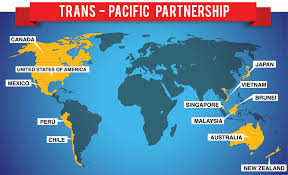
TPPOctober 5, 2015 will be remembered as a day when the United States and other 11 Pacific Rim nations reached final agreement on the largest regional trade accord in history – the conclusion of the Trans-Pacific Partnership (TPP.) The countries form a group with an annual gross domestic product of nearly $28 trillion that represents roughly 40 percent of global G.D.P. and one-third of world trade, which reflects enormity of the deal.

TPP addresses many complex issues from reducing tariffs and quotas, to imposing rigorous Environmental, Labor and Intellectual Property Standards on partners, easing cross-border data flows, establishing an investor-state dispute settlement mechanism, to free trade in services, and imposing competitive neutrality on state-operated businesses.

Together with the U.S. members are Australia, Canada, Japan, Malaysia, Mexico, Peru, Vietnam, Chile, Brunei, Singapore, and New Zealand. Geography would suggest for China to be member as well but though it has expressed interest in talks, it is not among founding countries (causing different speculations and interpretations).

The deal now needs the approval of lawmakers in member countries, including the U.S. Congress where it is expected to be under thorough scrutiny. Public debate is also weighting all pros and cons. Supporters say it will unlock opportunities for exporters but opponents see the partnership as a continuous way of sending manufacturing jobs to low-wage nations.

Similarly to congressional battle in 1993 for NAFTA partnership passage (234 to 200 votes in the House, and 61 to 38 in the Senate), president Obama is expected to face challenges while making it one of his final goals in the office. Similar difficulties are expected in Canada while the process should be straightforward in Japan or Singapore.

TPP is written to ease adoption by additional Asian nations (South Korea is already pressing for swift acceptance), and to provide a potential template to other initiatives underway, like the Transatlantic Trade and Investment Partnership (source NY Times).

Tune to our special webinar with International Trade Administration on December 17 to find out more about the TPP and how it is targeting small businesses.

For additional information on TPP, continue here.