3 Ways Employee Policies Can Protect Your Business

K Prinz

By Kristen Prinz, Founder and Managing Partner of The Prinz Law Firm

A study by specialty insurer Hiscox was recently published finding that U.S.-based companies have at least an 11.7 percent chance of facing an employment law charge. The study claims that the average cost for small and mid-sized businesses to defend these claims is $125,000. That’s a lot of money. It makes having effective employee policies all the more important.

On November 16, 2015, at 1:00 pm CST, I will be presenting the webinar 10 Employee Policies that Minimize Business Risk for WIPP and the WBDC. Participants will learn about 10 policies that can help businesses avoid the $125,000 average. Here are three ways that these polices can help protect your business:

  1. Address claims before they become lawsuits.

Employee policies can provide employees with an internal method to resolve a potential claim. Businesses can use policies to encourage and require that concerns about discrimination, harassment or even wage issues be reported. Knowing the concerns of your employees puts an organization in a much better position to swiftly resolve an issue that could otherwise become a lawsuit.

  1. Show the government your business is committed to compliance.

Having anti-discrimination and anti-retaliation policies shows the EEOC that your business has taken a stance against discrimination and retaliation. Similarly, an effective time keeping policy can show the DOL that your business is taking appropriate steps to comply with wage laws. These policies can bolster a defense when an agency audits your business or investigates a claim.

  1. Create a positive workplace culture.

Your business shouldn’t just have policies; it should abide by them and enforce them. Having well publicized policies that demonstrate your business’s dedication to a positive workplace is one of the best ways to deter employment law claims. Employees are far less likely to sue an employer they believe supports and values them.

To learn about the 10 policies that can help your business (i) address claims before they become lawsuits, (ii) show the government your business is committed to compliance, and (iii) create a positive workplace culture, register now for the WIPP and WBDC webinar 10 Employee Policies that Minimize Business Risk.

From The Hill: Dodd-Frank’s Impact on Small Business Lending

By Jake Clabaugh, WIPP Government Relations

wmn$

Women entrepreneurs face unintended consequences of wall-street reform. According to a House Committee hearing yesterday, the Dodd-Frank Wall Street Reform and Consumer Protection Act, introduced in an effort to prevent another financial crisis, is contributing to small businesses’ inability to access capital from banks.

WIPP’s Access to Capital Platform has cited some of Dodd-Frank’s regulations as a contributing factor to the decrease in small businesses lending. Capital access is a lifeline for small businesses. It is essential for entrepreneurs to have access to sufficient capital to found and grow businesses.

DF picThe House Committee on Small Business convened lenders and experts to discuss how Dodd-Frank has affected the ability to provide entrepreneurs with critical capital. Access to private capital, including bank loans is a primary concern to women entrepreneurs as women-owned small businesses receive only 4% of private sector lending dollars. Additional regulatory burdens could be exacerbating this problem.

The hearing touched on many of the difficulties WIPP members have experienced when trying to access to capital. The Committee cited increased administrative burdens as a significant cost for small and community banks, a primary lender to small businesses. These regulations have increased the cost of making loans and therefore made it more difficult for banks and borrowers. The result is less capital for entrepreneurs.

The hearing also cited the direct impacts on borrowers. Many that would have qualified pre-recession are no longer able to obtain loans from banks due to tighter lending standards. WIPP’s platform advocates for modernized credit scoring that would level the playing field for women business owners.

Until Dodd-Frank is fully implemented, its complete impact will remain unclear. WIPP continues to review ongoing regulations as well as work with Congress to scale back unnecessary barriers to capital access for women entrepreneurs.

What We Can Learn from High Growth Women Owned Firms

By Annie Wilson, Intern

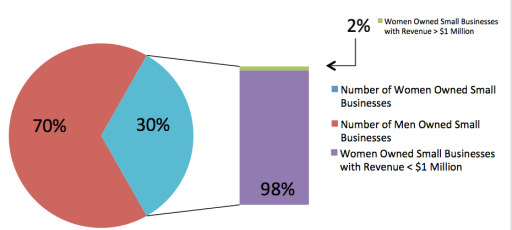
Last year Susan Coleman D.P.S. and Alicia Robb Ph. D published research prepared for the National Women’s Business Council examining the factors affecting access to capital for high-growth women-owned businesses. In their research, Coleman and Robb found that currently in the business community 30% of businesses were owned by women, however they are mostly small:

  • only 12% of women-owned small businesses (WOSBs) employ anyone other than the business owner;
  • 2% have 10 or more employees; and
  • only 2% have revenues in excess of $1 million.
NWBC Blog Image

This new data shows the need to engage and educate women owned businesses on growth strategies that can expand their businesses.

This report delves deeper into the issues relating to capital accessibility specifically for growth oriented firms, which comparative studies have yet to research thoroughly due to a lack of data.

According to the study, access to capital may be more challenging for women-owned firms than for men for a multitude of reasons:

  • In terms of financial capital, there are considerable gender gaps in the amounts of financing across firms. Men start firms with nearly double the amount of capital that women do and, of high growth firms, men use more than double of what women use. Men also indicated to have used six times the amount of financing that women do.
  • For startup capital, women were found to be more reliant on owner equity and insider financing as opposed to men who used outsider equity predominantly. For women owned firms, a very small fraction of startup capital came from outsider equity regardless of where the firm was on the size spectrum.
  • In terms of credit market experiences, women indicated to have similar loan application rates as men even though there are more unmet credit needs among women. Women were more likely to not apply for the necessary credit due to a fear of a denied loan application. Also, credit scores are generally lower for women.
  • While men and women are on par in terms of education levels, men exceed women in degrees in the STEM fields, which is the industry that experiences more growth.
  • By means of industry experience, as women tend to have lower levels of startup experience, team ownership and hours worked compared to men.
  • Women have higher rates of owning businesses that are home-based due to family commitments and research has indicated that being home based is negatively related to growth.

However, when comparing the top ranking female businesses by employment and growth potential, there are some considerable differentiations that set them aside.

  • They had a higher rate of employment from their startup year onwards.
  • They are more likely to be in tech industries.
  • They were more likely to offer services as opposed to products.
  • They were less likely to be based from the owner’s home.
  • They were more likely to be incorporated and as a result yield higher credit scores.

For leadership traits, women business owners of high growth firms also had some unique characteristics:

  • They were likely to have more years of industry experience and more likely to have more startup experience.
  • They started their businesses with much more capital (even more than the male owned firms overall.)
  • They used more outsider equity for startup capital. However, this was typically still less than their male counterparts.

Learning from these success measures, it is clear that increased capital for women entrepreneurs, specifically in the startup phase of their business, has an important correlation to the trajectory of women owned businesses. In order to foster a more successful environment for women, there must be changes in the business environment to give women the support and resources they need to turn this trend around.

It is clear that the financing gap between men and women business owners is a considerable detriment to the vitality of women-owned firms. In order to ensure stronger female entrepreneurship and make strides towards closing this gap, efforts must be made to strengthen the financial capabilities of women entrepreneurs and encourage accessibility to bank and equity financing. Also, providing more visibility and accessibility to successful female industry professionals and providing more opportunity for women to attain industry experience could help bolster the entrepreneurial confidence that women need to compete with their male competitors. Another important step forward would be an increased use of family-friendly policies, which could give women the flexibility to work outside of their homes and in an environment more conducive to entrepreneurial growth.

Take a look at WIPP’s recently launched Access to Capital platform to address funding gaps and the crisis of capital faced by women entrepreneurs.

To read the full report, click here.

WIPP’s Next Battle

A2C

For the better part of two decades, WIPP championed the effort to help bring women into the lucrative federal market. As many of you know, we accomplished much of what we set out to do with the addition of sole source authority. Since then, however, WIPP’s team in Washington has focused on a statistic that kept repeating in our brains: women receive only $1 out of every $23 that is being loaned to small businesses. How was that possible?

For months WIPP devoted time to researching the landscape of business finance, capital access, and small business lending. What we found was that there are many policy ideas about how to stimulate lending to women – ultimately growing the economy because we all know the economic impact of women-owned businesses.

But we have a long way to go. In 2013, more than two in three loan applications for women-owned firms were denied. WIPP’s annual membership survey regularly finds that women must make multiple attempts to secure bank loans or lines of credit – with a full 40% never succeeding. All this despite women making up one-third of business owners, generating more than $1 trillion annually in receipts, and growing at 1.5 times the rate of average businesses.

The platform WIPP released today, Breaking the Bank: Women Entrepreneurs & the Need for Capital, will hopefully change that. The solutions span three main themes: changing the capital infrastructure, supporting small lending institutions, and strengthening government investment. The platform has four solutions that will change the capital infrastructure. For example, WIPP wants the government lending programs to consider FICO’s alternative credit scoring system. This system modernizes the way credit is calculated to provide new opportunities for women entrepreneurs trying to obtain loans. WIPP also wants to support small lending institutions by pushing for an end to a “one-size-fits-all” approach to regulation. Removing these burdens on small banks will allow them to return their focus to lending.

Changes to government policies are an important part of the platform. WIPP believes a small business seat at the Securities & Exchange Commission will ensure that smaller women-owned firms have an advocate as the next generation of alternative lending, like CrowdFunding, is eventually put into place. Modernizing the Microloan Program, where women are the majority of loan recipients will also make a difference. Women owned small businesses are growing at 1.5 times the rate of average businesses, but they will never get off the ground if they cannot obtain early stage capital.

WIPP does not have a monopoly on good ideas but we have an important voice in public policy. Over time, we may add to this platform to ensure that all policy solutions improving access to funding for women entrepreneurs can become part of the debate in Washington. We ask you today to look through WIPP’s access to capital platform and share it with one other woman you know. If our successes in Washington in the 15 years WIPP has been an organization are any example, we will need a lot of women behind us to make this platform a reality.