
Time for Congress to Move a Neutral Net into Drive

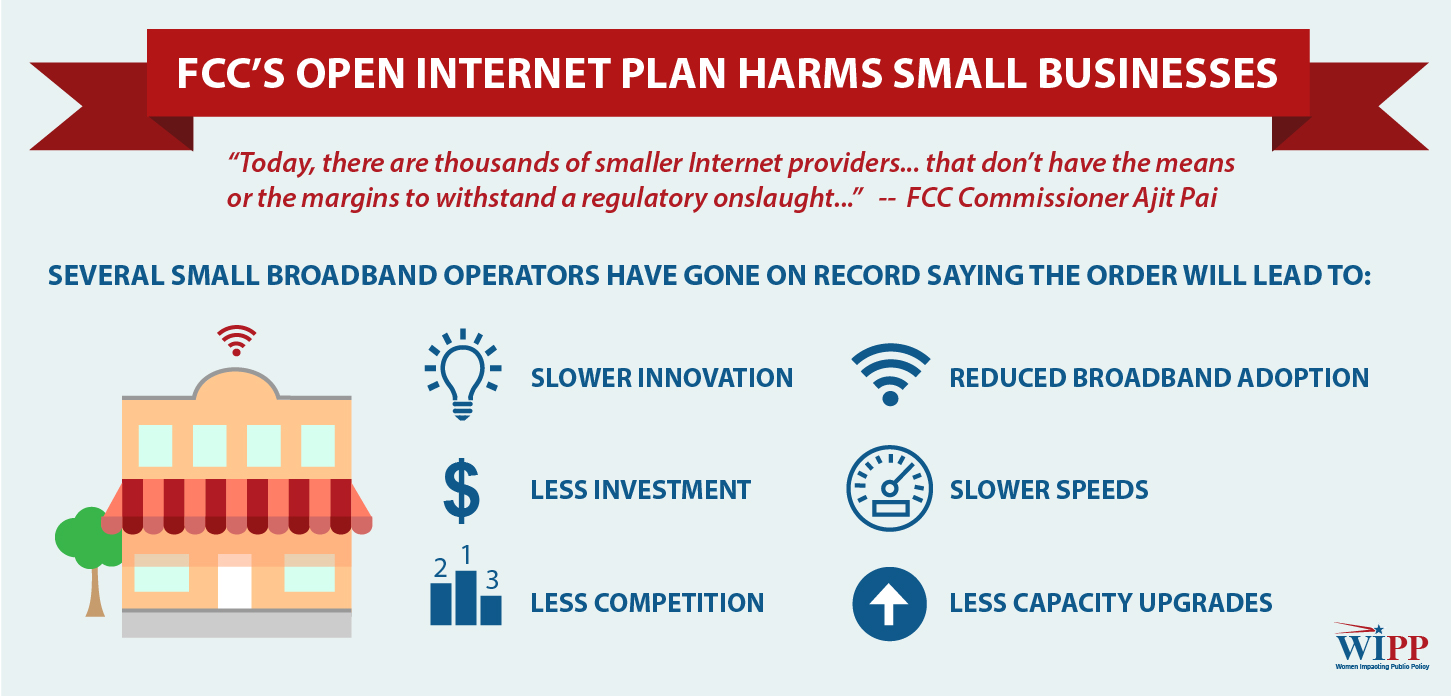
WIPP infographic II

Capital investment is a solid predictor of economic health. That’s why recent news in the communications policy arena deserves Congress’ attention.

Last week, a new regulatory regime over the Internet took effect. But before these rules came to life, a half-dozen small Internet providers in the Midwest, South and Pacific Northwest told federal officials that they had been forced to cut back on expanding faster broadband service because of the FCC’s recent decision to begin micromanaging the Internet.

All six of these Internet providers specialize in serving small towns and underserved areas; none have the size or scale to accommodate the new regulations’ expenses without budget cuts elsewhere. Moreover, their statements were made under threat of perjury.

For women in particular, this issue should raise serious concerns. Almost half of women-owned businesses are home-based. Anything that slows home broadband deployment has a potential to impact the full economic participation of women.

These verified reports about higher regulatory costs and less money for investment are a clear “canary in the coal mine” warning to Congress about the FCC’s decision to regulate the Internet with Title II regulations written in 1934. That 3-2 party line vote on February 26 overturned decades of successful experience about the benefits of “light touch” rules for the Internet.

Prior to that ill-fated FCC vote, federal Internet policy was both an area of broad agreement and a shining example of successfully encouraging an important new industry. The lack of federal micromanagement that was a hallmark of federal policy since Bill Clinton’s Presidency was key to unleashing a tidal wave of communications investment — $1.3 trillion since 1996 and $75 billion just in 2013.

The results speak for themselves, especially when compared with other countries’ experiences. The U.S. has a huge lead over Europe in both fiber optic deployment and high-speed 4G LTE broadband. Americans spend more time talking on their mobile phones than people in any developed country in the world.

This investment also produced jobs – lots of them. The growth of the mobile app economy, which developed because of America’s high-speed wireless networks, sustains more than 750,000 U.S. jobs, according to the Progressive Policy Institute.

The FCC’s decision to regulate the Internet as a public utility with outdated Title II rules undercuts the very policies that helped spur this success. The FCC’s action is as inexplicable as it is wrongheaded.

Indeed, the Commission’s efforts to explain this action border on the comical. As Hal Singer noted in a recent Forbes commentary, the FCC’s own economic analysis of its action is almost amusing. For example, the agency claimed that the broadband industry’s strong record of investment in 2010 showed that its regulations encourage investment, despite the fact that the Commission’s vote on a more reasonable set of Internet rules occurred on December 21, 2010.

Ultimately, the key reason that Congress must update America’s communications laws is to protect the people who lost an opportunity for better Internet service, because the FCC’s action added pointless new expenses and legal uncertainties to broadband deployment.

The 8,000 St. Louis-area residents served by Wisper ISP, a Missouri-based Internet provider, have felt the negative impact of these utility style regulations. As a result of the FCC’s decision, Wisper estimates that compliance costs will grow to 10% of its operating revenue. It has already had to cut investment, resulting in what the company calls “slower broadband speeds, less dense coverage, and absence of expansion into new areas.”

It is a testament to the bipartisan, light-touch policies implemented back when Internet access meant a 56 KB modem that consumers enjoy so much today. Yet, at just the time when the United States was poised to run the table in a 21st century economy, the FCC pulled the rug out from under small businesses. The FCC’s February vote, and last week’s rules enactment, undid the phenomenal success of the modern Internet.

It is time for Congress to set things right again. We hope that members of both parties come together to enact common-sense legislation that both protects the Internet and reinstitutes the wise telecom policy that has brought us the Internet we use and enjoy today.

Arianna’s world

Arianna Huffingtion profileToday I came across a very inspiring profile story on Arianna Huffington who we all recognize as an  “Internet Media Pioneer”. The article provides great overview of her story, explains why she is being known as “the Internet’s most improbable media pioneer” and how her career led to creation of the Huffington Post.
Great article for anyone who is interested in online news and wants to learn from one of the pioneers in the field! Read more in New York Times.

Women in Media CAN Get Ahead

by Barbara Kasoff, WIPP President 

I like to kick off my mornings reading Kristen Bellstrom’s The Broadsheet, a daily published dish on the world’s most powerful women. The articles give you timely and thought provoking insight into what powerful women are doing to shape the world. Recently one in particular caught my eye that I thought would be worth sharing – although most of them are worth reading. This one offers tips women in the media – however the tips really extend far beyond the media industry sector: “A Message to Women in Media”.  First, the bad news: We women who work in the media make 83% of what our male counterparts earn. The good news? The author of the article and Morning Joe co-host, Mika Brzezinski has some tips on how to get ahead.
Related links:

House Passes Permanent Internet Tax Freedom Act – GUEST POST

by Rob Shrum, myWireless.org

Good news from the U.S. House of Representatives!

myWireless logoThe House voted to pass the Permanent Internet Tax Freedom Act (H.R. 235), which is strongly supported bipartisan legislation that permanently protects consumers from having to pay taxes on Internet access.

Now it’s time for the Senate to do the same. The Internet Tax Freedom Forever Act (S. 431), as it’s called in the Senate, is the companion to the bill passed by the House today.

The Internet Tax Freedom Act, as both bills are commonly known, was originally passed in 1998 to foster and encourage the continued expansion of Internet use in the U.S. As we all know, the Internet has revolutionized the way we are able to communicate, learn and do business. This legislation has been incrementally extended over the years, and is scheduled to expire October 1, 2015.

Please take a moment to write your Senators today and urge them to pass S. 431.

Let’s work together to make sure Internet access remains affordable and accessible to everyone, and tax-free forever!

See the original post at:  http://bit.ly/1NFX4DF


Internet Regulation Hurts Instead of Helps

by Barbara Kasoff, WIPP President

EarlieInternetr this year, the FCC voted to adopt overbearing “Title II” regulations that have already led to legal battles which will likely extend for the next several years.  What is Title II?  Title II of the Communications Act of 1934 would grant the FCC additional regulatory authority; this is the authority they utilize over telecommunications services currently. Plenty of experts and economists, as well as the small business community, warned  against the consequences of applying outdated Title II regulations on our country’s Internet infrastructure.  For small telecom providers especially, it’s quickly becoming clear that Title II is detrimental to growth and investment in their businesses.

According to U.S. Census Bureau data, small businesses are the overwhelming majority in the telecommunications sector.  And in his dissent, FCC Commissioner Ajit Pai pointed out that “today there are thousands of smaller Internet service providers…that don’t have the means or the margins to withstand a regulatory onslaught. Smaller, rural competitors will be disproportionately affected, and the FCC’s decision will diminish competition.”

The FCC’s new regulations would subject those small businesses to uncertainty and costs, slowing innovation and leading to decreased investment.  A new policy memo from the Progressive Policy Institute highlights the investment issue, stating the FCC’s decision to adopt Title II regulations could undermine the FCC’s broadband adoption and expansion goals, as well as cost the economy billions in lost investment—a reduction in annual investment of $4 to $10 billion.

These damaging effects are not mere speculation: As of last week, many of these small broadband operators have gone on record, stating under penalty of perjury that these regulations are forcing them to cut back on investments.  These Internet providers include wireless Internet service providers, small-town cable operators, and others, from all across the country.  These different businesses are united, because they have been directly affected by regulations.  As a result, they are forced to cut back on network upgrades, expansion plans, capacity upgrades, and investment in rural and underserved areas.

For consumers, these cutbacks in investment will cause slower speeds, service delays, and coverage gaps.  Reduced investment means that expansion plans will be scrapped or at least delayed, especially in rural and underserved communities where increased broadband deployment is critical.  Consumers have been clear in their desire for faster speeds, expanded coverage, lower prices, and increased competition—but Title II regulations will result in the opposite, hurting small businesses along the way.

There’s a way out of this mess, one that doesn’t involve legal limbo: bipartisan legislation.  Congress can design bipartisan solutions that will protect the Open Internet and consumers, as well as provide light-touch regulation that prohibits blocking and throttling.  This approach will pave the way for increased investment, innovation, and competition—benefitting American consumers and relieving small businesses and entrepreneurs from an overwhelming regulatory burden.  These legislative efforts are currently underway, and we certainly look forward to a real solution, one that does not harm small businesses or consumers.

Spectrum is vital for wireless – and more is needed! [GUEST POST]

by Robert Shrum, myWireless.org

Earlier this week, The Brattle Group released a study highlighting the essential value of licensed spectrum to America’s economy, job creation, technological innovation, and most specifically, the wireless sector and consumers.

For a quick refresher, “spectrum” refers to the radio frequencies that allow hundreds of millions of people to use wireless service across the country. Only a finite amount of those frequencies are usable for mobile broadband service today, creating heavy demand for access to this critical resource. The spectrum used by your wireless provider is licensed (meaning dedicated for specific network use.) This licensed spectrum is the crucial highway that all wireless network information travels on – without it, your service wouldn’t exist. Chances are the phone you are using is dependent upon spectrum sold at auction in 2006 and 2008.

Not surprising, the licensed spectrum currently being used by providers is incredibly valuable. In the report, The Brattle Group reveals, “We estimate that the economic value of the 645.5 MHz of licensed spectrum is almost $500 billion.” Even more shocking is the finding that the current value of social welfare from the benefits of wireless services generated by licensed spectrum is 10 to 20 times that of its direct market value (between $5 trillion and $10 trillion).

Additionally, this licensed spectrum has a huge positive impact on the national economy, resulting in over $400 billion in economic activity per year throughout the country due to wireless companies and industry employees. This figure does not even include the economic benefits from innovations in mobile education, mobile health, and other similar business and services now reliant on licensed spectrum. That additional impact is especially evident in states where the booming app economy is a key driver of economic activity and job creation.

As more of these wireless-reliant industries emerge and wireless devices such as smartphones and smart devices continue to advance in functionality, larger amounts of licensed spectrum will be required to operate networks and transport information.What is being done to meet this rising demand? In the paper, the Brattle Group notes that a net of 98.5 megahertz of licensed spectrum has been reallocated for commercial use since the 2010 release of the Federal Communications Commission’s National Broadband Plan, which called for an additional 300 MHz of spectrum to be made available for licensed use by this year and a total of 500 MHz by 2020.

To help meet these targets, the FCC has scheduled an incentive auction for next year where television broadcasters will be able to voluntarily sell their spectrum to the FCC, which will then repackage and auction it off to wireless providers. A similar auction resulted in more than $40 billion in proceeds last winter.These auctions are significant steps forward, but unfortunately won’t meet the full demands of American consumers. It is urgent that Congress, the FCC and NTIA work in collaboration with the private sector to identify a future pipeline of additional spectrum for licensed use before it’s too late and the looming wireless traffic jam brings your smartphone to a screeching halt. We have no plan for after 2020 as a nation to address our mobile needs. It is time to start that dialogue.


Growing Women’s Representation in the STEM Fields

By Louisa Brown, WIPP Intern

STEM

Science, Engineering, Technology and Mathematics, known collectively as the STEM fields, are some of the fastest accelerating areas in the U.S economy today. Innovations seem to be springing up all around us, and with them new career opportunities that offer high wages and ample areas of growth. When we look to who are filling these jobs, however, the results are troubling. According to the new report from the American Association of University Women, titled Solving the Equation: The Variables for Women’s Success in Engineering and Computing, only 12% of engineers are women, and women make up only 30% of computing professionals.  Although women are gaining ground in the science and mathematics fields, they are still falling behind in engineering and technology, the fields which have the highest number of opportunities and offer the highest return on investments.

So, why is this happening, and what can we do about it? In a virtual Town Hall meeting today, hosted by the AAUW and STEMconnector®, experts from higher education, industry and nonprofits had the chance to engage with the results of this important report, and discuss the many ways that organizations are already working to advance women in the STEM fields. Christianne Corbett of the AAUW and co-author of the report, started the discussion by advocating for an intersectional perspective which recognizes the ways in which women of color are even more underrepresented in the engineering and computing fields than their white counterparts. Women of all ethnicities, however, are subjected to gender biases and stereotypes that inhibit their ability to obtain and retain jobs in engineering and technology. Such biases and stereotypes are often implicit and culturally ingrained, making them that much harder to confront.

Acknowledging these biases is an essential first step towards equality, for both educators and employers. Rob Denson, of Des Moines Area Community College, highlighted some important ways that colleges and universities are already working with the STEM Higher Ed Council to address biases and better align educational and industry goals. Emphasizing workplace-learning through paid internships and early research experiences are important to retaining women in computer science and engineering majors, while underlining the social impact of such fields helps women commit to these majors and gain access to the career opportunities that come with them.

The virtual Town Hall meeting also included important input from women in the manufacturing, telecommunications and defense industries. Esra Ozer of the Alcoa Foundation, Anne Wintroub of AT&T Aspire and Betty Smith of Lockheed Martin all emphasized the importance of diversity and partnerships in the workplace. A range of educational pathways is essential to creating a representative work force, and strong mentorships give women the professional support they need to succeed in their careers.

Finally, Linda Hallman, the executive director of AAUW provided insight into the Million Women Mentors program which aims to provide women entering the STEM fields with meaningful mentor relationships. This program is just one of the many ways in which organizations across the country are taking tangible steps to improve representation from women in the technology and engineering industries. What are some solutions that you believe can help attract more girls and women into STEM careers?

Net Neutrality: The Solution Lies With Congress

Last spring, the World Wide Web turned 25.  And in its relatively short lifespan, Internet access has become vital to modern life.  Numerous broadband-enabled devices have been developed, and high-speed connectivity now delivers opportunities to us that we could only imagine not long ago.  This connectivity is an important resource for small businesses, professionals, and entrepreneurs, as well as for families, students, and diverse communities.

For women business owners, high speed Internet has enabled them to increase efficiency of business operations, improve customer service, reduce cost, and grow by reaching new customers and markets.  The most significant impact that high-speed connectivity has provided to women is flexibility, allowing them to start and grow their businesses regardless of whether they are working from an office, their home, or while on the go.

These advancements and innovations happened under a light-touch regulatory approach, which was wisely adopted and adhered to for many years.  This approach increased private investment in new technology and networks, allowed innovations to thrive, and helped increase high speed Internet adoption rates.  Unfortunately, we are now facing a radical change in course by the Federal Communications Commission (FCC), which regulates interstate and international communications by radio, television, wire, satellite and cable.

Later this month, the FCC is expected to pass burdensome net neutrality rules created in the 1930s that reclassify the Internet as a public utility. This approach is guaranteed to slow investment into our country’s networks and jeopardize high speed Internet adoption at a time when encouraging both is especially vital to the success of our economy, our small businesses, and our families.  Net neutrality must be preserved, but the proposed FCC rules will do more harm than good. They call for a drastically altered course, one that would sabotage the approach that has helped the Internet thrive from the beginning.

Fortunately, there’s another solution. Congress can design rules that will protect net neutrality and consumers.  By offering opportunities for bipartisanship, lawmakers can work together to eliminate real threats to the Internet and to establish clear legal guidelines for the FCC.  This solution can also ensure that we get the right level of regulation, more in line with the light-touch framework that has worked so well for the past few decades.

A light-touch legislative solution that prohibits blocking, throttling, and paid prioritization while also protecting consumers and avoiding legal limbo, will lead to even more innovation and investment in our country’s Internet infrastructure.  It will also ensure that that all Americans, such as the fastest growing segment of small businesses – women business owners – have access to high-quality Internet and the technology they need to continue to grow our economy.

Tell Congress We Need #NetLawNow!

Below is a piece by the Multicultural Media, Telecom & Internet Council (MMTC, formerly Minority Media and Telecommunications Council), a national nonprofit organization dedicated to promoting and preserving equal opportunity and civil rights in the mass media, telecommunications and broadband industries, and closing the digital divide. MMTC is generally recognized as the nation’s leading advocate for minority advancement in communications.


Bad Choices Can Make Today’s Internet Tomorrow’s Memory.  

Here’s what is happening right now to your Internet:  On Thursday, February 26, the Federal Communications Commission (FCC), the government’s independent agency that oversees the media and telecommunications industries, is about to deliver a groundbreaking decision that will affect your Internet.

Consumers need to speak up because the FCC’s actions can take away the benefits that we enjoy today and in the future.

Why Should YOU Care?

  • TODAY’S INTERNET GIVES YOU POWER. You choose from all kinds of plans and combinations, from low-cost pre-paid plans, all the way up to that family plan with the special music collection you like.  Tomorrow’s Internet could have all of these programs eliminated under new FCC rules.
  • TODAY’S INTERNET GIVES YOU ACCESS. We all move around the Web, accessing movies, photos, emails, and whatever we want on our smartphones and tablets. Tomorrow’s Internet could negatively impact where and how we use the Internet under new FCC rules.
  • TODAY’S INTERNET IS GETTING CHEAPER. Over the last few years, the price of broadband has been decreasing.  Tomorrow’s Internet costs may increase and make it harder for some of us to pay. New, unnecessary taxes and fees on services could also open up from Thursday’s FCC rules, hitting you and your family in the wallet.

Today’s Internet is OPEN, and after Thursday, consumers won’t get anything that they didn’t have – except more rules, less choice, and the possibility of higher costs.

We are running out of time, and we need everyone to join in on the conversation! Contact your Representative so we can all enjoy the benefits of the Internet today and tomorrow!

Tweet #NetLawNow and tell your Members of Congress that you want them to act now to keep the Internet open!

What Do Americans Really Think About The Open Internet & Wireless [INFOGRAPHIC]

Take a look at this infographic by CTIA – The Wireless Association.

A vast majority of Americans (78 percent) recognize that wireless is different from wired broadband services and warrant a different approach to regulations like net neutrality, according to a Mobile Wireless Service Survey (PDF) released today by CTIA-The Wireless Association®. Conducted by TechnoMetrica, the survey shows a glaring disconnect between the views of a majority of Americans on regulation, mobile services and net neutrality and the policy direction currently being pursued by the Federal Communications Commission.
2015-10-18_22-09-50

Full infographic here:  ctia_infographic_openinternet-wireless

3 Undeniable Business Trends You Need to Embrace

technologyAdaptability is the key ingredient of success for those looking to accomplish great things in today’s business climate.   This is one of the key business trends highlighted by Huffington Post’s blogger, Doug G. Sandler in his ARTICLE : 3 Undeniable Business Trends You Need To Embrace. We live in a business world that is moving faster than it ever has and adaptability seems to be the only acceptable policy for an entrepreneur, even though for many it will mean changing the status quo of how you operate, and for others – the newbie business owners – time and resources will need to be spent creating and improving their networks and key resources. Either case, you should embrace these three trends to make your own way towards success.

  1. The Internet is here to stay! The most successful businesses of tomorrow will be able to master technology but still provide a human touch as well.
  2. Content is king.  Blogging, writing and sharing content with existing customers and potential customers is vital. Be an expert in your industry, stay connected to your market and provide content that is relevant, interesting and easy to read.
  3. Adapt or perish. You cannot ignore business trends or your business will be left behind.

Read more here.