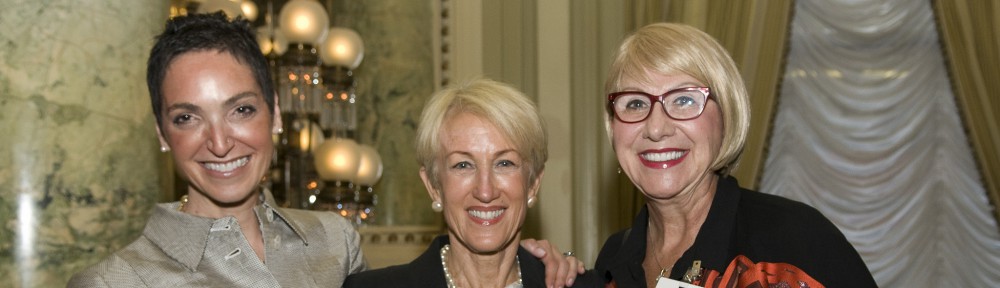

Gloria Larkin, WIPP’s National Partner of the Month – February 2017

113016_glarkintargetgov_headshot

Gloria Larkin, president of TargetGov, has been a staunch ally of WIPP for years. She leads GiveMe5 webinars, responds quickly and effectively to WIPP’s calls to action, and is always on the lookout for new WIPP members. It’s thanks to people like Gloria that WIPP thrives!

Read our Q&A with Gloria to learn more about her and her work.

Q: Tell us a little about TargetGov and its mission

A: TargetGov is celebrating its 20th year in business in 2017! Our mission is to help small, mid-sized and large government contractors win business and aggressively grow their companies. Our clients have won over $3.9 billion in federal contracts in just the last five years.

Q: Have you always been an entrepreneur? If not, what inspired you to take the leap?

A: I have been both an employee and an entrepreneur. I took the leap 20 years ago because I wanted to do something that no one else was doing—help businesses see great success and increase their revenues with a targeted, proactive marketing and business development process.

Q: Have you encountered challenges you had to overcome as a business woman and if so, what have you learned from them?

A: The challenges have been constant, and access to capital is one of the biggest. Through the years, I have had several business loans to grow my business, and none of them were the amount I asked for. It’s an issue even to this day. In applying for a line of credit, I was offered less than half of what I thought it should be. I had the chutzpah to say exactly the amount I thought they should give me (more than double what they offered) and was pleasantly surprised that they agreed. In the past I wouldn’t have pushed, but now, I do.

Q: Do you have a success story that you are particularly proud of? Tell us about it!

A: My proudest moments are when our clients contact us and tell us of their awarded contracts and successful business growth. It feels like my children are successful and I am one proud parent! The first billion was a heady milestone. Now as we see the four-billion milestone coming this year, we are ecstatic about their success!

Q: What is the biggest lesson learned working with the federal government?

A: The biggest lesson is that the federal government market is constantly changing. The rules and regulations are burdensome, yes, but success is predicated on having a strategy and plan that addresses this constant change and adapts proactively, with a trackable, measureable and scalable process. Seeing it work in real life is extraordinary!

Q: Do you have any tips you would like to share with women pursuing federal contracts?

A: This is a demanding market and one must be well prepared, have a well-thought-out roadmap, the discipline to execute it, and measurable actions to track success. This is truly the market in which you can think BIG and see results. But it takes effort and knowledge; use the experts to help you!

Q: Tell us about your experience as a WIPP member. What resources and value has WIPP provided that has been helpful to you and your company?

A: WIPP has truly changed my life. I started getting involved as a committee chair, then learned how to talk to my Congress people. I participated in virtually every area WIPP works in and found a home on the procurement committee. Then I worked my way onto the government board, and then to Chair of the Educational Foundation. Thanks to WIPP, I have testified before the House Small Business Committee, and traveled to more than 15 states and had lifetime trips to Dubai and Abu Dhabi, Japan and Oxford, England to speak or work with women in those counties. Working to start the GiveMe5 program, and supporting it through the years has been a great highlight. WIPP has impacted more than 30,000 women business owners through GiveMe5! And I am deeply honored to have many WIPP members as clients and heart-felt friends.

10 Things You Should Know From the Linda McMahon Hearing

By Ann Sullivan, WIPP Chief Advocate

On Jan. 24, the Senate Small Business Committee held a hearing on the confirmation of Linda McMahon (former WWE CEO), to become Administrator of the Small Business Administration (SBA). Here are the 10 things you should know about her hearing:

  1. SBA is still part of the cabinet—President Obama elevated the position of SBA Administrator to cabinet level. President Trump is sticking with that change.
  2. Existing programs are safe…for now—When questioned by numerous senators on specific program commitments, McMahon repeatedly said that if the program is working then it should be continued.
  3. She will go to bat for small business in the executive branch—McMahon sees herself as the small business advocate within the executive branch, and will go to other agencies and make sure that more federal contracting opportunities are provided to small businesses.
  4. She will work to expand the 5% contracting goal for women—Senator Duckworth (IL), asked about the 5% goal, and McMahon expressed support for women entrepreneurs, broadly, “I have been very forthcoming in wanting women entrepreneurship to grow. And I will continue to support that, it is very near and dear to my heart.”
  5. She has a history working with Veterans—According to McMahon, WWE was always concerned about veterans and how to help create jobs for them. Senator Cardin (MD) discussed the Veterans Institute for Procurement (VIP) program and noted its impact and high performance.
  6. Look for an emphasis on mentoring—Given McMahon’s background in business mentoring, she may focus on programs that incorporate mentorship. As co-founder of Women’s Leadership LIVE, McMahon’s organization educates entrepreneurs about all facets of starting and expanding their business.
  7. She wants to help free small businesses from burdensome regulations—While many senators asked questions about regulatory burdens on small businesses, Senator Ernst brought up the PROVE It Act—legislation passed out of committee last session that empowers the SBA Office of Advocacy to require agencies to analyze rules for their small business impact.
  8. Speaking of advocacy—McMahon expressed support for expanding the independent SBA Office of Advocacy to ensure that the voice of small business is heard on federal regulations.
  9. She wants small businesses to participate in anticipated Infrastructure projects—When asked about promoting fair opportunities for small businesses to compete for work in the highly anticipated infrastructure plan, McMahon stated that small business participation was a given.
  10. Streamlining cumbersome federal contracting—McMahon expressed support for streamlining the alphabet soup of federal websites and databases like SAM and FBO.

This was a conciliatory confirmation hearing. Given the contentious nature of other confirmation hearings, it was unknown what tone McMahon’s hearing would take. But the hearing went well. Senators were polite and McMahon was responsive to concerns. With so much partisanship in Washington, it was positive to see McMahon’s interest in working with the committee—both sides.

A Report Worth Reading

By John Stanford, WIPP Government Relations

Shortly after adding sole source authority to the WOSB program, WIPP’s Chief Advocate (and my boss, full disclosure) Ann Sullivan asked our policy team a simple question: what’s next?

Surely the much-needed improvements to the women’s procurement program we had spent the last fifteen years attaining were not the only steps needed to remove barriers women face in the federal market. The answer was straightforward, WIPP’s procurement portfolio would go onward, exploring more ways women entrepreneurs can bring innovation and value to the federal government.

The next question was not so simple. While anecdotes and intuition told us that the playing field was far from level, we lacked the data to point to the next set of systemic issues that limit access. “What are they and what can we do about them,” began a quest that reached a major milestone two weeks ago with the release of Do Not Enter, WIPP’s latest report about disparity in federal contracts.

The salient details are in the related one-pager with a full executive summary and findings in the formal report. I’ll refrain from re-digesting those documents here, but instead make a plea that you visit them. The key findings and recommendations will be the pillars of WIPP’s next push – ensuring that these mega-contracts are fair opportunities for women business owners.

Many people ask where an advocacy campaign truly begins; something that will ultimately lead to a new law or a change in regulations. At WIPP, it begins with our members. Tackling this issue would never have happened without women business owners communicating their struggles—far more than individual challenges, but instead ongoing concerns about disparities—to WIPP.

We listened. But compiling a few narratives from members will not move the needle in Washington. We needed data, analysis, and recommendations across regions and industries to garner the attention of policymakers. Enter this report. It is the launching point for a broad campaign to educate and change a contracting system that continues to leave women business owners at a disadvantage.

At WIPP’s Annual Leadership meeting earlier this month, we detailed the report to attendees and Congress. In follow up, a new WIPP member commented that she was thrilled WIPP would be taking on this issue. She described her feeling of helplessness as she lacked the voice to challenge her customer, but felt that she continued to have limited success because of the structure of her contracts. The barriers she faced could have come straight from the pages of this report.

While her story was compelling, new policies are not implemented because of individual experience. Simply put, Congress is little moved by lone stories of inequity. That is why, at WIPP, these kinds of efforts serve as a reminder that a team in Washington, backed by organizations and businesses across the country, stand shoulder to shoulder with you on these issues. Do Not Enter, and its ensuing efforts, should remind us all that no one is alone.

As the next chapter of WIPP’s advocacy for women business owners seeking access to the federal market begins, it does so not in the form of grand rhetoric or a press release, but spread out across dozens of pages of research and data confirming what we knew to be true: more work remains to be done to ensure women have a shot at the government’s largest contracts.

We hope you will join us in this fight.

Does the Tax Code discriminate against women?

By Caroline Bruckner, Managing Director of the Kogod Tax Policy Center

indexWomen-owned businesses are one of the fastest growing segments of our economy. Between 1997 and 2013, the number of women-owned businesses increased by 59% – 1.5 times the rate of U.S. businesses overall, according to a 2013 Women-Owned Business Report prepared by American Express. What’s more, over the past 16 years, employment by companies owned by female entrepreneurs is up by 10% and their revenues grew by 63%. Both increases exceed those of all but the largest, publicly traded firms. Today, more than 8.6 million U.S. businesses are owned by women. They generate more than $1.3 trillion in revenues and employ nearly 7.8 million people.

Those are impressive figures, especially considering that women business owners face many challenges men do not, such as having a much harder time accessing capital than their male counterparts. Only 4% of all commercial loan dollars go to women, in fact. But what other hurdles must they overcome? What about the U.S. tax code? Is the tax code—first codified more than 100 years ago, before women even won the right to vote—written in a way that inherently discriminates against women entrepreneurs?

The Kogod Tax Policy Center, with WIPP’s help, intends to find out.

Kogod will perform groundbreaking research in the coming months into whether small business tax incentives discriminate against women business owners—a question that has received scant attention from policymakers and academia.

Given the current political and budget environment, we think that researching and answering this question is vital to informing Congress about the policy implications of existing small business tax incentives as policymakers look to move forward with tax reform.

The tax code is ripe with provisions designed to specifically target various taxpayer populations like small businesses, veterans, and low-income workers. However, little academic or policy study has been dedicated to the tax challenges women business owners face and whether small business tax incentives favor men.

But how could the tax code discriminate against women? It can’t see the difference between male and female any more than it can play the piano or skip rope. Well, let’s look at some details of the tax code’s inception:

  • The income tax code was written in 1913.
  • Women didn’t get the right to vote until 1920.
  • Women weren’t able to fully access credit until 1974.

Women business owners weren’t even a footnote as our nation’s tax code was being written and developed. Simply because the tax code is supposedly gender neutral does not mean it impacts people equally.

We plan to analyze the federal budget implications of annual small business tax expenditures in relation to how many women-owned firms claim them.

We recently announced our project at WIPP’s Annual Leadership Meeting in Washington, D.C. As part of the study, Kogod will partner with WIPP to survey women business owners to determine how they view the tax code and its impact on their business, so watch your inbox and make sure to participate so we can use your experience and voice in our study!

Given the enormous role women entrepreneurs play in our economy, answering these questions will determine whether they are playing on a level field and could lead to positive policy changes that help the economy overall by boosting women’s entrepreneurial output even more.

The time has come to review the tax code and determine whether the specific tax provisions are serving women entrepreneurs so they can fully unleash their economic potential.


If you have questions about our research, want to help support the Kogod Tax Policy Center with a gift or would like to participate in the survey, contact Caroline Bruckner at cbruck@american.edu.

Government Contracting – Starting, Sustaining, and Scaling

By Sonja N. Hines–President, H&S Resources Corporation and Member of the Women Presidents’ Organization.

The federal government purchases products and services from just about every industry. Key points to consider when doing business with the government are starting, sustaining and scaling. Many rules and administrative regulations require implementation before business can be done.

Starting

  • In order to do business with the government, you must first register your company in the System for Award Management Database (SAMS). SAM registration incorporates all government contractor information into one system. Contractors and vendors can register, file representations and certifications, and then search for contracting opportunities. A contractor enters information once, which reduces the risk of duplicating or entering conflicting information.
  • Determine your North American Industry Classification System (NAICS) codes. These ID codes which identify business establishments by category are to government contractors what Social Security numbers are to individuals.
  • Establish an account with the Federal Business Opportunity Database (FEDBIZOPPS) website, an internet data source about contracting opportunities & purchases the US government needs to make. It is one of some sources that post the government contracts.
  • Meet with the Office of Small and Disadvantaged Business Utilization (OSDBU) representatives at Federal Agencies to introduce your company and learn how the agency procurement cycle works.

Sustaining

  • Establish a pipeline to identify ongoing business opportunities. There are a number of products, websites and companies that are helpful. For example, our company uses GovWin which is an online government intelligence portal providing contacts, information and resources needed to create and award successful solicitations. These companies, as well as other free government resources, help you find opportunities ahead of time, have information and market analysis needed to strategically pursue an opportunity and make sure you compete in the markets that represent the best fit and increase your probability of a win.
  • Review FEDBIZOPPS and other opportunity databases on an ongoing basis.
  • Market your services to the appropriate agency. To increase the U.S. Department of Labor’s utilization of all types of small businesses, the Department’s Office of Small and Disadvantaged Business Utilization (OSDBU) sponsors Small Business Vendor Outreach Sessions (VOS). These sessions offer small businesses the opportunity to market their capabilities directly to OSDBU and agency program officials and learn about potential Department procurement opportunities. The OSDBU develops and implements appropriate outreach programs aimed at heightening the awareness of the small business community to the contracting opportunities available within the Department. Outreach efforts include activities such as sponsoring small business fairs and procurement conferences, as well as participating in trade group seminars, conventions, and other forums that promote the utilization of small business as contractors.

Scaling

  • Establish a process to search for opportunities across all agencies on a regular basis.
  • Be proactive: look at agency forecasts so you can contact the buyer before an opportunity/solicitation is released for bid.
  • Set up a meeting with potential contracting officers.
  • Participate in appropriate opportunities and submit a bid.

Tips

  • Remember that persistence is the key.
  • Form strategic partnerships with other firms enables you to go after work you would not ordinarily be able to pursue to increase your reach and scope.
  • Make sure you thoroughly understand your company’s financials and have the appropriate back office infrastructure in place to be able to grow.
  • Participate in the agency procurement cycles.
  • Be sure you have enough money set aside to continue normal business operations; the average payout by the government is 45 days.

Diversify your business mix to include government and commercial work.

Regulatory Race to the Finish

By Debbie Kobrin, WIPP Government Relations

173414-425x283-government_regulationsWith the party conventions right around the corner, and a few months to a new President, you might think the current administration would be slowing down. But things are moving in the opposite direction. The Administration is churning out plenty of new contracting rules, and shows no signs of stopping anytime.

In June, SBA finalized a new subcontracting rule which will help WOSBs with subcontracting requirements, by easing the “50 percent rule” to allow a WOSB to do less than 50 percent of the work on a contract, as long as the WOSB subcontracts to other WOSBs. The rule also shifts the limitations on subcontracting from requiring a prime to perform at least 50 percent of the labor on the contract, to requiring a prime perform at least 50 percent of the dollar amount of the contract. The rule also contains changes to subcontracting plans, roles for Procurement Center Representatives (PCR), Joint Ventures and more.

Also last month,  the GSA finalized a new regulation requiring contractors to report transaction or task order level data on goods and services to GSA. Under the transactional data rule, businesses are required to tell GSA what federal agencies purchase through GSA. This rule applies to GSA contracts including the Federal Supply Schedule (FSS) and Government-wide Acquisition Contracts (GWAC).

Last week, the FAR Council finalized a rule strengthening subcontracting regulations by finalizing the “ list us, use us” requiring for prime contractors to make a good faith effort to utilize small subcontractors to the same degree as listed in the bid or proposal. WIPP has supported this change for a number of years, and testified on its value to women business owners. The rule also requires prime contractors to assign NAICS codes to subcontracts, and restricts prime contractors from prohibiting a subcontractor from discussing payment issues with the contracting officer.

In addition to what we have seen over the past several months, SBA is expected to release a new Mentor-Protégé Program for all-small-businesses any day now. The SBA is also expected to work on rules associated with lower-tier subcontracting credit, WOSB certification, and the WBC program.

The FAR Council continues to work through its back-log and plans to release new rules that include creating a government-wide definition for consolidation and bundling, providing subcontractors with additional payment protections, and implementing the Department of Labor Fair Pay, Safe Workplaces Executive Order.

As we enter the home stretch of the Obama Administration, there is a clear impetus to do as much as possible over the next several months. As new information about rules becomes available, WIPP is committed to keeping you informed.

 Let us know what you think about Regulations by taking We Decide 2016 Quick Poll.

Are Regulations Discouraging Entrepreneurship?

By: Jake Clabaugh, WIPP Government Relations

Is the federal regulatory process stacked against entrepreneurs? The Joint Economic Committee sought to answer this question during a hearing entitled “Encouraging Entrepreneurship: Building Business, Not Bureaucracy.” The Committee’s Vice-Chair, Pat Tiberi (R-OH) opened the hearing with this direct question to witnesses: Is the thicket of government bureaucracy strangling private initiative?

Before taking on the Vice-Chair’s question, the witnesses began by framing the landscape. Entrepreneurship – the birth of new firms – has been trending downward since President Jimmy Carter’s Administration in the 1970’s. Dr. Tim Kane, a Research Fellow at Stanford University’s Hoover Institution, highlighted the decline in the number of startup firms from 16% of total firms in the U.S. in 1977 to just 8% today.

Despite the decline in overall start-ups, National Women’s Business Council (NWBC) Chair Carla Harris lauded the growth in women-owned businesses. Since 2002, the number of women-owned firms has leaped from 6.5 million to 10 million. Women are creating businesses at 2 -1/2 times the national average. The progress made by women business owners provided a bright spot in otherwise gloomy testimony on the outlook for entrepreneurs.

When the witnesses were asked what regulations were causing the most headaches, the Affordable Care Act (ACA) was the most commonly cited culprit. Specifically, the ACA defines a full-time employee as an individual working thirty hours a week instead of the traditional forty. This definition determines whether a business is exempt from the employer mandate. The witnesses echoed the experiences of many WIPP members who have found the thirty-hour workweek definition detrimental.

To tackle this and other regulatory challenges, WIPP partnered with the National Association of Manufacturers, Small Business & Entrepreneurship Council and International Franchise Association to launch Rethink Red Tape.  As part of this initiative, WIPP will be calling on policymakers to produce better, fairer rules. In the opinion of the Joint Economic Committee and WIPP Members alike, regulatory reform will be a win for entrepreneurship.

Federal Contractor, The Boeing Company, Shares Tips with WIPP on Subcontracting

Interview with Boeing Supplier Diversity Manager, Champagne Bell.

  1. Tell us a little about The Boeing Company.

Champagne Bell: Boeing is the world’s largest aerospace company and leading manufacturer of commercial jetliners and defense, space, and security systems. As a top U.S. exporter, Boeing supports airlines and provides products and services support to customers in 150 countries. We have global footprint and continue to expand it.

Boeing products and tailored services include commercial and military aircraft, satellites, weapons, electronic and defense systems, launch systems, advanced information and communication systems, and performance-based logistics and training.

  1. How does Boeing work with small businesses?

Champagne Bell: Boeing has contracts with 21,500 suppliers and partners globally and we focus on partnering worldwide for mutual growth and prosperity. Currently, we contribute over $5B to small and diverse businesses annually and Boeing is a part of the Billion Dollar Roundtable (note: an organization that brings together major corporations that make meaningful and measurable contributions to the economic growth of woman-owned and minority-owned companies).

  1. Do you have a supplier diversity program? Can you tell us little more about it?

Champagne Bell: Since 1951, Boeing has had a Supplier Diversity Program in place. In addition, we have also targeted initiatives and one of them focuses on women-owned enterprises.

Our commitment to small and diverse business enables us to manage our businesses and deliver value and solutions where our suppliers, Boeing, and customers win.

We are proud that our Supplier Diversity Program has demonstrated results including:

  • Highest rating from Government customer.
  • Received national industry awards.
  • Dedicated enterprise Supplier Diversity team.
  • Boeing has received recognition from our external and industry partners for its supplier diversity work.
  1. What role do subcontractors play in your government business?

Champagne Bell: Our subcontractors play a critical role on our business and help support our commitment to adhering to DOD Statutory Contracting and Subcontracting Goals.

  1. Do you have any programs to target women owned businesses for subcontracting?

Champagne Bell: Yes. One of our Strategic Initiatives focuses on enhancing relationships with eligible women-owned small businesses to ensure we maintain a viable supply chain of WOSBs to support our businesses.

  1. What are the key qualifications you are looking for among your suppliers/subcontractors?

Champagne Bell: Boeing is looking for suppliers who:

  • Do their homework to fully understand how their products and services can directly benefit Boeing and the solutions we offer our customers.
  • Share our commitment to performance excellence in terms of cost, quality, and delivery.
  • Are financially healthy and are continuously focused on improving affordability and efficiency through Lean operations.
  • Will share their knowledge for how we can all better manage our businesses and deliver value and solutions where our suppliers, Boeing, and customers win.
  • We need suppliers who are looking toward the future with us, applying what we learn together as we continue to invest in technologies that will help us deliver the critical products and services that our customers will demand. We are looking for long-term partnerships.
  1. What would you recommend to WOSBs looking for subcontracting opportunities?

Champagne Bell: To summarize it:

  1. How do you think can ChallengeHER and WOSB program help women-business owners to get into the federal procurement?

Champagne Bell: As mentioned above, we have a strategic initiative which focuses on WOSB suppliers and we believe that the programs like ChallengeHER are helping a lot to encourage women to enter the federal procurement business. It also helps us, the Boeing Company, to find diversified suppliers that we are looking for.

Other general advice is:

  • Understand the procurement practices and requirements.
  • Understand quality requirements.
  • Small business owners are admired for their ingenuity and aggressiveness so embrace that mindset to find your customers and know their business.
  • Leverage engagement with large primes to understand business needs.

FCC Set Top Box Hearing – Move Towards Good Direction

This week, WIPP kept a close eye on the House Energy and Commerce Committee’s oversight hearing of the Federal Communications Commission.  The hearing had a major focus on the Commission’s proposal to regulate set-top boxes which has received much criticism from since its release earlier this year.

More than 190 Members of Congress from both sides of the aisle and several advocacy groups and industry leaders have spoken out against how the proposal could negatively affect media diversity and consumer privacy. We at WIPP expressed our own concerns about how the proposal could specifically harm women and minority programmers in the media marketplace.

Under the FCC’s proposal, the playing field would be stacked against minority programmers in tilted in favor of tech giants.  These large companies would be able to take content from independent and minority programmers and redistribute it without having to pay the content creator.  As a result, these programmers would lose revenue that is necessary to maintaining and funding the creation of new quality content for their audiences.

This past February, 18 independent programmers and content creators wrote a letter to Congress expressing concern about the “devastating and lasting harm” the proposed regulations could have on media diversity and their businesses.  They stated that “It’s clear that the independent programming landscape would quickly become a ‘race to the bottom’ if this rule were to pass.

Fortunately, the video industry recently came up with an alternative to the FCC’s proposal that would protect the copyrights of programmers’ original content. Under this plan, pay-TV providers would offer apps that can be used on third-party boxes or streaming devices.  This way, content creators remain in control of how their programming is distributed and consumers are able to access their favorite shows on the device of their choice.

It seems that after months of debate, the Commission is moving forward in a positive direction.  During this week’s House hearing, Rep. Marsha Blackburn asked the FCC Commissioners if they believe their original proposal to regulate set-top boxes is flawed.  All Commissioners acknowledged that the original proposal needs improvement and that the video industry’s proposal is potentially a better approach.

Commissioner Jessica Rosenworcel and Commissioner Mignon Clyburn further stated that the Copyright Office voiced concerns with the FCC’s proposal and that copyright security and privacy must be put in place.

We strongly encourage the FCC to move forward with this apps approach.  This alternative offers a constructive solution for all content creators, especially women and minority businesses enabling them to continue doing what they do best: providing consumers the diverse content they demand.

Trade Agreements: Path to Prosperity


 Mergen_Ashley


By Ashley E. Mergen
Senior Manager, International IP Policy
Global Intellectual Property Center | U.S. Chamber of Commerce


With the all the hysteria flying left and right in this election cycle, it’s no wonder folks are second-guessing why the U.S. even pursues free trade agreements. But the overheated rhetoric of presidential campaigns is obfuscating what really is at stake- American competitiveness.

The United States is already among the most open markets in the world – and has been since the end of World War II. That openness has honed the edge of American competitiveness and helped stem the price inflation that fuels inequality. Trade agreements are a tool to ensure that U.S. products and services have the same fair and non-discriminatory access to international markets.

As the leader of the free world, the U.S. has worked to shape the rules of the road in the international economy. Free trade agreements are one of the most effective mechanisms for doing so. The alternative to U.S. free trade agreements is a global economy shaped by others who don’t have America’s interests at heart.  The world is not sitting still: The World Trade Organization counts 419 trade agreements in force around the world, while the United States is party to only 20.

It’s true that 21st century trade deals like the Trans-Pacific Partnership (TPP) Agreement and Transatlantic Trade and Investment Partnership (TTIP) are growing even more complex, especially as they tackle emerging and critical issues like intellectual property rights in digital trade or biopharmaceuticals.

But knowledge-intensive trade isn’t limited to big corporations or scientists curing cancer. It is also providing a significant platform for entrepreneurial women to connect with previously untapped markets.Take Lolita Healy, who after obtaining her first copyright at the age of 12 built a multi-million dollar empire painting designs on glassware, eventually selling 14 million products around the world. Lolita is just one example of the 40 million Americans who are employed by the creative and knowledge-intensive industries. The U.S. Department of Commerce has found that they represent over a quarter of all jobs in the economy, driving 60% of total U.S. exports.

The best part is, there are Lolita’s everywhere- from Michigan to Malaysia or Pennsylvania to Peru. This year’s International IP Index from the U.S. Chamber of Commerce estimated that economies which espouse meaningful and robust IP rights also enjoy more access to venture capital, more foreign direct investment, more R&D expenditure, more growth in high-value jobs, the list goes on…

Trade agreements like the TPP and TTIP continue this path to prosperity by ensuring innovation — the very cornerstone of the business community — remains protected as we expand markets abroad. So before you buy into the hype, take a look behind the curtain and see how trade really puts our innovators front and center on the world’s stage.