WIPP partnered with Pfizer Consumer Health Care to discuss the growing important of “self-care,” and ways business owners can decrease health costs for their companies. Nationally, employers lose a total of $165 billion in lost productivity costs due to employee health issues. Much of this, however, can be mitigated by encouraging employee wellness — which doesn’t have to be expensive. Gary Surmay, Director of North America Public Affairs at Pfizer, shares employee wellness tips for employers in the webinar Self Care: Empowering Employee Health & Wellness. Filled with clear and simple infographics, this webinar easily guides employees and employers to take control of their health and get back to work.
Author Archives: Women Impacting Public Policy
Santa’s Wish list for Eight Crazy Nights
By: Ann Sullivan, WIPP Chief Advocate
Being located in the Nation’s Capital and leading the advocacy team for WIPP, gives us the opportunity to wish for things uniquely Washington. So, in the spirit of the holidays, and maybe a little tongue in cheek, here’s our wish list for Santa with a nod to Hanukkah.
Santa, please bring us:
1. A Congress that knows how to make deals. This is also called bipartisanship but at the heart of the matter, it requires willingness to bend without compromising principles (or giving away the store). A lost art in Washington, straight party votes and initiatives lead to a “do-nothing” Congress. Perhaps the new President–elect, who wrote a book on deal-making, can assist.
2. More women in Congress. Building on the first wish, we know firsthand that women in Congress are inclined to be practical and open to working with the opposing party. The 114th Congress will start with a record 108 women. Santa, please get more women to run for public office.
3. Busting through the 5% women-owned small business goal for federal contracts. We know that record $$$ were awarded to women-owned firms in 2016, but there is so much work to do to ensure they have equal access to federal contracts. Santa, you may have to place some of your elves in federal agencies to make this happen.
4. Rethinking Red Tape. Federal contractors got hit with lots of new requirements, for example, the Executive Order called Fair Pay and Safe Workplaces. Although the contracting community pointed out many flaws in these Executive Orders, they were largely ignored. So, Santa, just get rid of these Executive Orders.
5. More WIPP accomplishments for 2017 than we had in 2016. Ok, we know this one’s on us. We have a pretty long list of 2016 accomplishments on the legislative and regulatory side but we want the sled to overflow. Because of our efforts, Health Reimbursement Accounts are an option for small employers, contracts through the WOSB procurement program increased to over $18 billion, there is a new Mentor-Protégé Program for WOSBs, and more!
6. The end of massive motorcades. This really is an inside Washington request, but the motorcades for the President and visiting dignitaries have now reached epic proportions and wait times have stretched to half an hour. Talk about impeding commerce. We could really use a little Santa ”stealth” when it comes to moving the president around the city.
7. A fresh look. We are in the final days of the 114th Congress and about to head into the 115th Congress. Out with the old and in with the new. Here’s hoping Congress hits the reset button to look at women’s business issues in a new way.
8. A stable federal budget cycle. Actions of Congress directly affect the behavior of the economy and the stock market. Congress has all the tools it needs to produce a budget and accompanying appropriations every year. These last budget minute shuffles and funding extensions damage the economy and really put small contractors in a tough place. We realize this is a really big ask. But our understanding is that Santa can work his magic anywhere.
WIPP’s advocacy throughout 2016 has yielded great results for women entrepreneurs, but our strong advocacy is never over. There is still much work to be done. Thank you for your support and happy holidays from the WIPP Policy Team!
2016: What Kind of Year it has Been
While there is little doubt that most Americans think our political system is broken, quite a bit was accomplished in Washington this year.
In February, two announcements by SBA marked the result of more than 15 years of WIPP’s advocacy. For the first time ever, the federal government met its goal of awarding 5% of all contracts to women-owned firms. The following day, the WOSB procurement program, which helped make reaching the goal a reality, was expanded from 83 to 113 industries. The government now contracts $18 billion a year with women-owned small businesses, largely due to this program we spent so many years building.
As the snow began to melt, focus turned to the final months of the Obama Presidency. The Administration moved swiftly to issue Executive Orders aligned with their priorities. New rules were finalized from the U.S. Department of Labor including Fair Pay Safe Workplaces, Overtime, and Paid Sick Leave (though all three are under litigation and are expected to be rescinded by President-elect Trump). The General Services Administration finalized the Transactional Data Rule which adds an unnecessary burdensome reporting requirement for GSA schedule contract holders.
Regulations can also help small business. SBA released its updated Limitations on Subcontracting rule, making it easier for WOSBs to follow subcontracting rules by encouraging additional work with other WOSBs. SBA also began accepting applications for the long-awaited all-small Mentor Protégé Program, that helps WOSBs team with a mentor business and pursue federal opportunities.
In the fall, we welcomed Jane Campbell as the new President of WIPP. Her longtime advocacy for women entrepreneurs, coupled with her experience as a business owner, as the first woman Mayor of Cleveland, and as Staff Director of the Senate Committee on Small Business and Entrepreneurship, allowed her to hit the ground running.
At the end of the year, Congress passed the National Defense Authorization Act (NDAA), a bill that include policies to help women small business owners by establishing a pilot program to allow subcontractors to seek past-performance credit and dedicates additional agency resources to assist small contractors. These are positive changes that will expand access to the federal market for women entrepreneurs.
Also passed as Congress comes to a close was the “21st Century Cures” legislation that addresses medical funding, cancer research, and changes the Food and Drug Administration (FDA) approval process. Inside the legislation is the reintroduction of Health Reimbursement Arrangements or HRAs, which offer business owners a tax-friendly way to subsidize employee medical costs, including insurance premiums. WIPP has long advocated for the return of HRAs because allowing employees to find their own individual insurance and reimbursing them was popular with small firms wishing to offer health benefits.
Finally, in 2016 our country elected the most diverse Congress, with more female senators than ever before. As departing Senate Minority Leader Harry Reid (D-NV) stated during his farewell speech, “the Senate is a better place because of the women being here.” We know women in Washington get more done.
As we look forward to 2017, WIPP and women entrepreneurs will continue to press for important policy changes with the Trump Administration and the new Congress. We count on your support to make that happen.
HRAs Back in Time for the New Year
Tucked deep within the 824-page “21st Century Cures” legislation passed this week, was a major victory for Women Impacting Public Policy and entrepreneurs nationwide. The bill, on its way to the President for his signature will allow for the return of Health Reimbursement Arrangements, or “HRAs”, a small business-friendly way to offer health benefits.
In short, HRAs offer business owners an easy and tax-friendly way to subsidize employee medical costs, including insurance premiums. For example, a business owner could offer $200 a month to employees toward their individual premiums instead of providing health insurance through a company plan.
In practice, employees shop for plans in the individual market, finding what best fits their needs and budget. The business reimburses employees for some or that entire premium. This was a popular method for small businesses for which company-wide insurance plans were prohibitively costly.
The Affordable Care Act, however, and its interpretation by the IRS created stiff penalties (up to $500,000) for businesses using this method to offer a health benefit. This legislation reverses that interpretation, making clear that such plans are acceptable, penalty free.
Employers can now offer up to $4,950 per employee per year ($10,000 for employees with dependents) and employees must show they used funds on medical purposes, including premiums. Companies must have 50 or fewer employees and must offer the benefit to all employees to be eligible.
WIPP has long advocated a fix to this unintended consequence and took the lead in pressing Health and Human Services Secretary Sylvia Burwell to provide temporary relief last year.
John Stanford, WIPP Government Relations
Janice Hamilton: WIPP National Partner of the Month – December 2016

Janice Hamilton
Interview with Janice Hamilton, CEO and founder of CarrotNewYork. Continue reading
WIPP leadership at NASDAQ
WIPP joined with the NYC Department of Small Business Services to ring the NASDAQ opening bell on Friday, in honor of Small Business Saturday.
WIPP Joins NYC Small Business Services to Ring NASDAQ Opening Bell in Honor of Small Business Saturday… https://t.co/YhI3E8YBRs #TJ
— merchant biz (@merchantbiznews) November 26, 2016
WIPP leadership at Nasdaq Small Biz Sat–J Bisceglie-Vigillence, G Larkin-TargetGov, C Fairchild-Global Services #SmallBizSat #ShopSmall pic.twitter.com/tyQ4puKTYW
— TargetGov (@TargetGov) November 25, 2016
#WIPP ladies are feeling the #SmallBiz love at @NASDAQ bell ringing ceremony honoring #SmallBizSat. Celebrating #WomenInBiz today, evryday! pic.twitter.com/a0ldCgO05N
— WIPP (@WIPPWeDecide) November 25, 2016
#WIPP President Jane Campbell and @NYCSmallBizSvcs Commissioner Gregg Bishop at @NASDAQ bell ringing to honor #SmallBizSat. pic.twitter.com/CzmWAhqYiQ
— WIPP (@WIPPWeDecide) November 25, 2016
And Then There Were None!
The number of small businesses winning federal contracts is declining. Many attribute the decrease to the growing practice of using large “multiple awards contracts” or MACs, which pick 10-100 businesses to compete for billions of dollars of work. The government has called this effort a number of names over the last two decades – Federal Supply Schedules, Strategic Sourcing, Category Management – all reflecting the same buying philosophy.
The rationale driving these changes is buying smarter; it is the taxpayer’s money after all. The problem, however, is that these policy proposals limit the ability of women-owned businesses and all businesses to compete for and win government contracts.
It is for that reason that last week, WIPP submitted public comments on a proposed rule that will encourage federal agencies to do more strategic sourcing. For years, WIPP has consistently raised concerns around categorizing diverse solutions into narrow groups under the Federal Strategic Sourcing Initiative (FSSI), Category Management, or any other policy that limits the ability for women-owned businesses to bring their innovations and services to the federal market
As WIPP member Gloria Larkin informed the House Small Business Committee in 2013, “WIPP opposes the implementation of Strategic Sourcing methods without adequate consideration and protection of small business concerns. We recognize that increased consolidation and bundling of contracts are symptomatic of this Strategic Sourcing initiative.”
This proposed rule would require contracting officers when purchasing services or supplies offered under FSSI, but when FSSI is not used, to document on the contract file why FSSI has not been utilized. The documentation must include a comparative value analysis of price and non-price factors between the supplies and services offered under the FSSI, and what has been offered from the outside source being used for the purchase.
While the rule does not require use of FSSI, requiring an overworked contracting officer to to produce additional documentation is not in their best interest. Therefore, the clear result of this rule will be much broader use of strategic sourcing and will have an even more harmful impact on the small business community, including the women entrepreneurial community, than it already has.
Acquisition policies like FSSI and Category Management risk eroding our nation’s small business industrial base by maximizing short-term savings through large contract vehicles. Actions taken over the past several years to consolidate contracting have decreased the number of small businesses engaging in federal contracting. While a select few small business benefit from these large contract vehicles, it comes at a high price.
Women entrepreneurs continue to struggle with access to federal markets and greater use of strategic sourcing will set women business owners back, by making it harder to compete. WIPP is committed to working against broader strategic sourcing and the full comments can be found here.
Facts About Recent Changes to Overtime
The Administration’s final overtime rule, published on May 18th, will make an estimated 4.2 million new workers eligible for overtime pay. Salaried workers, making up to $47,476 annually, will get time-and-a-half payments for work over 40 hours in a week. The effective date is December 1, 2016.
Background
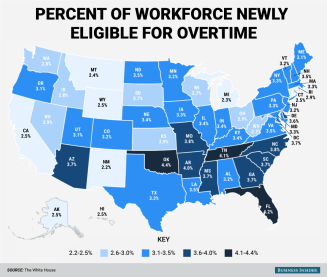
On March 13, 2014, President Obama signed a Presidential Memorandum directing the Department of Labor (DOL) to “propose revisions to modernize and streamline the existing overtime regulations.” Specifically, the President cited the exemption for executive, administrative and professional employees as having “not kept up with the modern economy.”
In response to the President’s memorandum, Department of Labor issued the proposed rule on July 6, 2015. The final rule was issued on May 18, 2016 and can be found here.
How The Overtime Rule Works
The Fair Labor Standards Act (FLSA) guarantees workers a minimum wage and overtime pay for hours worked above 40 hours in a week. However, some employees are exempted from the overtime pay requirement if:
(1) the employee makes a pre-determined and fixed salary;
(2) the salary is above $47,476 annually;
(3) the employee’s job duties primarily involve executive, administrative, or professional (EAP) tasks.
Since 2004, that salary threshold was set at $23,660 per year. The new rule more than doubles the threshold to $47,476 per year. Employees in executive, administrative, or professional positions making less than the increased salary threshold will not meet this exemption and thus must receive overtime pay. Furthermore, the salary threshold will automatically update every 3 years beginning on January 1, 2020.
WIPP’s Comments and Concerns
The 508-page rule addresses many of the more than 270,000 comments received including specific comments made by WIPP. WIPP advocated for an exemption for small businesses. The DOL recognized WIPP’s concerns, but concluded that their final salary threshold would “provide relief” as it is slightly lower than the $50,440 that was originally proposed. While the salary threshold is lower than estimated, it is still double the current threshold.
DOL also recognized WIPP’s concern of a loss of workplace flexibility. WIPP’s comment noted that many employees perform some of their work remotely and outside of normal business hours, such as working from home. The DOL responded that it “does not believe that workers will incur the significant change in flexibility.” The rule went on to state that, “Employers should be able to trust such valued employees to follow the employers’ instructions regarding when, where, and for how many hours they may work and to accurately record their hours worked.”
WIPP’s also commented on the difficulty of tracking employee hours to ensure compliance. This comment was also recognized by DOL, but they did not address this concern in their final rule.
The Fair Labor Standards Act, which governs the overtime rules, includes a carve-out for businesses that have less than $500,000 in annual revenue and do not engage in interstate commerce. However, DOL guidance suggests that the interstate commerce requirement is likely met by most businesses.
DOL has published additional information on these changes here. Please reach out to WIPP’s Government Relations team at advocacy@wipp.org with any questions.

EVENT: The Primary Process & What to Expect at the Upcoming Conventions
Women Impacting Public Policy (WIPP) invites you to a special, complimentary WE Decide 2016 event for women in business in Washington D.C. You’ve heard the buzzwords – “delegates”, “super delegates”, “brokered or contested convention”, now join us to learn more about how primaries work and get a preview of what to expect at the upcoming Democratic and Republican Conventions in July.
Join us on Tuesday, May 3rd from 3:00pm – 4:30pm in Washington, D.C. to hear from Elaine Kamarck, Founding Director of the Center for Effective Public Management and Senior Fellow in Governance Studies at the Brookings Institution.
Elaine is a public sector scholar with wide experience in government, academia and politics. She is an expert on government innovation and reform in the United States, OECD countries and developing countries. In addition, she also focuses her research on the presidential nomination system and American politics and has worked in many American presidential campaigns.
Elaine is the author of “Primary Politics: Everything You Need to Know about How America Nominates Its Presidential Candidates.” She will be speaking with women in business on what to expect at the upcoming party conventions and how the delegate process works.
REGISTER HERE FOR THIS FREE EVENT!
This is an important election year, and through WE Decide 2016, you have the opportunity to educate the candidates, the media and voters on issues impacting women business owners, like you.
Critical Updates to WOSB Procurement Program
If you are women-owned small business in the federal contracting arena, please take a look at the following critical updates to the WOSB Procurement Program.
The WOSB procurement program website is undergoing a facelift. A new website, called SBA ONE, will allow for the electronic submission of SBA forms, as well as a streamlined location to monitor all certifications for your company including the repository. With the change, there are three things you need to know:- All WOSBs will need to create a new login for the new system. The new website is actually an entirely new system and as such all WOSBs will need to create a new account and login (but not reload all documents – see next). The SBA is also asking that after creating a new account, all WOSB/EDWOSB companies submit new Form 2413 (WOSB certification) and/or Form 2414 (EDWOSB certification) electronically. Businesses should do this as soon as possible.
- The repository is being migrated, but is currently closed. This is important for two reasons: 1) your documents previously submitted should move to your new account and not require resubmission (except as mentioned above a new electronic Form 2413/2414); and 2) Contracting officers will not be able to view your repository documents for WOSB awards. Instructions for you to provide to a CO about how they can confirm your eligibility is available at the end of this document. This only impacts WOSB/EDWOSBs about to win EDWOSB or WOSB set-aside or sole source awards.
- The new site supports self-certification. Self-certification for WOSB/EDWOSBs remains an option until SBA finalizes new certification requirements. The website supports companies electing this option by allowing for the electronic submission of required documents. Third-party certifications can be uploaded as well.
SBA ONE, located at certify.sba.gov, will eventually house all program certifications, but is beginning with the WOSB program. Additional programs will be incorporated onto the site on the following projected timeline: 8(a) Business Development Program (Fall 2016), HUBZone Program (Spring 2017) and Dynamic Small Business Search (DSBS) (Spring 2017).
* * *
Information to Share with Contracting Officers
(Direct from SBA)
If you are working with a contract officer on a pending award requiring them to review your status, the following is information provided directly from SBA which you may share with contract officers.
Due to the system upgrade, access to the WOSB Federal Contract Program Repository will be temporarily unavailable for contracting officers (CO), starting on Wednesday, March 23 at 1:00 EDT. This may be down for several weeks. During this time, in order to comply with the WOSB Program requirements at 13 CFR 127.301 and FAR 19.1505(e) (specifying that a CO shall verify that an apparent successful offeror has provided all the required documents set forth in 127.300(e) to the WOSB Repository), SBA will review the Repository on behalf of a CO.
A CO may request that SBA review the Repository on their behalf by sending an email to wosb@sba.gov (link sends e-mail) with the following in the subject line:
“PENDING AWARD UNDER FAR 19.505(e) VERIFICATION REQUEST- SOLICITATION NUMBER [insert solicitation number].”
In the body of the email, the CO should provide the following: provide the apparent successful offeror’s DUNS, EIN, FIRM NAME, OWNER NAME; indicate whether the pending award is a WOSB or EDWOSB set-aside or sole source award; specify the NAICS code assigned to the procurement; and identify the State where the CO is located. Within 2 business days, SBA will perform the necessary check to determine whether the apparently successful offeror has filed all the required eligibility documents and provide the CO with an email response which either: (a) notifies the CO that all required documents have been provided or (b) identifies which documents are missing in order to allow the CO to file a status protest in accordance with SBA regulations and the FAR.
Emails for this information will be processed only for Contracting Officers.
* * *
- Upcoming Webinar: WIPP is working to arrange for a special webinar with experts from the SBA’s Office of Government Contracting to further review the new site and re-registration process. More details will follow.
- If you have any questions about the certification program, or comments on improving the site, please email certify@sba.gov. More details on the transition of repository documents are available atwww.sba.gov/wosb.

