Appropriations & Continuing Resolutions

Faced with a December 8 deadline, Congress passed a short-term continuing appropriations resolution (CR), funding the federal government through December 22. Designed to give Congressional appropriators time to negotiate funding for the balance of FY18, Congressional GOP leadership must now decide whether to negotiate an FY18 omnibus with Democrats to ensure the eight votes needed to pass the bill in the Senate. House Republicans have proposed a hybrid means of funding—a bill that would fund defense for the remainder of FY18 with the remainder of the federal government operating on a CR—which Democrats strongly oppose. The other option is to punt funding for the government into January with another short-term CR.

A major issue surrounding the decision is the level of spending caps imposed by the Budget Control Act. Congressional GOP leadership wants to lift the caps and pass a $230 billion increase in defense spending over two years. Democrats also want to lift the caps, but are insisting that any increase in defense spending be matched by increased non-defense funding.

Additionally, there are two measures under consideration for inclusion in the CR legislation, including the Deferred Action for Childhood Arrivals (DACA) program, and the Alexander-Murray healthcare bill which restores cost sharing subsidies for participating insurance plans. Senator Susan Collins (R-ME) made her support for the tax reform bill contingent on passage of the healthcare fix.

NDAA Signed into Law


Joni Ernst

Sen. Joni Ernst, who along with Sen Kirsten Gillibrand sponsored legislation requiring the SBA to study small business participation in large government contracts, accepted an award during WIPP’s 2017 annual leadership meeting.

Last month, the Senate passed the FY18 National Defense Authorization Act (NDAA), which was signed into law by President Trump on Tuesday. One of the few must-pass bills in Congress, the measure included WIPP’s top priority requiring the administrator of the SBA to conduct a study and submit a report to Congress on the utilization of small businesses (WOSBs, HUBZones, 8(a)s, and Service Disabled Veterans) with respect to Multiple Award Contracts (MACs). The effort was spearheaded by Senators Joni Ernst (R-IA) and Kirsten Gillibrand (D-NY).

Also included in the NDAA is the creation of Federal Online Marketplaces, similar to Amazon and Walmart, for purchases under $250,000. This would drastically change how the federal government buys its products. It should be noted that the Congress increased the micro purchase threshold from $150,000 to $250,000. These purchases are reserved for small businesses.

Tax Plan Steams Ahead

unnamed

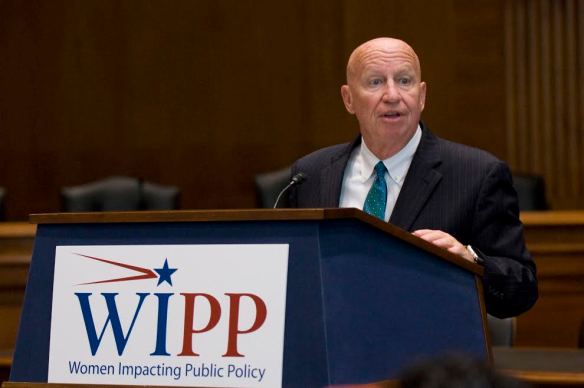
House Ways and Means Chairman Kevin Brady of Texas discusses tax reform during WIPP’s 2017 annual meeting.

Last week, the Senate passed tax reform (H.R. 1), setting up a conference to produce a united bill with the House. Versions passed by the Senate and the House contain significant differences which must be resolved before final passage.

Proposed business tax changes are listed below, highlighting the differences in the House and Senate version.

  • Individual Tax Rates
    • House: Four Brackets—12%, 25%, 35% and 39.6%—allows an additional rate for higher income earners
    • Senate: Seven Bracket—10%, 12%, 22%, 24%, 32%, 35%, and 38.5%
  • Pass-Through Treatment
    • House: tax rate for qualified business income 25%. Only 30% of business income is eligible for this rate. Personal services companies are not eligible for this rate.
    • Senate: Deduction allows for 23% of qualifying business income, up to $250,000 for single filers or $500,000 for joint filers (expires after 2025)
  • Corporate Tax Rate
    • House: Permanent reduction to 20% (effective 2018)
    • Senate: Permanent reduction to 20% (effective 2019)
  • State and Local Taxes (SALT)
    • House: Preserves property tax deduction of as much as $10,000
    • Senate: Preserves property deduction up to $10,000 (expires after 2025)
  • Estate Tax
    • House: Doubles the exemption to $11 million for single tax payers and $22 million for married tax payers (repeals in 2025)
    • Senate: Doubles the exemption to $11 million for single tax payers and $22 million for married tax payers through 2025 (no repeal)
  • Alternative Minimum Tax (AMT)
    • House: Repeals the AMT for individual and corporate filers
    • Senate: Retains the AMT for individual and corporate filers and raises the individual threshold
  • Healthcare Mandate
    • House: Maintains the individual mandate requiring the purchase of health insurance
    • Senate: Repeals the individual mandate requiring the purchase of health insurance

A Senate and House conference has met to come up with a single bill to send to the president. Republican leaders in the Congress hope to vote on the conference version next week.


Letter from WIPP President Jane Campbell: December 2017

Winter is here and the weather is chilly, but things are boiling over in Washington. Congress is running full-tilt to try to complete a herculean amount of work before year’s end. In this newsletter, we cover developments in taxes, the National Defense Authorization Act, the deadline to sign up for health coverage and a looming deadline to appropriate  funds for the 2018 budget.

Jane Campbell photo 2 2

WIPP President Jane Campbel

We saw record support in 2017 from business organizations, with more than 575 organizations nationwide supporting small businesses on Small Business Saturday—an 18 percent increase over previous years.

WIPP, in conjunction with American Express, founded the Small Business Saturday Coalition in 2011. This year, 7,200 events and activities celebrating Small Business Saturday were held nationwide, engaging more than 2.2 million small businesses.

Every year, WIPP is proud to work with public officials at all levels of government and hundreds of organizations and thousands of small businesses to encourage all Americans to “shop small” at local businesses and “dine small” at local bars and restaurants.

As you do your last-minute shopping, consider going to a small business to get it done.

Happy Holidays!

ChallengeHER Success Story: Rosemary Swierk, President, Direct Steel and Construction

Rosemary Swierk, president of Direct Steel and Construction, said her ability to grow her Chicagoland business “fundamentally changed” as soon as she figured out how to better demonstrate the true value of her services to potential clients.

“It took a long time to learn this, but the value proposition I heard myself articulating was not how other people were hearing it,” Swierk said, recalling a critical lesson she now shares with other women entrepreneurs. “The most important thing is to know what your company does best and the value it provides your clients.”

In July, Swierk appeared on a ChallengeHER panel in Chicago with other women entrepreneurs about overcoming obstacles to advancing their business. It’s the third time Swierk has participated in a ChallengeHER panel and the fourth time she has attended a ChallengeHER workshop, which are organized by Women Impacting Public Policy (WIPP), the Small Business Administration and American Express. The events are designed to be a one-stop-shop for connecting women-owned businesses with organizations and other resources to pursue and compete for government contracts.

“Each year, the caliber of attendees continues to get stronger,” Swierk said, noting the combination of government representatives, procurement officers, SBA officials and WIPP members present. “It’s wonderful for business owners to have the opportunity to meet one-on-one with government entities doing the purchasing.”

Swierk said crafting a clear and strong profile—both in various government contracting systems and through personal connections—is critical to landing contracts. She recently advised a woman who stated her value proposition as “better, cheaper and faster” to think more deeply about how to differentiate her services.

“What is the painpoint you are solving that is different from your competition?” she asked.

For Swierk’s company, the answer is Direct Steel’s ability to tackle commercial, industrial, educational and office building projects from myriad perspectives—as a general contractor, construction manager and owner’s representative. Knowing from experience that clients will eventually struggle with at least one component of new construction—scope, budget, schedule or quality—her goal is to mitigate as much uncertainty as possible before any major steps are taken.

“Customers realize the value of that, and are bringing us in earlier and earlier,” she said.

Launched in 2004, her business survived the recession of 2008 when little was being built and earned its first government contract building a flight simulator building in Nevada, a project funded by the American Recovery and Investment Act of 2009. That led to other government contracts, and now the company has a balance of public and private clients, including a $12 million contract with the Army Corps of Engineers made possible by 2016 regulation that created set-asides for women-owned businesses. While she has her own employees, she also uses sub-contractors in areas where she wins bids—and that is another key consideration business owners should make when evaluating contracts.

“You really have to think about your individual business and whether to go after government work or not,” Swierk said. “You have to consider what the government is buying or not buying. Does it make sense to be a prime or a sub?”

Those questions lead back to understanding the value of your company, she said. That is the main point she drives home with women she meets at ChallengeHER events.

“Customers pay to have a problem solved,” she said, “and you have to articulate why your company solves the problem better.”

ChallengeHER Success Story: Debbie Banko, CEO of Link Technologies

After running a successful business for nearly 20 years, Debbie Banko, the founder and CEO of Link Technologies in Las Vegas, knows the importance of networking. And the importance of networking with other women business owners, in particular.

It’s why, after running a business that does nearly 40 percent of its business with the federal government, Debbie still loves attending events like ChallengeHER—a national initiative to boost government contracting opportunities for women-owned small businesses—where she continues to reap the benefits of networking with other women business owners in the federal contracting space.

“Women have to help each other,” said Debbie, who attended a recent ChallengerHER event in Las Vegas. “It was great to meet all those wonderful women, and hear the questions they have—it almost made me feel nostalgic for building something. To be in a room with all these entrepreneurial women and hear about the options for us in the federal contracting space was great. What’s more, there are few things better than networking with and doing business with other women. I even have some dinners set up with potential partners that came out of the event!”

In addition to networking, Debbie said the information provided at ChallengeHER is invaluable. Given the speed at which rules and regulations change or are being updated, and the complexity of many of the regulations and processes, events like ChallengerHER are essential for women who want and need to keep ahead of the game.

“For a new business owner just starting their company, ChallengeHER is one of the best events I’ve seen—and I’ve seen a lot of them over the years,” Debbie said. “Even for someone like me who’s been doing this a long time, this event had something for everyone. The laws are changing, and everyone at ChallengeHER knew exactly what they were talking about and had the latest information.”

Debbie ‘s business, which is an IT engineering and consulting firm, has around 150 employees, some fulltime staff and some contractors. She specializes in IT security, compliance, governance, information sharing and project management. Debbie started the business by herself, armed with $10,000 in start-up capital she had saved herself and a whole lot of drive and ambition.

That drive, her work ethic and a little “right time, right place” synergy helped her land her first government contract in her first year in business at the Naval Air Station in Fallon, Nevada, several hours north of her headquarters in Las Vegas.

Doing business with the federal government has been a boon to her business.

“I like the government contracts,” Debbie said. “If you are a good partner and do good work, you’re good. It’s hard to get in, but once you get in, you’re definitely a partner.”

For women business owners who haven’t been able to land a government contract, events like ChallengeHER are excellent ways to learn exactly what they need to do to become one of the government’s go-to partners.

“For any woman business owner out there struggling to understand, help is out there,” Debbie said. “There are no silver bullets, and you have to help yourself, too, but resources like ChallengeHER, the Small Business Administration, Procurement Technical Assistance Centers—they’re all there to help. Any woman business owner who wants to get into government contracting should use them.”

What’s more, events like ChallengeHER show women business owners that they can partner with other women business owners to increase their chances of winning government contracts, or simply boosting their businesses.

“The best lesson I’ve learned is to try always try to partner with other women business owners like yourself,” Debbie said.